
[Paper Review] MixPro: Data Augmentation with MaskMix and Progressive Attention Labeling for Vision Transformer
MixPro proposes a novel data augmentation method for Vision Transformers by introducing MaskMix, which uses adjustable, patch-sized masks to mix images while preserving global context, and Progressive Attention Labeling (PAL), which dynamically reweights attention-based labels to reduce noise from unreliable early-training attention maps. The method achieves 73.8% top-1 accuracy on ImageNet using DeiT-T, outperforms TransMix across multiple benchmarks, and improves transferability to downstream tasks like segmentation and detection.
The recently proposed data augmentation TransMix employs attention labels to help visual transformers (ViT) achieve better robustness and performance. However, TransMix is deficient in two aspects: 1) The image cropping method of TransMix may not be suitable for ViTs. 2) At the early stage of training, the model produces unreliable attention maps. TransMix uses unreliable attention maps to compute mixed attention labels that can affect the model. To address the aforementioned issues, we propose MaskMix and Progressive Attention Labeling (PAL) in image and label space, respectively. In detail, from the perspective of image space, we design MaskMix, which mixes two images based on a patch-like grid mask. In particular, the size of each mask patch is adjustable and is a multiple of the image patch size, which ensures each image patch comes from only one image and contains more global contents. From the perspective of label space, we design PAL, which utilizes a progressive factor to dynamically re-weight the attention weights of the mixed attention label. Finally, we combine MaskMix and Progressive Attention Labeling as our new data augmentation method, named MixPro. The experimental results show that our method can improve various ViT-based models at scales on ImageNet classification (73.8\% top-1 accuracy based on DeiT-T for 300 epochs). After being pre-trained with MixPro on ImageNet, the ViT-based models also demonstrate better transferability to semantic segmentation, object detection, and instance segmentation. Furthermore, compared to TransMix, MixPro also shows stronger robustness on several benchmarks. The code is available at https://github.com/fistyee/MixPro.
Motivation & Objective
- To address the limitations of TransMix, which uses region-level cropping that disrupts global context and relies on unreliable attention maps during early training.
- To improve generalization and robustness of Vision Transformers (ViT) through more effective data augmentation.
- To design a data augmentation strategy that preserves global image structure and reduces noise in mixed labels during early training.
- To enhance transfer learning performance of ViT-based models on downstream tasks such as semantic segmentation, object detection, and instance segmentation.
Proposed method
- MaskMix constructs mixed images using a patch-like grid mask where each mask patch is a multiple of the input image patch size, ensuring each output patch originates from only one source image.
- The mask size is adjustable and designed to maintain global image structure by avoiding patch-level mixing across images.
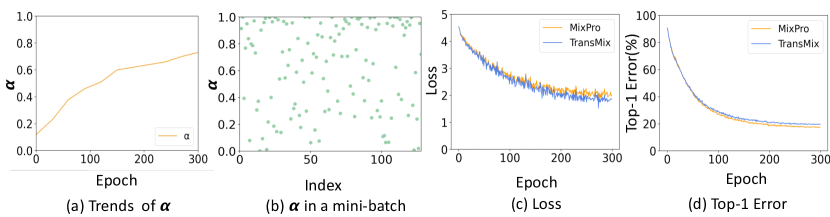
- Progressive Attention Labeling (PAL) dynamically reweights the attention-based label confidence using a progressive factor α, reducing reliance on unreliable early-training attention maps.
- The progressive factor α gradually increases during training, allowing the model to rely more on attention maps as they become more reliable.
- MixPro combines MaskMix and PAL into a unified data augmentation pipeline that improves both image-level and label-level mixing.
- The method is applied during pre-training on ImageNet and evaluated on classification, detection, segmentation, and robustness benchmarks.

Experimental results
Research questions
- RQ1How does MaskMix improve image mixing for Vision Transformers compared to region-based cropping in TransMix?
- RQ2Can progressive attention labeling reduce noise in mixed labels during early training when attention maps are unreliable?
- RQ3Does MixPro improve generalization and robustness of ViT-based models on ImageNet and downstream tasks?
- RQ4How does MixPro compare to TransMix in terms of accuracy, robustness to occlusion, and out-of-distribution detection?
- RQ5What is the optimal scale of mask patches and progressive factor strategy for maximizing performance?
Key findings
- MixPro achieves 73.8% top-1 accuracy on ImageNet using DeiT-T over 300 epochs, outperforming TransMix and vanilla ViT.
- On DeiT-S, MixPro improves top-1 accuracy by 1.3% on ImageNet-A natural adversaries, reaching 22.4% compared to 21.1% for TransMix.
- MixPro achieves 32.4% AURRAC on ImageNet-A, a 3.6% improvement over TransMix-DeiT-S, indicating better uncertainty estimation.
- For out-of-distribution detection on ImageNet-O, MixPro-DeiT-S achieves 23.1% AUPRC, 1.2% higher than TransMix-DeiT-S and 2.2% higher than vanilla DeiT-S.
- MixPro-trained models show stronger transferability, achieving better performance on downstream tasks including semantic segmentation, object detection, and instance segmentation.
- Ablation studies confirm that both MaskMix and PAL contribute significantly to performance, with optimal mask patch scales and progressive factor strategies enhancing robustness and accuracy.
Read this paper
Open the full text in the Nubint reader and ask about any passage as you read.
Read this paper on NubintThis review was generated by AI from the original paper. Please check the paper before citing it.