
[Paper Review] Mixture-of-Agents Enhances Large Language Model Capabilities
The paper introduces a Mixture-of-Agents (MoA) framework that uses layered assemblies of LLMs to collaboratively generate and refine responses, achieving state-of-the-art results on AlpacaEval 2.0, MT-Bench, and FLASK with open-source models.
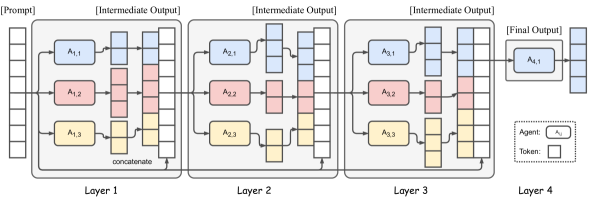
Recent advances in large language models (LLMs) demonstrate substantial capabilities in natural language understanding and generation tasks. With the growing number of LLMs, how to harness the collective expertise of multiple LLMs is an exciting open direction. Toward this goal, we propose a new approach that leverages the collective strengths of multiple LLMs through a Mixture-of-Agents (MoA) methodology. In our approach, we construct a layered MoA architecture wherein each layer comprises multiple LLM agents. Each agent takes all the outputs from agents in the previous layer as auxiliary information in generating its response. MoA models achieves state-of-art performance on AlpacaEval 2.0, MT-Bench and FLASK, surpassing GPT-4 Omni. For example, our MoA using only open-source LLMs is the leader of AlpacaEval 2.0 by a substantial gap, achieving a score of 65.1% compared to 57.5% by GPT-4 Omni.
Motivation & Objective
- Demonstrate that collaboration among multiple LLMs can improve response quality beyond single-model generation.
- Characterize the collaborativeness phenomenon where models benefit from outputs of other models.
- Develop a prompting-based, non-fine-tuned MoA framework that can compete with proprietary models.
- Evaluate MoA on standard benchmarks (AlpacaEval 2.0, MT-Bench, FLASK) and analyze cost and scalability.
Proposed method
- Propose a layered MoA architecture where each layer contains multiple LLM agents that receive auxiliary information from the previous layer.
- Define an Aggregate-and-Synthesize prompt to combine outputs from agents in a layer.
- Reuse models across layers and use a final aggregator (e.g., Qwen1.5-110B-Chat) to produce the final output.
- Compare single-proposer versus multi-proposer configurations to study the role of diversity in proposals.
- Relate MoA to Mixture-of-Experts (MoE) and justify the prompting-based, model-level ensemble approach without fine-tuning.
Experimental results
Research questions
- RQ1Can mixtures of diverse LLMs across layered stages outperform single-model prompts on standard benchmarks?
- RQ2What roles do proposers and aggregators play in MoA, and which models serve these roles best?
- RQ3How does the number of proposers and model diversity affect performance and cost?
- RQ4How does MoA compare to LLM-based reranking and other ensemble methods in quality and efficiency?
Key findings
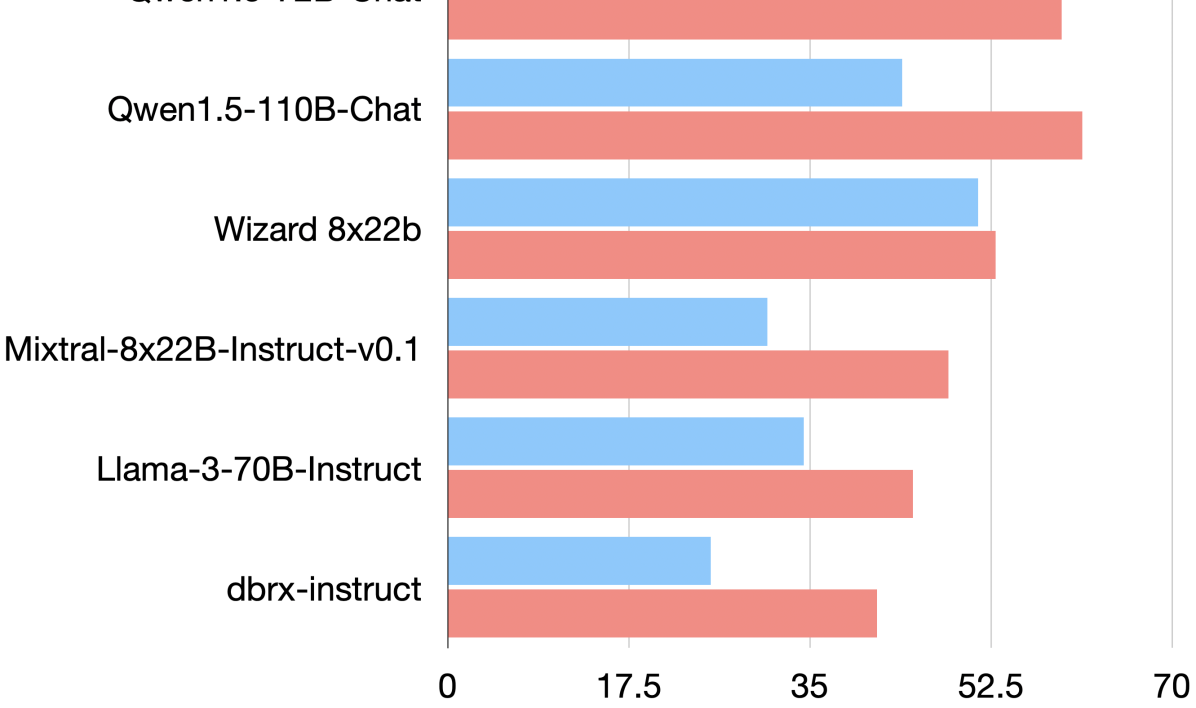
- MoA with open-source models achieves 65.1% LC win rate on AlpacaEval 2.0, surpassing GPT-4 Omni at 57.5%.
- MoA with GPT-4o as final aggregator attains 65.7% LC win rate and 78.7% win on AlpacaEval 2.0 metrics.
- MoA-Lite (fewer layers) still outperforms GPT-4o by 1.8 percentage points on AlpacaEval 2.0.
- On MT-Bench, MoA attains top leaderboard performance with overall gains and strong first/second-turn scores.
- On FLASK, MoA improves robustness, correctness, efficiency, factuality, and metacognition over the aggregator alone and GPT-4 Omni in several metrics.
- MoA shows gains over an LLM-based ranker baseline, indicating that aggregation over multiple proposals yields better results than selecting a single proposal.
- Increasing the number of proposers and ensuring diversity (different models) consistently improves performance, suggesting scaling width is beneficial.
- Specialized model roles emerge: GPT-4o, Qwen, LLaMA-3 are versatile as both proposers and aggregators, while WizardLM excels as proposer but less effective as aggregator.
- Budget analysis indicates MoA can approach GPT-4 Turbo performance at lower cost, with MoA-Lite achieving strong quality-cost trade-offs.
Read this paper
Open the full text in the Nubint reader and ask about any passage as you read.
Read this paper on NubintThis review was generated by AI from the original paper. Please check the paper before citing it.