
[Paper Review] Mixture-of-Depths: Dynamically allocating compute in transformer-based language models
This paper introduces Mixture-of-Depths (MoD), a method that dynamically allocates compute in transformer language models by allowing tokens to skip layers via a learned top-k routing mechanism, capping total FLOPs per layer. MoD models achieve equivalent or better performance than baseline transformers with up to 50% fewer FLOPs per forward pass and up to 50% faster inference, while maintaining training efficiency and hardware compatibility through a static computation graph.
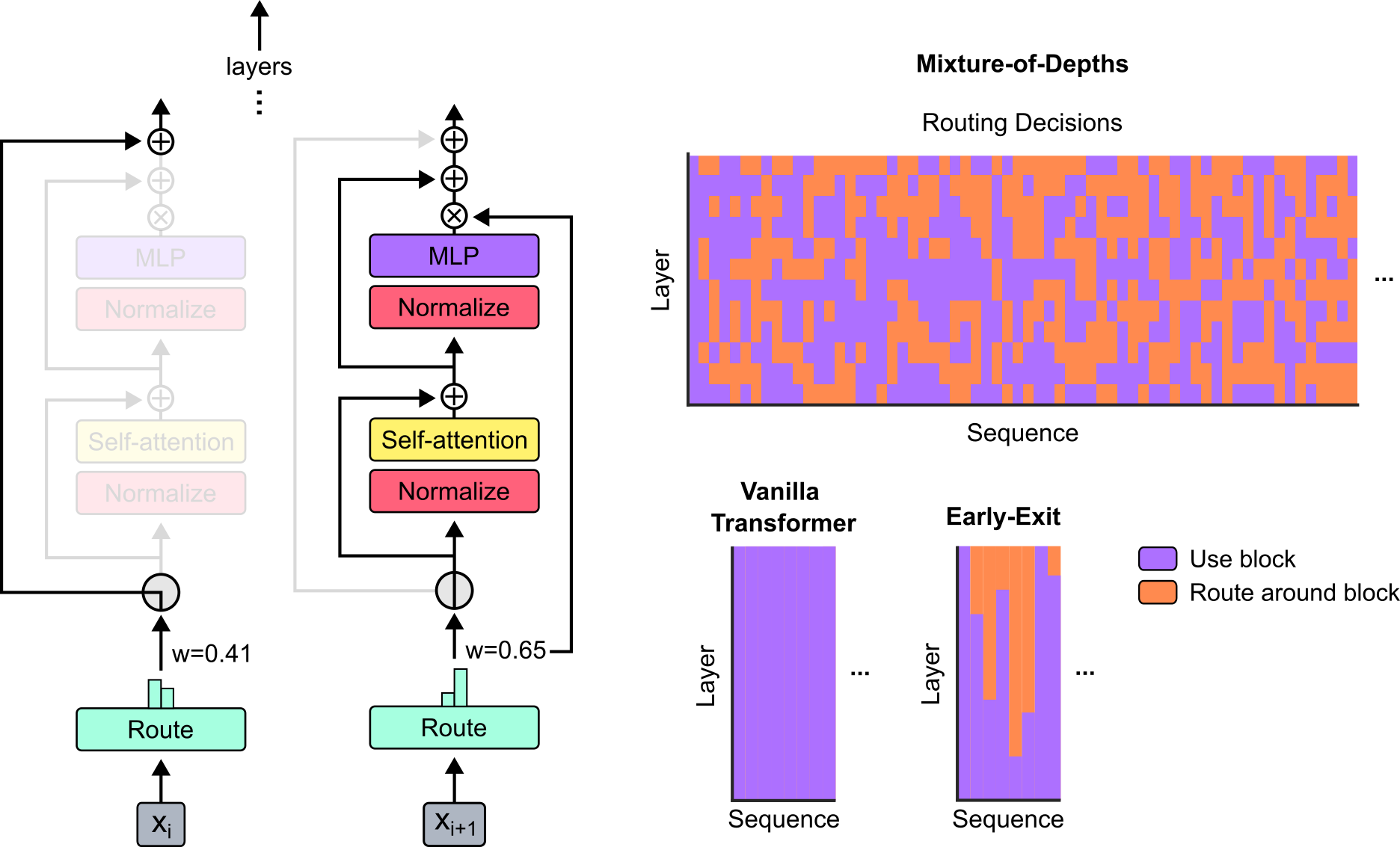
Transformer-based language models spread FLOPs uniformly across input sequences. In this work we demonstrate that transformers can instead learn to dynamically allocate FLOPs (or compute) to specific positions in a sequence, optimising the allocation along the sequence for different layers across the model depth. Our method enforces a total compute budget by capping the number of tokens ($k$) that can participate in the self-attention and MLP computations at a given layer. The tokens to be processed are determined by the network using a top-$k$ routing mechanism. Since $k$ is defined a priori, this simple procedure uses a static computation graph with known tensor sizes, unlike other conditional computation techniques. Nevertheless, since the identities of the $k$ tokens are fluid, this method can expend FLOPs non-uniformly across the time and model depth dimensions. Thus, compute expenditure is entirely predictable in sum total, but dynamic and context-sensitive at the token-level. Not only do models trained in this way learn to dynamically allocate compute, they do so efficiently. These models match baseline performance for equivalent FLOPS and wall-clock times to train, but require a fraction of the FLOPs per forward pass, and can be upwards of 50\% faster to step during post-training sampling.
Motivation & Objective
- To address the inefficiency of uniform compute distribution in transformers, where all tokens receive equal FLOPs regardless of computational need.
- To enable dynamic, context-sensitive compute allocation across both token and layer dimensions without introducing dynamic computation graphs.
- To maintain hardware efficiency and training speed while reducing FLOPs per forward pass through intelligent routing of tokens through varying depths of the model.
- To explore whether learned routing can improve model efficiency and performance without sacrificing training time or accuracy.
- To demonstrate that compute can be saved at inference time without performance degradation, enabling faster inference or model scaling.
Proposed method
- A top-k routing mechanism selects which tokens participate in self-attention and MLP computations at each layer, based on a router head, with k fixed a priori.
- Tokens not selected by the router are passed through a residual connection, effectively skipping the transformer block computation and saving FLOPs.
- The method enforces a static computation graph with known tensor sizes, ensuring hardware efficiency and compatibility with existing accelerators.
- The routing decisions are learned end-to-end during training, with no auxiliary balancing loss required, leveraging top-k routing for stability.
- During autoregressive sampling, the router is distilled using a simple auxiliary classifier or loss to mimic training-time routing decisions without future token information.
- The approach allows trade-offs between speed and performance by adjusting the compute budget (k) per layer, enabling faster inference or model scaling.
Experimental results
Research questions
- RQ1Can transformers learn to dynamically allocate compute across tokens and layers while maintaining a static computation graph?
- RQ2Does dynamic compute allocation via routing lead to significant FLOP savings without performance degradation?
- RQ3Can MoD models achieve better performance or faster inference compared to standard transformers under equivalent training FLOP budgets?
- RQ4How does the absence of future token information during inference affect routing performance, and can it be mitigated?
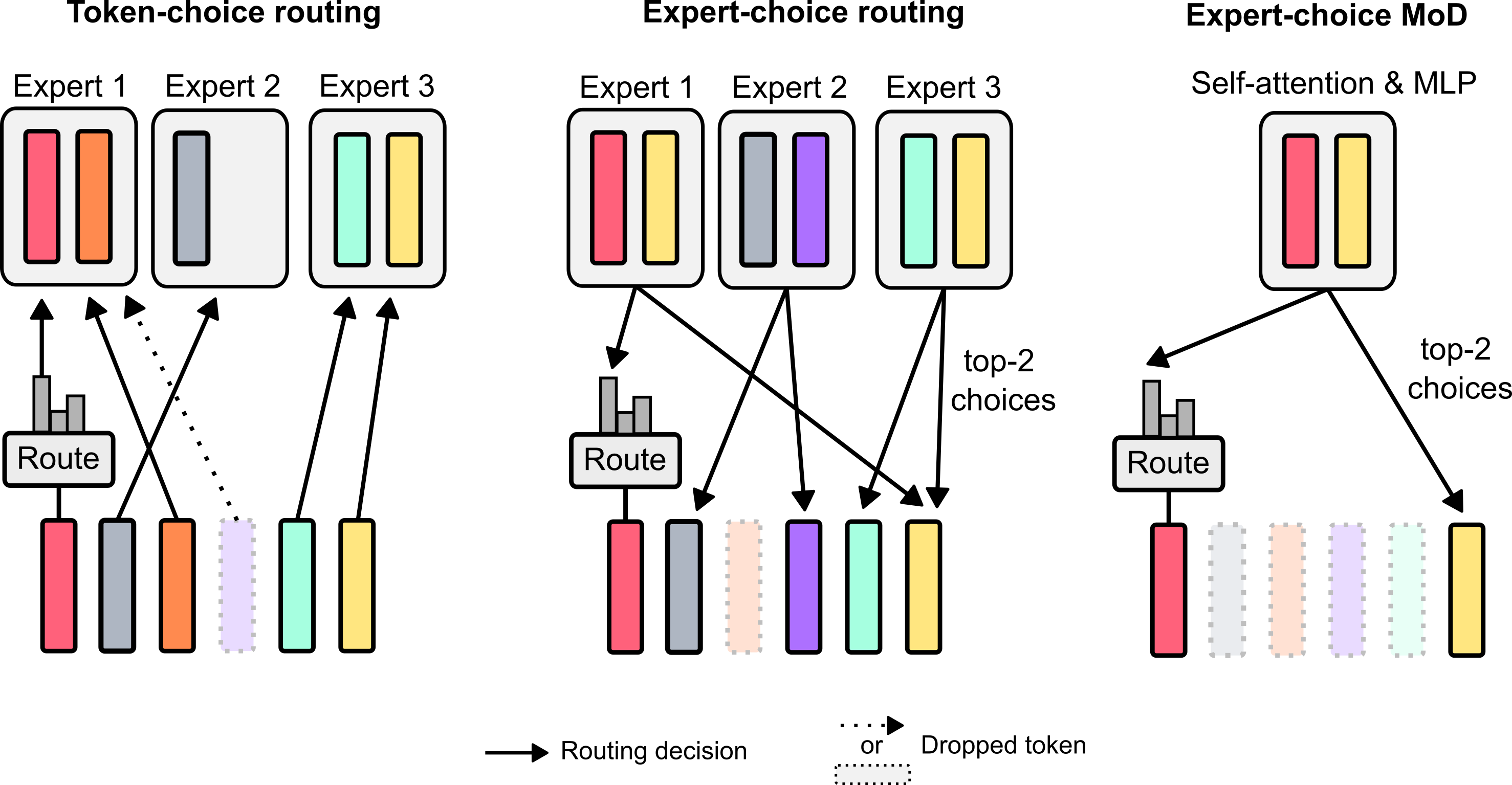
- RQ5Can the routing mechanism be extended to support different types of computation beyond standard blocks and residual connections?
Key findings
- MoD models achieve equivalent or better performance than baseline transformers when trained with the same FLOPs and wall-clock time, demonstrating improved compute efficiency.
- MoD models reduce FLOPs per forward pass by up to 50% compared to standard transformers, enabling faster inference without performance loss.
- The method enables up to 50% faster inference steps during post-training sampling, even when training FLOPs and time are kept constant.
- The top-k routing mechanism during training generalizes well to autoregressive inference, with minimal performance degradation, even when future token identities are unavailable.
- MoD models learn to route intelligently, skipping unnecessary computations for easier predictions while preserving long-range dependencies through strategic attention routing.
- The framework is extensible and can support routing to diverse computation types (e.g., memory lookup, tool use), enabling new architectural designs with controlled FLOP costs.
Better researchstarts right now
From reading papers to final review, dramatically reduce your research time.
No credit card · Free plan available
This review was created by AI and reviewed by human editors.