
[Paper Review] Mixture-of-Experts Meets Instruction Tuning:A Winning Combination for Large Language Models
The paper shows that sparse MoE models greatly benefit from instruction tuning, achieving state-of-the-art results with lower compute; notably, Flan-MoE-32B outperforms Flan-PaLM-62B at about one-third the FLOPs.
Sparse Mixture-of-Experts (MoE) is a neural architecture design that can be utilized to add learnable parameters to Large Language Models (LLMs) without increasing inference cost. Instruction tuning is a technique for training LLMs to follow instructions. We advocate combining these two approaches, as we find that MoE models benefit more from instruction tuning than dense models. In particular, we conduct empirical studies across three experimental setups: (i) Direct finetuning on individual downstream tasks devoid of instruction tuning; (ii) Instructiontuning followed by in-context few-shot or zero-shot generalization on downstream tasks; and (iii) Instruction tuning supplemented by further finetuning on individual downstream tasks. In the first scenario, MoE models overall underperform dense models of identical computational capacity. This narrative, however, dramatically changes with the introduction of instruction tuning (second and third scenario), used independently or in conjunction with task-specific finetuning. Our most powerful model, FLAN-MOE-32B, surpasses the performance of FLAN-PALM-62B on four benchmark tasks, while using only a third of the FLOPs. The advancements embodied byFLAN-MOE inspire a reevaluation of the design principles of large-scale, high-performance language models in the framework of task-agnostic learning.
Motivation & Objective
- Demonstrate that instruction tuning significantly enhances MoE model performance compared to dense models of similar capacity.
- Quantify how MoE models respond to instruction tuning across direct finetuning, in-context generalization, and subsequent task-specific finetuning.
- Analyze routing strategies, expert counts, and auxiliary losses to identify best practices for Flan-MoE.
- Show scaling behavior of Flan-MoE and compare it to dense baselines and PaLM-style models in terms of accuracy and compute efficiency.
- Discuss limitations such as multilingual/generalization challenges and implications for MoE design principles.
Proposed method
- Adopt sparse MoE layers in Transformer architectures by replacing feed-forward networks in alternating layers with MoE layers.
- Fine-tune Flan-MoE using the prefix-LM objective on the FLAN mixture of datasets, updating all parameters with specified hyperparameters.
- Evaluate using zero-shot and few-shot prompts across MMLU, BBH, reasoning, and QA benchmarks, plus a normalized average metric.
- Compare Flan-MoE to equivalent dense encoder-decoder (T5) models across model sizes and FLOPs.
- Scale up to Flan-ST-32B (32B parameters) and compare against Flan-PaLM-62B and other baselines, highlighting compute efficiency.
- Investigate routing strategies (token-choice vs expert-choice) and auxiliary losses (balancing vs Z-loss) through ablations.

Experimental results
Research questions
- RQ1Does instruction tuning have a larger impact on MoE models than on dense models?
- RQ2How do routing strategies and the number of experts affect instruction-tuned MoE performance across diverse benchmarks?
- RQ3Can Flan-MoE achieve competitive or superior performance to state-of-the-art dense models at reduced FLOPs?
- RQ4What are the effects of auxiliary losses and parameter freezing on MoE instruction-tuning?
- RQ5What are the limitations of MoE models in multilingual scenarios and how might they be mitigated?
Key findings
- Instruction tuning dramatically boosts MoE gains over dense models across downstream and held-out tasks.
- Flan-MoE models outperform comparable dense counterparts in second and third experimental setups, with notable gains on MMLU, BBH, reasoning, and QA benchmarks.
- The largest Flan-ST-32B model achieves strong few-shot performance, surpassing Flan-PaLM-62B while using less than 30% of FLOPs per token.
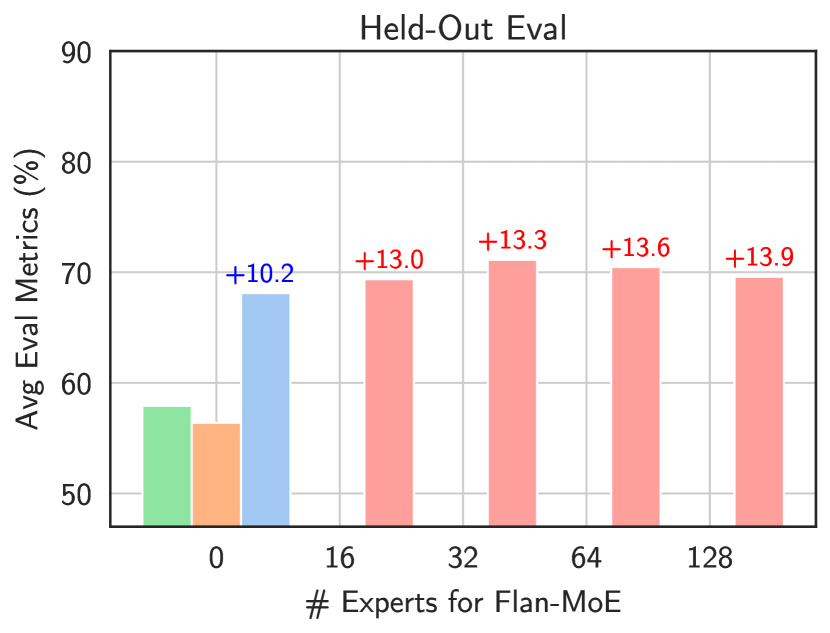
- MoE performance scales with the number of experts up to a point, after which gains saturate, with routing strategy (expert-choice vs token-choice) influencing outcomes.
- Instruction tuning substantially benefits MoE models more at larger scales, and Flan-EC (expert-competition) routing often outperforms Flan-GS (gate routing) across tasks.
- While Flan-MoE shows substantial gains, multilingual benchmarks (TyDiQA, MGSM) reveal persistent weaknesses, indicating multilingual coverage requires diverse training data.
Read this paper
Open the full text in the Nubint reader and ask about any passage as you read.
Read this paper on NubintThis review was generated by AI from the original paper. Please check the paper before citing it.