
[Paper Review] Π-ML: A dimensional analysis-based machine learning parameterization of optical turbulence in the atmospheric surface layer
This paper introduces Π-ML, a physics-informed machine learning framework that uses dimensional analysis to derive non-dimensional features from atmospheric variables, enabling high-accuracy prediction of optical turbulence (Cₙ²) in the surface layer. By training an ensemble of XGBoost models on these dimensionless groups, Π-ML achieves R² = 0.958 ± 0.001 on out-of-sample data, with normalized potential temperature variance (Π₂ = θ̄/σ_θ) identified as the dominant predictor.
Turbulent fluctuations of the atmospheric refraction index, so-called optical turbulence, can significantly distort propagating laser beams. Therefore, modeling the strength of these fluctuations ($C_n^2$) is highly relevant for the successful development and deployment of future free-space optical communication links. In this letter, we propose a physics-informed machine learning (ML) methodology, $Π$-ML, based on dimensional analysis and gradient boosting to estimate $C_n^2$. Through a systematic feature importance analysis, we identify the normalized variance of potential temperature as the dominating feature for predicting $C_n^2$. For statistical robustness, we train an ensemble of models which yields high performance on the out-of-sample data of $R^2=0.958\pm0.001$.
Motivation & Objective
- To develop a physics-informed machine learning model that improves upon conventional Monin-Obukhov similarity theory (MOST) parameterizations for optical turbulence (Cₙ²) in the atmospheric surface layer.
- To leverage dimensional analysis to transform physical variables into non-dimensional groups (Π-sets), enhancing generalization and reducing extrapolation risk in ML models.
- To assess the predictive performance of the model on real-world MLO field campaign data, focusing on out-of-sample robustness and feature importance.
- To evaluate whether a minimal set of non-dimensional features can maintain high predictive accuracy, reducing model complexity without significant performance loss.
- To compare the performance of dimensionless features against traditional dimensional inputs in ML-based Cₙ² estimation, demonstrating the advantages of physical scaling.
Proposed method
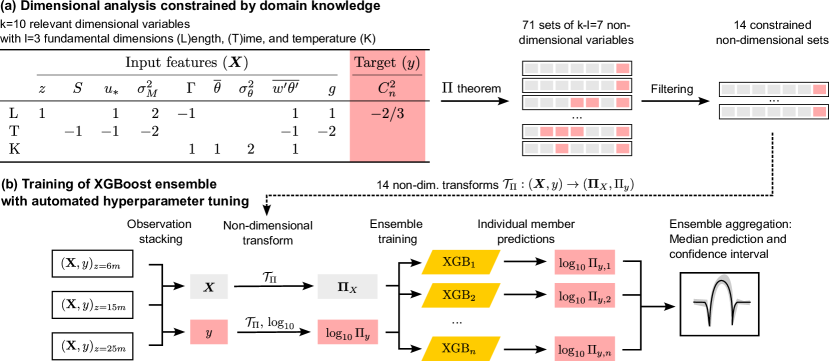
- Apply the Buckingham Π theorem to derive non-dimensional groups (Π-sets) from fundamental atmospheric variables, including wind shear, potential temperature gradient, fluxes, and length scales.
- Construct a non-dimensional dataset by transforming observed dimensional variables into Π-sets, enabling interpolation across diverse field campaigns and altitudes.
- Train an ensemble of XGBoost regression models on the non-dimensional features to predict Cₙ² scaled as (Cₙ²)^{3/2} × z, improving generalization and robustness.
- Use a 14-day test set from mid-July 2006 to evaluate model performance, ensuring training data captures seasonal trends and minimizing extrapolation risk.
- Perform systematic feature importance analysis using XGBoost to identify the most influential Π-sets, with Π₂ = θ̄/σ_θ emerging as the dominant predictor.
- Compare the performance of the full Π-ML model with a reduced-order version using only Π₂, and with a traditional ML model using dimensional inputs (e.g., 2m-T, 2m-RH), to validate the benefits of non-dimensionalization.
Experimental results
Research questions
- RQ1Can dimensional analysis improve the generalization and predictive accuracy of machine learning models for Cₙ² in the atmospheric surface layer?
- RQ2Which non-dimensional feature set (Π-set) provides the most informative input for predicting optical turbulence strength?
- RQ3How does the performance of a physics-informed ML model based on non-dimensional variables compare to conventional ML models using dimensional inputs?
- RQ4To what extent can a minimal set of non-dimensional features (e.g., only Π₂) maintain high predictive accuracy for Cₙ²?
- RQ5Does the use of non-dimensional features enable the model to be independent of the measurement height (z), unlike traditional approaches?
Key findings
- Π-ML achieves an out-of-sample coefficient of determination R² = 0.958 ± 0.001, demonstrating high statistical robustness and predictive accuracy on unseen data.
- The normalized variance of potential temperature (Π₂ = θ̄/σ_θ) is identified as the most important feature for predicting Cₙ², explaining the majority of predictive power.
- A reduced-order Π-ML model using only Π₂ as input achieves R² = 0.929 ± 0.000 and RMSE = 0.220 ± 0.000, showing that a single non-dimensional feature captures most of the physical signal.
- The performance of the full Π-ML model degrades significantly (R² drops to ~0.93) when the test set is taken from the beginning or end of the dataset, confirming that the model relies on interpolation rather than extrapolation.
- Traditional ML models using dimensional inputs (e.g., 2m-T, 2m-RH, 15m-Γ, 15m-S) exhibit nearly twice the RMSE and lower R² compared to Π-ML, highlighting the advantage of non-dimensional scaling.
- The non-dimensional framework enables height-independent prediction of Cₙ², whereas traditional models require separate training per altitude level.
Read this paper
Open the full text in the Nubint reader and ask about any passage as you read.
Read this paper on NubintThis review was generated by AI from the original paper. Please check the paper before citing it.