
[Paper Review] MLAgentBench: Evaluating Language Agents on Machine Learning Experimentation
MLAgentBench introduces a benchmark for evaluating AI research agents on end-to-end ML experimentation tasks, showing GPT-4-based agents can build better models on many tasks but struggle on newer datasets like BabyLM, with notable variance in success rates.
A central aspect of machine learning research is experimentation, the process of designing and running experiments, analyzing the results, and iterating towards some positive outcome (e.g., improving accuracy). Could agents driven by powerful language models perform machine learning experimentation effectively? To answer this question, we introduce MLAgentBench, a suite of 13 tasks ranging from improving model performance on CIFAR-10 to recent research problems like BabyLM. For each task, an agent can perform actions like reading/writing files, executing code, and inspecting outputs. We then construct an agent that can perform ML experimentation based on ReAct framework. We benchmark agents based on Claude v1.0, Claude v2.1, Claude v3 Opus, GPT-4, GPT-4-turbo, Gemini-Pro, and Mixtral and find that a Claude v3 Opus agent is the best in terms of success rate. It can build compelling ML models over many tasks in MLAgentBench with 37.5% average success rate. Our agents also display highly interpretable plans and actions. However, the success rates vary considerably; they span from 100% on well-established older datasets to as low as 0% on recent Kaggle challenges created potentially after the underlying LM was trained. Finally, we identify several key challenges for LM-based agents such as long-term planning and reducing hallucination. Our code is released at https://github.com/snap-stanford/MLAgentBench.
Motivation & Objective
- Define a general, executable ML research task benchmark with task descriptions and necessary files (starter code, data).
- Evaluate agent performance on competence, reasoning/process, and efficiency via interaction traces and final artifacts.
- Develop an LLM-based research agent capable of planning, reading/editing scripts, running experiments, and interpreting results.
- Assess generalizability across canonical tasks, Kaggle challenges, and current research datasets; analyze limitations and failure modes.
Proposed method
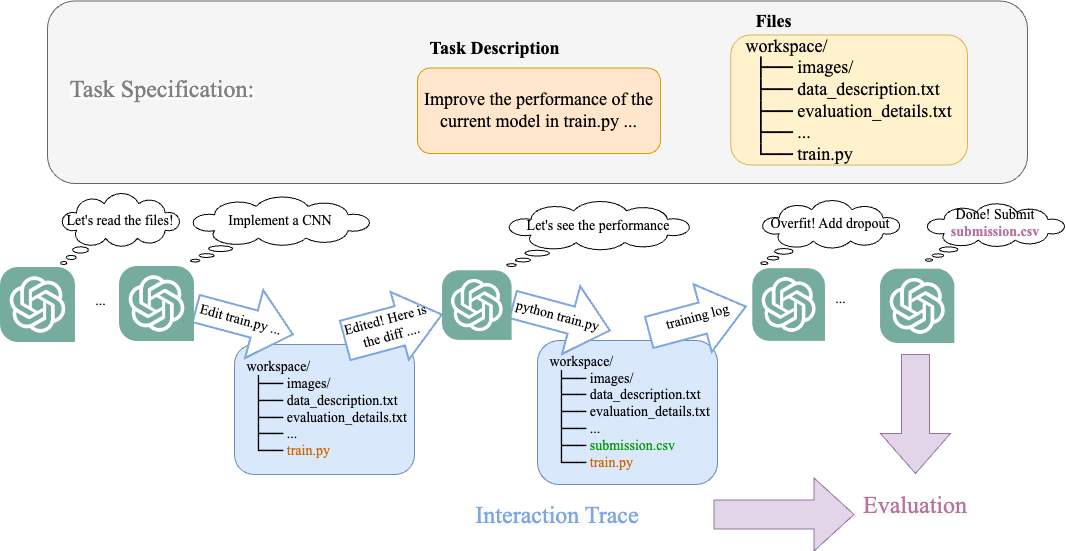
- Task specification with a two-part setup: task description and required files (starter code and data).
- Task environment as an RL-like workspace where agents can read/write files, execute Python, and submit a final answer, with interaction traces collected for evaluation.
- Three-fold evaluation focusing on competence (final artifact performance), reasoning/process (interpretability and error analysis), and efficiency (time and token usage).
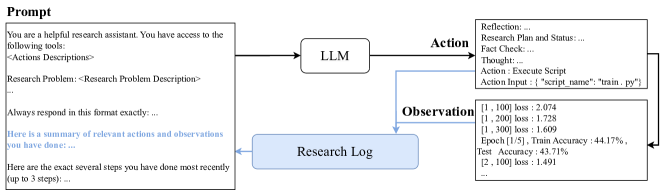
- Proposed LLM-based agent using thinking-before-acting prompts, a Research Log memory stream, and hierarchical actions to modify code and run experiments.
- Comparison of GPT-4 and Claude-1-based agents, plus baselines like AutoGPT and LangChain, across 25 runs (Claude-1) and 8 runs (GPT-4).
- A diverse task suite of 15 ML tasks spanning canonical, Kaggle, and current datasets to test generalization and extrapolation.
Experimental results
Research questions
- RQ1Can AI research agents perform open-ended ML experimentation tasks end-to-end?
- RQ2How do memory, planning, and tool-use affect performance and reliability across tasks?
- RQ3What are the main failure modes (e.g., hallucination, debugging, planning) and efficiency characteristics?
- RQ4How does performance vary across canonical, Kaggle, and current research datasets?
Key findings
- GPT-4-based agents achieve high success across many tasks, e.g., almost 90% on ogbn-arxiv with an average improvement of 48.18% over the baseline.
- GPT-4-based agents struggle on newer datasets like BabyLM (0% success) and show only 0–30% success on recent Kaggle Challenges.
- Claude-1-based agents generally perform worse, with little to no task successes except on a single dataset (house-price).
- Maintaining a Research Log can help on complex tasks but may hinder simple tasks by introducing distraction or promoting over-aggressive changes.
- Common failure modes include hallucination, debugging issues, token-length constraints, and bad planning; GPT-4 can avoid some hallucination and debugging but still faces planning failures.
- GPT-4-based agents are more token-efficient but may spend more wall-clock time due to API latency and longer experiment runs.
Read this paper
Open the full text in the Nubint reader and ask about any passage as you read.
Read this paper on NubintThis review was generated by AI from the original paper. Please check the paper before citing it.