
[Paper Review] MMC: Advancing Multimodal Chart Understanding with Large-scale Instruction Tuning
This paper introduces MMC-Instruction, a 600k-instance instruction-tuning dataset for multimodal chart understanding, and MMCA, a vision-language model finetuned on this data that achieves state-of-the-art performance on chart QA benchmarks. It also proposes MMC-Benchmark, a human-annotated, comprehensive evaluation suite with nine diverse tasks, revealing significant limitations in existing LMMs—including GPT-4V—especially on complex tasks like chart-to-datatable and chart-to-json conversion.
With the rapid development of large language models (LLMs) and their integration into large multimodal models (LMMs), there has been impressive progress in zero-shot completion of user-oriented vision-language tasks. However, a gap remains in the domain of chart image understanding due to the distinct abstract components in charts. To address this, we introduce a large-scale MultiModal Chart Instruction ( extbf{MMC-Instruction}) dataset comprising 600k instances supporting diverse tasks and chart types. Leveraging this data, we develop MultiModal Chart Assistant ( extbf{MMCA}), an LMM that achieves state-of-the-art performance on existing chart QA benchmarks. Recognizing the need for a comprehensive evaluation of LMM chart understanding, we also propose a MultiModal Chart Benchmark ( extbf{MMC-Benchmark}), a comprehensive human-annotated benchmark with nine distinct tasks evaluating reasoning capabilities over charts. Extensive experiments on MMC-Benchmark reveal the limitations of existing LMMs on correctly interpreting charts, even for the most recent GPT-4V model. Our work provides an instruction-tuning methodology and benchmark to advance multimodal understanding of charts. Code and data are available at https://github.com/FuxiaoLiu/MMC.
Motivation & Objective
- Address the gap in large multimodal models' (LMMs) ability to understand complex, abstract chart elements such as trend lines, legends, and axis labels.
- Overcome the limitations of existing chart understanding datasets, which are often small, templated, or lack diversity in language style and chart types.
- Develop a comprehensive, human-annotated benchmark (MMC-Benchmark) to evaluate LMMs across diverse, cognition-aligned tasks beyond simple QA.
- Improve LMM performance on chart understanding through large-scale instruction tuning using a diverse, open-ended instruction dataset.
- Identify and analyze persistent weaknesses in current LMMs—especially on data extraction tasks like chart-to-datatable and chart-to-json—despite their strong general vision-language capabilities.
Proposed method
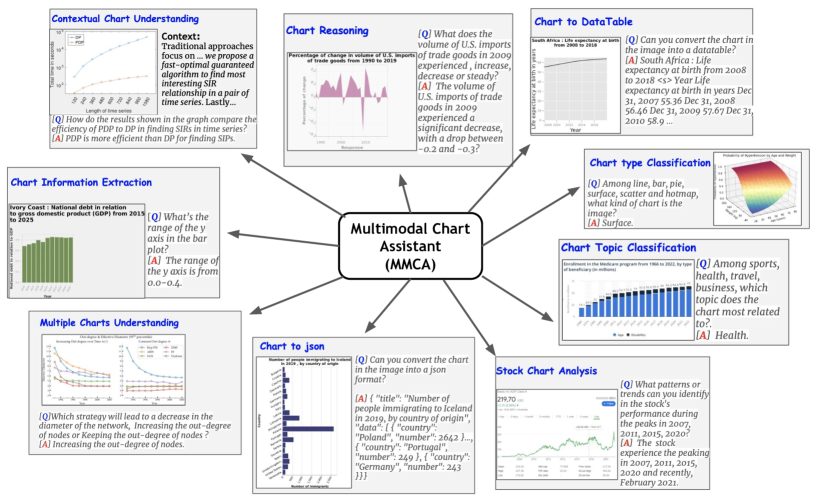
- Construct MMC-Instruction, a 600k-instance dataset using GPT-4 to generate diverse, free-form, open-ended instructions across 9 distinct chart understanding tasks.
- Design MMC-Benchmark as a human-annotated, comprehensive evaluation suite with 9 subtasks, including chart information extraction, reasoning, topic classification, and data format conversion (e.g., chart-to-datatable, chart-to-json).
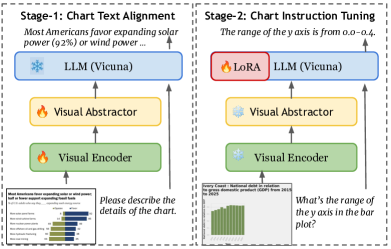
- Develop MMCA, a modular, instruction-tuned LMM finetuned on MMC-Instruction using unified instruction tuning with updated vision projectors to improve visual-textual alignment.
- Employ two evaluation protocols: free-form generation evaluation using ChatGPT and multiple-choice QA to assess both reasoning and factual accuracy.
- Use a unified training strategy that updates the vision projector during fine-tuning to better integrate visual features into the LLM’s input space.
- Conduct extensive ablation and comparison experiments on both standard benchmarks (e.g., ChartQA) and MMC-Benchmark to evaluate performance across diverse chart types and tasks.
Experimental results
Research questions
- RQ1Can large-scale, diverse instruction tuning significantly improve LMMs’ performance on multimodal chart understanding beyond zero-shot or few-shot capabilities?
- RQ2How do existing LMMs, including GPT-4V, perform on complex, open-ended chart understanding tasks such as chart-to-datatable and chart-to-json conversion?
- RQ3To what extent does the proposed MMC-Benchmark reveal limitations in current LMMs that are not exposed by existing, simpler benchmarks?
- RQ4What are the key failure modes of current LMMs in chart understanding, particularly regarding instruction following and visual feature integration?
- RQ5Can a unified instruction-tuning approach with a large, diverse dataset like MMC-Instruction close the performance gap between open-source LMMs and proprietary models like GPT-4V on chart reasoning tasks?
Key findings
- MMCA achieves state-of-the-art performance on existing chart QA benchmarks, significantly outperforming existing open-source LMMs across all nine tasks in MMC-Benchmark.
- Even GPT-4V, the most advanced multimodal model tested, performs poorly on chart-to-datatable and chart-to-json tasks, indicating a critical gap in data extraction accuracy.
- The overall scores of existing LMMs on MMC-Benchmark are substantially lower than on previous benchmarks like ChartQA, due to the increased diversity and open-ended nature of questions and answers.
- The MMC-Instruction dataset enables a large performance boost over baseline LMMs across all nine tasks in MMC-Benchmark, demonstrating its effectiveness for instruction tuning.
- Common failure modes include poor instruction following (e.g., answering 'Yes' to a proportion question), weak vision encoders (e.g., CLIP-based models), and inaccurate OCR-like data extraction.
- Vision encoder limitations and lack of fine-tuning on chart-specific data are major contributors to poor performance, especially on tasks requiring precise data value extraction.
Better researchstarts right now
From reading papers to final review, dramatically reduce your research time.
No credit card · Free plan available
This review was created by AI and reviewed by human editors.