
[Paper Review] MobileVLM V2: Faster and Stronger Baseline for Vision Language Model
MobileVLM V2 delivers faster and stronger mobile-oriented vision-language models by scaling data, refining training strategies, and introducing a lightweight projector, achieving state-of-the-art accuracy with lower latency than many larger VLMs.
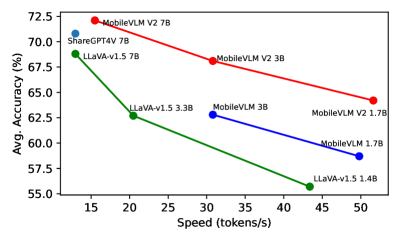
We introduce MobileVLM V2, a family of significantly improved vision language models upon MobileVLM, which proves that a delicate orchestration of novel architectural design, an improved training scheme tailored for mobile VLMs, and rich high-quality dataset curation can substantially benefit VLMs' performance. Specifically, MobileVLM V2 1.7B achieves better or on-par performance on standard VLM benchmarks compared with much larger VLMs at the 3B scale. Notably, our 3B model outperforms a large variety of VLMs at the 7B+ scale. Our models will be released at https://github.com/Meituan-AutoML/MobileVLM .
Motivation & Objective
- Motivate making VLMs practical for resource-constrained devices (mobile/edge).
- Investigate data scaling and training strategies to close the gap between small and large VLMs.
- Design a lightweight projection mechanism to efficiently align visual and language features.
- Show that open, high-quality data and end-to-end training can boost small VLM performance.
- Demonstrate Pareto-optimal accuracy-latency tradeoffs across standard benchmarks.
Proposed method
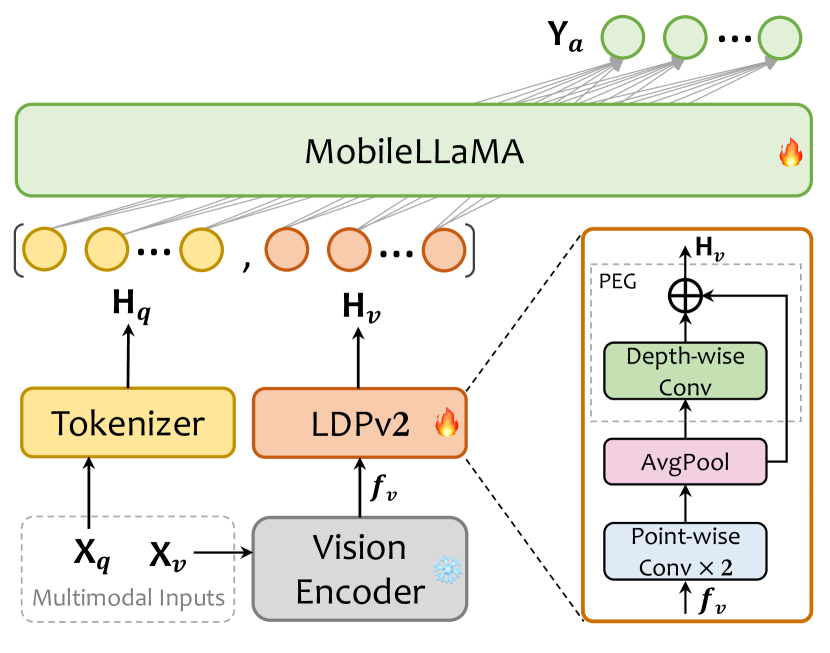
- Use CLIP ViT-L/14 as the vision encoder with 336x336 input resolution.
- Adopt MobileLLaMA (1.4B/2.7B) as the language model for open, efficient inference.
- Introduce a lightweight downsample projector (LDPv2) that reduces image tokens via pooling and simple convolutions with positional enhancement.
- Train in two stages: pre-training (image-text alignment with full projector+LLM) and multi-task training (vision-language tasks).
- Pretrain on ShareGPT4V-PT (1.2M image-text pairs) and perform multi-task training on 2.4M samples from diverse VLM datasets.
- Fine-tune all projector and LLM parameters while freezing the vision encoder for efficiency and better data utilization.
Experimental results
Research questions
- RQ1Does data scaling with high-quality multimodal datasets improve performance of small VLMs to rival larger models?
- RQ2Can a lightweight, downsampled visual projection bridge vision and language effectively on mobile-friendly LLMs?
- RQ3What training regimen (pre-training vs. multi-task) best exploits high-quality data for small VLMs?
- RQ4How does MobileVLM V2 perform in terms of accuracy and latency compared to state-of-the-art VLMs across standard benchmarks?
Key findings
- MobileVLM V2 1.7B achieves on-par or better performance than much larger VLMs on standard benchmarks.
- The 3B MobileVLM V2 model outperforms many 7B+-scale VLMs on average across benchmarks.
- MobileVLM V2 delivers ~75% faster inference than some baselines while achieving higher average accuracy.
- A 7B MobileVLM V2 model outperforms several large-scale VLMs in both accuracy and speed on desktop/mobile-like test settings.
- A highly data-efficient, end-to-end training regime with a lightweight projector yields a strong accuracy-latency Pareto frontier.
Read this paper
Open the full text in the Nubint reader and ask about any passage as you read.
Read this paper on NubintThis review was generated by AI from the original paper. Please check the paper before citing it.