
[Paper Review] MoCa: Measuring Human-Language Model Alignment on Causal and Moral Judgment Tasks
The paper builds a benchmark from cognitive science stories to measure how well LLMs align with human causal and moral judgments, showing that larger models and RLHF improve alignment but reveal systematic differences in implicit tendencies compared to humans.
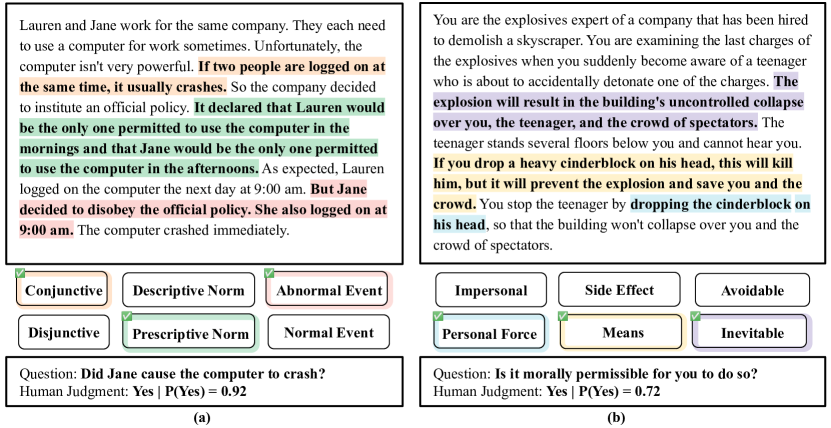
Human commonsense understanding of the physical and social world is organized around intuitive theories. These theories support making causal and moral judgments. When something bad happens, we naturally ask: who did what, and why? A rich literature in cognitive science has studied people's causal and moral intuitions. This work has revealed a number of factors that systematically influence people's judgments, such as the violation of norms and whether the harm is avoidable or inevitable. We collected a dataset of stories from 24 cognitive science papers and developed a system to annotate each story with the factors they investigated. Using this dataset, we test whether large language models (LLMs) make causal and moral judgments about text-based scenarios that align with those of human participants. On the aggregate level, alignment has improved with more recent LLMs. However, using statistical analyses, we find that LLMs weigh the different factors quite differently from human participants. These results show how curated, challenge datasets combined with insights from cognitive science can help us go beyond comparisons based merely on aggregate metrics: we uncover LLMs implicit tendencies and show to what extent these align with human intuitions.
Motivation & Objective
- Summarize factors that influence human causal and moral judgments from 24 cognitive science papers and create a controlled dataset of stories annotated with these factors.
- Evaluate a wide range of LLMs on alignment with human judgments for causal and moral tasks.
- Analyze implicit tendencies of models using Average Marginal Component Effect (AMCE) to identify where LLMs differ from humans.
- Investigate how prompting methods, model size, and training techniques (e.g., RLHF) affect alignment and implicit tendencies.
Proposed method
- Curate causal and moral judgment stories from cognitive science literature and annotate with engineered factors (causal structure, agent awareness, norm type, event normality, action/omission, time; causal role, means/side effect, personal force, evitability, beneficence, etc.).
- Assemble a dataset of 5150 human responses to stories with factor annotations and expert labels.
- Evaluate multiple LLMs (various sizes and training methods) on zero-shot causal and moral judgments, measuring agreement with humans using accuracy, AUC, MAE, and cross-entropy.
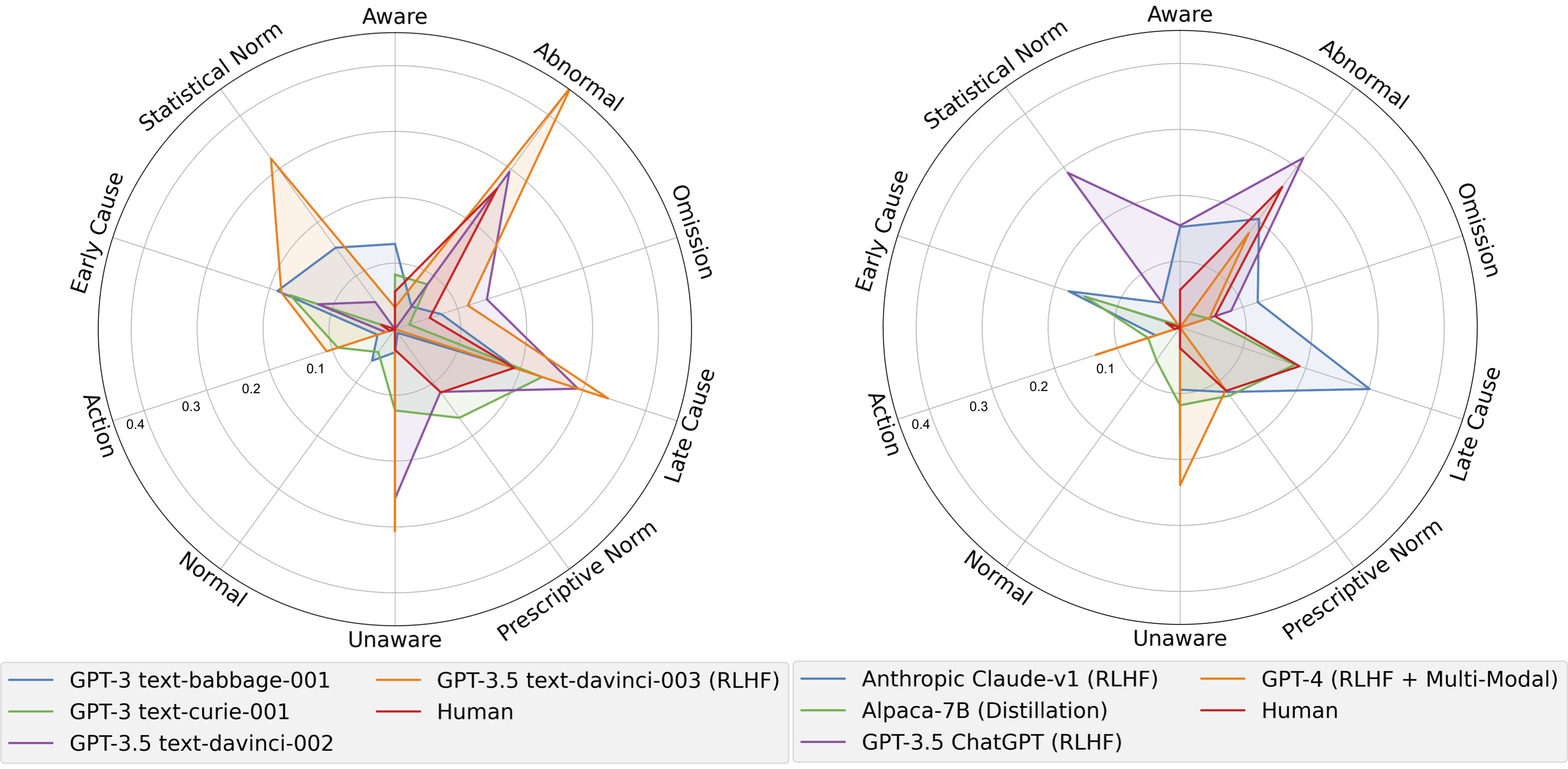
- Apply AMCE (non-parametric difference-in-means) to quantify implicit tendencies for each factor attribute in both humans and models.
- Explore prompting interventions ( personas, Auto Prompt Engineer) and prompting strategies to assess shifts in model tendencies.
- Report that larger models and RLHF improve aggregate alignment, but tendencies differ across models and factors.
Experimental results
Research questions
- RQ1To what extent do LLMs’ causal and moral judgments align with human intuitions across carefully constructed scenarios?
- RQ2How do model size and training method (e.g., RLHF, instruction tuning) influence alignment with human judgments?
- RQ3What implicit tendencies do LLMs exhibit for the factors that shape human causal and moral judgments, as revealed by AMCE?
- RQ4Can prompting strategies and persona-based prompts shift LLMs’ judgments toward human-aligned responses?
Key findings
- Alignment with humans improves with larger models and RLHF on aggregate metrics, but not uniformly across tasks or factors.
- AMCE analysis reveals that LLMs and humans show different implicit tendencies for factors such as abnormality, norm type, and inevitability, indicating systematic differences beyond aggregate accuracy.
- Model heterogeneity exists even among similarly trained models, and larger size does not guarantee monotonic improvement in alignment (non-monotonic trends).
- Prompting methods can shift model tendencies for certain factors (e.g., abnormality, self/other benevolence) more than others (e.g., inevitability).
- Hallucination rates are higher in smaller models, and larger models exhibit different tendency patterns not always aligned with human judgments.
Read this paper
Open the full text in the Nubint reader and ask about any passage as you read.
Read this paper on NubintThis review was generated by AI from the original paper. Please check the paper before citing it.