
[Paper Review] Modality-Transferable Emotion Embeddings for Low-Resource Multimodal Emotion Recognition
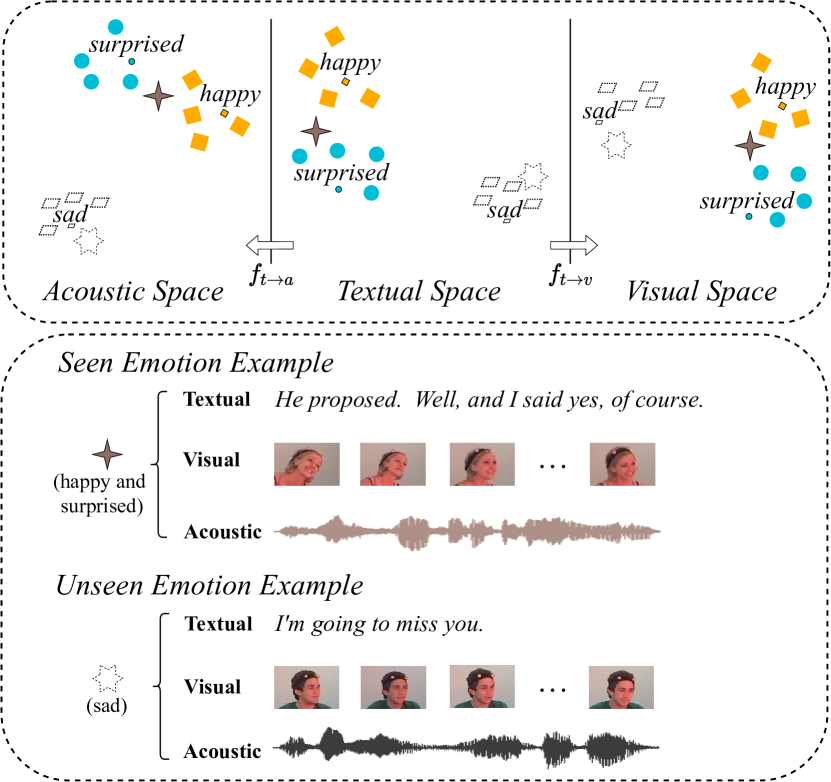
This paper proposes a modality-transferable model for low-resource multimodal emotion recognition that uses pre-trained GloVe embeddings to represent emotion categories and learns mapping functions to transfer these embeddings into acoustic and visual spaces. By measuring distances between input representations and emotion embeddings across modalities, the model achieves state-of-the-art performance and enables effective zero-shot and few-shot recognition for unseen emotions.
Despite the recent achievements made in the multi-modal emotion recognition task, two problems still exist and have not been well investigated: 1) the relationship between different emotion categories are not utilized, which leads to sub-optimal performance; and 2) current models fail to cope well with low-resource emotions, especially for unseen emotions. In this paper, we propose a modality-transferable model with emotion embeddings to tackle the aforementioned issues. We use pre-trained word embeddings to represent emotion categories for textual data. Then, two mapping functions are learned to transfer these embeddings into visual and acoustic spaces. For each modality, the model calculates the representation distance between the input sequence and target emotions and makes predictions based on the distances. By doing so, our model can directly adapt to the unseen emotions in any modality since we have their pre-trained embeddings and modality mapping functions. Experiments show that our model achieves state-of-the-art performance on most of the emotion categories. In addition, our model also outperforms existing baselines in the zero-shot and few-shot scenarios for unseen emotions.
Motivation & Objective
- Address the lack of modeling inter-emotion relationships in multimodal emotion recognition, which leads to sub-optimal performance.
- Tackle the challenge of low-resource emotion recognition, especially for rare or unseen emotion categories.
- Enable zero-shot and few-shot learning for unseen emotions by leveraging pre-trained emotion embeddings and modality transfer.
- Improve generalization and robustness in low-resource settings through end-to-end learning with shared semantic knowledge across modalities.
Proposed method
- Use pre-trained GloVe embeddings as semantic representations for emotion categories in the textual modality.
- Learn two mapping functions, $f_{t\rightarrow a}$ and $f_{t\rightarrow v}$, to project textual emotion embeddings into acoustic and visual spaces.
- For each modality, compute the distance between input sequence representations and target emotion embeddings to make predictions.
- Fuse distances from all modalities using a learned attention mechanism to produce final emotion predictions.
- Enable zero-shot inference by directly applying the same flow to unseen emotion categories using their pre-trained embeddings.
- Support few-shot adaptation via joint training and continual learning to prevent catastrophic forgetting on seen classes.
Experimental results
Research questions
- RQ1Can modeling inter-emotion relationships through shared semantic embeddings improve multimodal emotion recognition performance?
- RQ2To what extent can a model generalize to unseen emotion categories without any labeled training data?
- RQ3How effective is the proposed method in few-shot scenarios with minimal data for low-resource emotions?
- RQ4Does modality-specific performance vary, and can single-modality zero-shot prediction outperform multi-modal settings in certain cases?
Key findings
- The proposed model achieves state-of-the-art performance on most emotion categories in the IEMOCAP and CMU-MOSEI datasets.
- On the IEMOCAP dataset, the model achieves 89.1% zero-shot accuracy using only acoustic and visual modalities, outperforming multi-modal baselines.
- In few-shot learning, the model with joint training (JT) achieves 86.1% accuracy on the unseen emotion 'surprise' using only 1% of training data.
- The model outperforms fine-tuning baselines in few-shot scenarios, as fine-tuning leads to catastrophic forgetting and performance degradation.
- Single-modality zero-shot prediction can surpass multi-modal performance when an emotion has strong discriminative cues in one modality, such as 'surprise' in the acoustic modality.
- Ablation studies confirm that textual and acoustic modalities contribute more than visual modality, and modality fusion consistently improves performance across settings.

Read this paper
Open the full text in the Nubint reader and ask about any passage as you read.
Read this paper on NubintThis review was generated by AI from the original paper. Please check the paper before citing it.