
[Paper Review] Model Extraction Attacks on Split Federated Learning
This paper exposes that Split Federated Learning (SFL) is vulnerable to novel Model Extraction (ME) attacks despite blocking prediction queries, by leveraging gradient information from the server. The authors propose five ME attack variants—Craft-ME, GAN-ME, GM-ME, Train-ME, and SoftTrain-ME—that exploit white-box access to the client-side model and gradient queries, achieving over 90% accuracy on CIFAR-10 with VGG-11 when the server-side model has five layers, even without original training data.
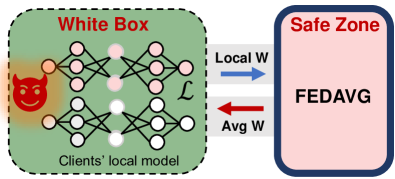
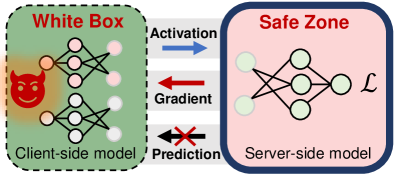
Federated Learning (FL) is a popular collaborative learning scheme involving multiple clients and a server. FL focuses on protecting clients' data but turns out to be highly vulnerable to Intellectual Property (IP) threats. Since FL periodically collects and distributes the model parameters, a free-rider can download the latest model and thus steal model IP. Split Federated Learning (SFL), a recent variant of FL that supports training with resource-constrained clients, splits the model into two, giving one part of the model to clients (client-side model), and the remaining part to the server (server-side model). Thus SFL prevents model leakage by design. Moreover, by blocking prediction queries, it can be made resistant to advanced IP threats such as traditional Model Extraction (ME) attacks. While SFL is better than FL in terms of providing IP protection, it is still vulnerable. In this paper, we expose the vulnerability of SFL and show how malicious clients can launch ME attacks by querying the gradient information from the server side. We propose five variants of ME attack which differs in the gradient usage as well as in the data assumptions. We show that under practical cases, the proposed ME attacks work exceptionally well for SFL. For instance, when the server-side model has five layers, our proposed ME attack can achieve over 90% accuracy with less than 2% accuracy degradation with VGG-11 on CIFAR-10.
Motivation & Objective
- To investigate whether Split Federated Learning (SFL) is truly resistant to Model Extraction (ME) attacks under a realistic threat model where prediction queries are blocked.
- To identify and exploit new attack vectors in SFL that leverage gradient information and white-box access to the client-side model.
- To evaluate the impact of server-side model size (number of layers, N) on ME attack success and the resulting trade-off between IP protection and data privacy.
- To explore and validate defensive mechanisms, such as L1 regularization, to enhance SFL's resistance to ME attacks.
- To assess the effectiveness of ME attacks under varying data assumptions, model architectures, and data distributions (e.g., non-IID).
Proposed method
- Design five novel ME attack variants—Craft-ME, GAN-ME, GM-ME, Train-ME, and SoftTrain-ME—specifically tailored to SFL’s threat model with gradient access and no prediction query access.
- Utilize white-box knowledge of the client-side model architecture and parameters to guide surrogate model construction and gradient-based optimization.
- Employ gradient queries from the server to iteratively refine a surrogate model that mimics the behavior of the full SFL model.
- Apply data augmentation and transfer learning techniques in attacks like GAN-ME and GM-ME to improve surrogate model generalization.
- Implement a defense mechanism using L1 regularization on the client-side model to suppress feature extraction and reduce information leakage.
- Benchmark attack performance across multiple datasets (CIFAR-10, CIFAR-100, ImageNet), architectures (VGG-11, ResNet-20, MobileNet-V2), and data regimes (with/without original data, non-IID data).
Experimental results
Research questions
- RQ1Is SFL truly resistant to Model Extraction (ME) attacks when prediction queries are blocked, as previously assumed?
- RQ2Can gradient information from the server-side model be exploited to reconstruct a high-accuracy surrogate model of the full SFL model?
- RQ3How does the number of layers in the server-side model (N) affect the success of ME attacks in SFL?
- RQ4What is the trade-off between IP protection (resistance to ME) and data privacy (resistance to membership inference) in SFL?
- RQ5Can simple regularization techniques like L1 regularization effectively defend against ME attacks in SFL?
Key findings
- SFL is not inherently resistant to ME attacks; five novel attack variants can successfully extract a surrogate model with over 90% accuracy on CIFAR-10 using only gradient queries and white-box access to the client-side model.
- When the server-side model has five layers (e.g., in VGG-11), the Train-ME attack achieves over 90% accuracy on CIFAR-10 with less than 2% degradation, even without access to the original training data.
- ME attack success drops significantly with larger server-side models (higher N), but such configurations compromise client data privacy by reducing the client-side model size, making them impractical.
- For complex datasets like CIFAR-100 and ImageNet, ME attacks are less effective, with accuracy gaps exceeding 20% and 10% respectively, indicating dataset complexity acts as a natural defense.
- ResNet-20 and MobileNet-V2 architectures are more resistant to ME attacks than VGG-11 under similar split configurations, suggesting architectural complexity enhances IP protection.
- Applying L1 regularization (λ = 5e-5 to 2e-4) on the client-side model reduces ME attack performance while causing only minor accuracy degradation (e.g., 90.43% accuracy at λ = 5e-5), demonstrating its viability as a defense mechanism.
Read this paper
Open the full text in the Nubint reader and ask about any passage as you read.
Read this paper on NubintThis review was generated by AI from the original paper. Please check the paper before citing it.