
[Paper Review] Model-Free Robust Average-Reward Reinforcement Learning
This paper proposes model-free algorithms for robust average-reward reinforcement learning under model uncertainty, introducing robust relative value iteration TD and Q-learning that converge to optimal solutions despite unknown transition dynamics. The key contribution is a theoretical characterization of solutions to the robust average-reward Bellman equation and convergence guarantees under various uncertainty sets, including KL divergence and Wasserstein distance.
Robust Markov decision processes (MDPs) address the challenge of model uncertainty by optimizing the worst-case performance over an uncertainty set of MDPs. In this paper, we focus on the robust average-reward MDPs under the model-free setting. We first theoretically characterize the structure of solutions to the robust average-reward Bellman equation, which is essential for our later convergence analysis. We then design two model-free algorithms, robust relative value iteration (RVI) TD and robust RVI Q-learning, and theoretically prove their convergence to the optimal solution. We provide several widely used uncertainty sets as examples, including those defined by the contamination model, total variation, Chi-squared divergence, Kullback-Leibler (KL) divergence and Wasserstein distance.
Motivation & Objective
- Address the lack of model-free algorithms for robust average-reward reinforcement learning under model uncertainty.
- Characterize the solution structure of the robust average-reward Bellman equation, which is non-linear and non-unique.
- Design model-free algorithms—robust RVI TD and robust RVI Q-learning—with provable convergence to optimal robust policies.
- Construct unbiased estimators with bounded variance for the robust Bellman operator across multiple uncertainty sets.
- Establish theoretical convergence for algorithms in the average-reward setting, where standard contraction arguments fail.
Proposed method
- Propose a solution structure for the robust average-reward Bellman equation: any solution is a relative value function for some worst-case transition kernel, up to an additive constant.
- Adopt an offset subtraction technique (similar to non-robust average-reward methods) to stabilize iterates in the absence of contraction.
- Design robust RVI TD and robust RVI Q-learning algorithms that update value functions using unbiased estimators of the robust Bellman operator.
- Use uncertainty sets defined by total variation, KL divergence, Chi-squared divergence, and Wasserstein distance to model distributional shifts.
- Prove convergence by leveraging the solution structure and span semi-norm analysis, showing that the span of value differences contracts over iterations.
- Apply the span semi-norm to bound the difference between Q-functions and establish convergence to the optimal robust average-reward.
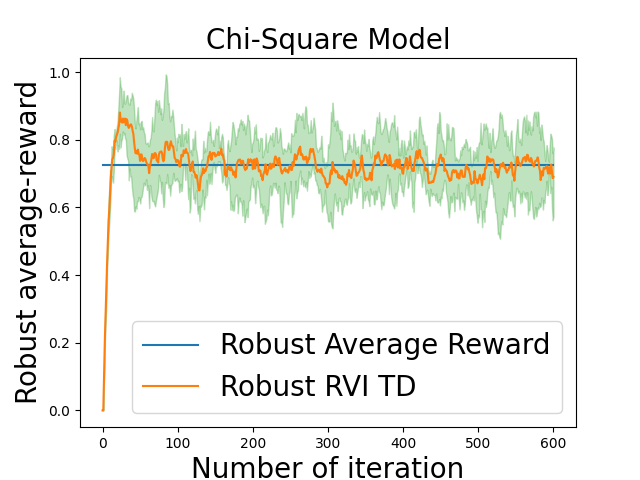
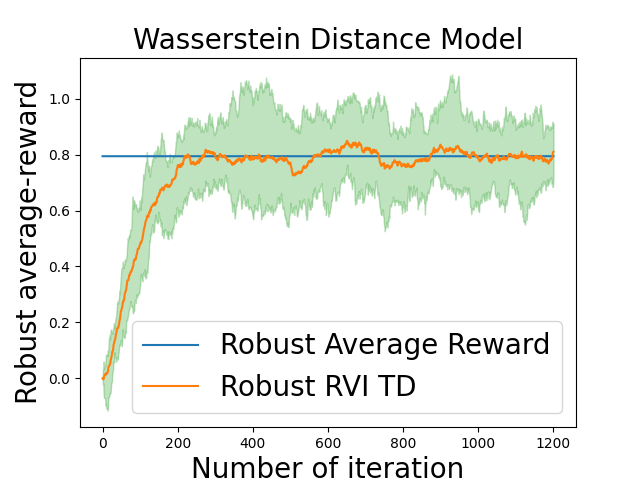
Experimental results
Research questions
- RQ1What is the fundamental solution structure of the robust average-reward Bellman equation, given its non-linear nature?
- RQ2Can model-free algorithms be designed for robust average-reward RL when only samples from the nominal MDP are available?
- RQ3How can convergence be proven for robust average-reward algorithms when the Bellman operator is neither linear nor a contraction?
- RQ4What types of uncertainty sets (e.g., KL, Wasserstein) allow for unbiased estimation and stable learning in the model-free setting?
- RQ5How does the performance of the proposed robust algorithms compare to non-robust methods under distributional shift or adversarial perturbations?
Key findings
- The solution to the robust average-reward Bellman equation is not unique, but any solution corresponds to a relative value function of a worst-case transition kernel, up to an additive constant.
- Robust RVI TD converges to the optimal robust average-reward, as validated in the Garnet and Frozen-Lake environments.
- Robust RVI Q-learning converges to a greedy policy that is optimal under the worst-case MDP, outperforming non-robust Q-learning in perturbed environments.
- In the one-loop task, robust RVI Q-learning learns a policy favoring action $a_l$ at state $s_1$, which is more robust than the non-robust method’s preference for $a_r$.
- Under perturbed testing environments, the robust policy learned by the proposed method achieves significantly higher average-reward than the non-robust baseline.
- Theoretical analysis confirms that the span semi-norm of the difference between Q-functions contracts over time, enabling convergence despite the lack of contraction in the Bellman operator.
Read this paper
Open the full text in the Nubint reader and ask about any passage as you read.
Read this paper on NubintThis review was generated by AI from the original paper. Please check the paper before citing it.