
[Paper Review] Modeling and Analysis of Reconfigurable Intelligent Surfaces for Indoor and Outdoor Applications in Future Wireless Networks
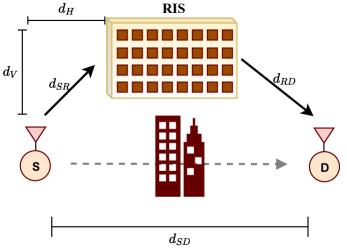
This paper proposes a unified framework for modeling and analyzing reconfigurable intelligent surfaces (RIS) in indoor and outdoor 6G wireless networks across sub-6 GHz to millimeter-wave bands. It demonstrates that RISs significantly enhance spectral efficiency and error performance by enabling intelligent wave manipulation, with multiple RIS selection offering up to 30% higher achievable rates than non-selected systems under practical phase and channel estimation imperfections.
Reconfigurable intelligent surface (RIS)-empowered communication is one of the promising 6G technologies that allows the conversion of the wireless channel into an intelligent transmit entity by manipulating the impinging waves using man-made surfaces. In this paper, the potential benefits of using RISs are investigated for indoor/outdoor setups and various frequency bands (from sub 6 GHz to millimeter-waves). First, a general system model with a single RIS is considered and the effect of the total number of reflecting elements on the probabilistic distribution of the received signal-to-noise ratio and error performance is investigated under Rician fading. Also for this case, the path loss exponent is analyzed by considering empirical path loss models. Furthermore, transmission models with multiple RISs are developed and analyzed for indoor and outdoor non line-of-sight (NLOS) scenarios. The conventional RIS selection strategies are also integrated for systems equipped with multiple RISs for the first time. Through extensive simulations, it is demonstrated that the RIS-assisted systems provide promising solutions for indoor/outdoor scenarios at various operating frequencies and exhibit significant results in error performance and achievable data rates even in the presence of system imperfections such as limited range phase adjustment and imperfect channel phase estimation at RISs.
Motivation & Objective
- To investigate the performance gains of RIS-empowered wireless systems in diverse indoor and outdoor propagation environments.
- To analyze the impact of RIS reflection elements and path loss models on signal-to-noise ratio (SNR) and bit error rate (BER) under Rician fading.
- To develop and evaluate multi-RIS transmission models for non-line-of-sight (NLOS) scenarios with practical hardware constraints.
- To introduce and evaluate novel RIS selection strategies in multi-RIS systems to optimize performance under dynamic user mobility.
- To assess system robustness under non-ideal conditions, including limited phase resolution and imperfect channel phase estimation.
Proposed method
- Developed a general single-RIS system model with probabilistic SNR and BER analysis under Rician fading and empirical path loss models.
- Formulated multi-RIS transmission models for NLOS scenarios using coordinate-based RIS placement and path loss modeling across frequency bands.
- Proposed a novel RIS selection strategy using SNR-based link selection among multiple RIS pairs to optimize performance.
- Integrated practical hardware constraints: limited phase shift range (−150° to 140°) and non-ideal reflection coefficient (|Γ| = −1 dB).
- Modeled phase estimation errors using a zero-mean von Mises distribution with concentration parameter κ to simulate real-world imperfections.
- Conducted extensive simulations comparing ideal vs. non-ideal RIS performance across varying numbers of reflecting elements (N) and estimation accuracy (κ).
Experimental results
Research questions
- RQ1How does the number of reflecting elements on a single RIS affect the SNR distribution and error performance in Rician fading environments?
- RQ2What is the impact of empirical path loss models on the overall system performance in indoor and outdoor RIS-aided scenarios?
- RQ3How do multiple RISs improve achievable data rates and reliability in non-line-of-sight (NLOS) environments compared to single-RIS setups?
- RQ4To what extent does RIS selection among multiple RIS pairs enhance system performance while reducing complexity and phase adjustment costs?
- RQ5How sensitive is RIS-assisted communication to hardware impairments such as limited phase resolution and imperfect channel phase estimation?
Key findings
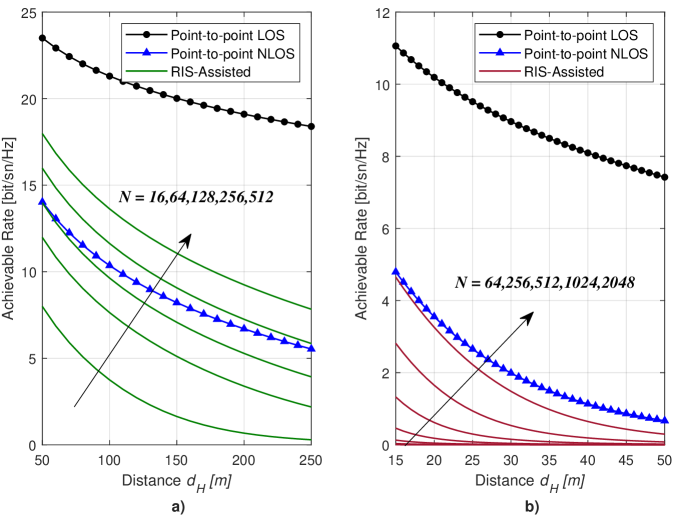
- Increasing the number of reflecting elements on a single RIS significantly improves SNR and reduces BER by enabling constructive signal combining.
- RIS-assisted systems achieve up to 30% higher achievable data rates compared to non-selected multi-RIS systems, especially when users are near optimal RIS locations.
- RIS selection based on SNR outperforms fixed-path transmission, with peak performance observed when users are located near RISs (e.g., at x = 5 m and 25 m in simulations).
- Even with non-ideal RIS hardware (limited phase range: −150° to 140°), error performance remains close to ideal RISs, indicating robustness to practical implementation constraints.
- Phase estimation errors degrade performance, but the impact is mitigated with higher numbers of reflecting elements (N) and improved estimation accuracy (higher κ).
- Path loss is the dominant factor in RIS selection, with shorter paths providing better performance than longer ones under similar fading conditions.
Read this paper
Open the full text in the Nubint reader and ask about any passage as you read.
Read this paper on NubintThis review was generated by AI from the original paper. Please check the paper before citing it.