
[Paper Review] Modeling Causal Mechanisms with Diffusion Models for Interventional and Counterfactual Queries
This paper introduces Diffusion-Based Causal Models (DCM), a novel framework that leverages denoising diffusion models to learn structural causal models from observational data and a known causal graph. By modeling each node's structural equation via a diffusion process with latent encodings as proxies for exogenous noise, DCM enables accurate sampling under interventions and counterfactual inference, outperforming state-of-the-art methods by up to an order of magnitude on nonadditive noise models.
We consider the problem of answering observational, interventional, and counterfactual queries in a causally sufficient setting where only observational data and the causal graph are available. Utilizing the recent developments in diffusion models, we introduce diffusion-based causal models (DCM) to learn causal mechanisms, that generate unique latent encodings. These encodings enable us to directly sample under interventions and perform abduction for counterfactuals. Diffusion models are a natural fit here, since they can encode each node to a latent representation that acts as a proxy for exogenous noise. Our empirical evaluations demonstrate significant improvements over existing state-of-the-art methods for answering causal queries. Furthermore, we provide theoretical results that offer a methodology for analyzing counterfactual estimation in general encoder-decoder models, which could be useful in settings beyond our proposed approach.
Motivation & Objective
- To develop a flexible and scalable framework for answering observational, interventional, and counterfactual queries in structural causal models using only observational data and a causal graph.
- To leverage the expressive power of diffusion models to learn causal mechanisms by treating latent codes as proxies for unobserved exogenous noise.
- To provide a unified method for both intervention and counterfactual inference through a deterministic, autoencoder-style diffusion process (DDIM).
- To theoretically analyze the accuracy of counterfactual estimates in encoder-decoder models, with bounds applicable beyond diffusion models.
- To empirically validate DCM’s superiority over existing state-of-the-art methods across diverse structural equation types and real-world data.
Proposed method
- Model each node in the causal graph as a conditional diffusion model that takes parent values as input and learns to encode observations into a latent space and decode back to the variable space.
- Use Denoising Diffusion Implicit Models (DDIM) as the underlying diffusion architecture, enabling deterministic sampling and efficient inference via a learned reverse process.
- Train the DCM in topological order, ensuring that each node’s diffusion model is conditioned on its parents’ values, mimicking the structural equation model (SCM) generation process.
- For interventional queries, apply do-interventions by fixing the intervened variable’s value and sampling from the corresponding diffusion model.
- For counterfactual queries, perform abduction by encoding the observed outcome into the latent space, then apply action (intervention on the latent) and prediction (reconstruction) steps.
- Leverage the latent representation as a proxy for exogenous noise, enabling the model to capture complex, nonparametric structural equations.
Experimental results
Research questions
- RQ1Can diffusion models effectively learn causal mechanisms from observational data and a causal graph to support all three types of causal queries?
- RQ2How does the performance of DCM compare to existing state-of-the-art methods in interventional and counterfactual inference, especially under nonadditive noise?
- RQ3What theoretical guarantees can be provided for counterfactual estimation in encoder-decoder models like DCM?
- RQ4Can DCM generalize to real-world data, such as fMRI data, with complex, nonlinear dependencies?
- RQ5Does the latent space in DCM serve as a valid proxy for exogenous noise, enabling accurate abduction and counterfactual reasoning?
Key findings
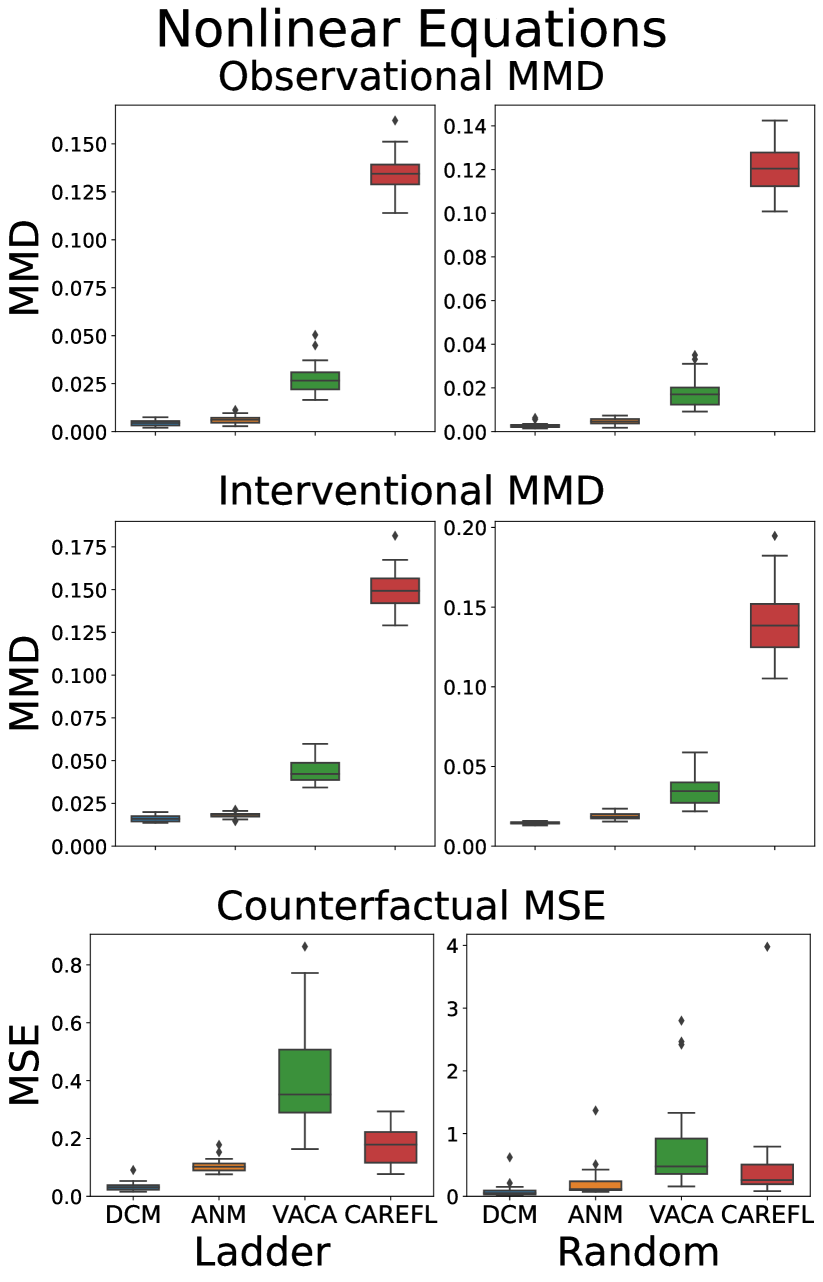
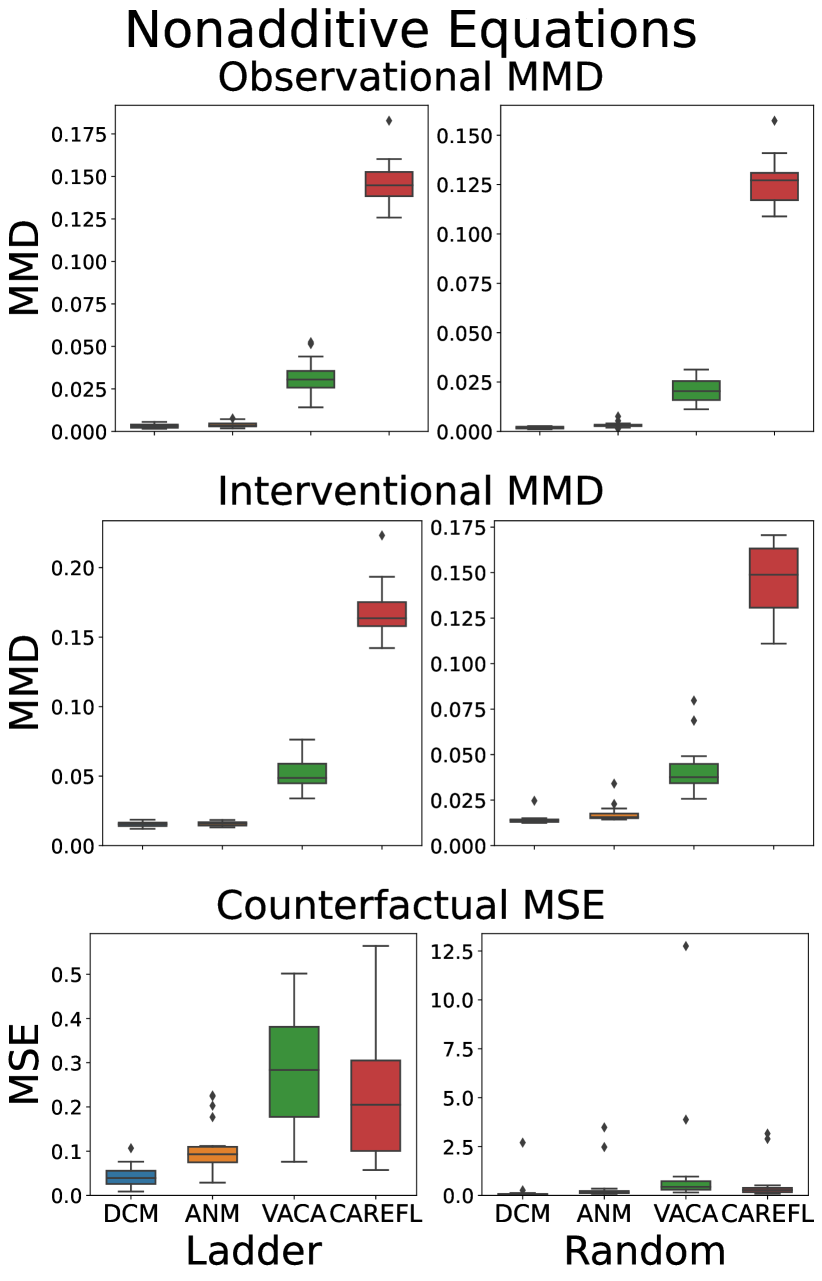
- DCM outperforms existing state-of-the-art methods by up to an order of magnitude on interventional and counterfactual queries in nonadditive noise models, with a 10.42 ± 2.77 MSE on the Y graph in the NADD setting.
- On the semi-synthetic Sachs dataset, DCM achieves the lowest counterfactual MSE (0.72 ± 0.19 × 10⁻²) in the NLIN setting, significantly outperforming VACA (17.71 ± 9.23 × 10⁻²) and CAREFL (7.30 ± 0.95 × 10⁻²).
- In the NADD setting on the Sachs dataset, DCM achieves a counterfactual MSE of 1.99 ± 2.49 × 10⁻², outperforming VACA (7.30 ± 11.57 × 10⁻²) and CAREFL (8.30 ± 8.34 × 10⁻²).
- DCM achieves the lowest observational MMD (0.16 ± 0.11) on the Ladder graph in the NLIN setting, indicating strong distributional fidelity.
- Theoretical analysis shows that counterfactual estimation error in DCM can be bounded under reasonable assumptions, providing a general framework applicable to other encoder-decoder models.
- Empirical results on synthetic datasets with various structural equation types (linear, nonlinear, nonadditive) consistently show DCM’s superiority in interventional and counterfactual queries across all graph structures tested.
Better researchstarts right now
From reading papers to final review, dramatically reduce your research time.
No credit card · Free plan available
This review was created by AI and reviewed by human editors.