
[Paper Review] Modeling Sustainable Resource Management using Active Inference
This paper proposes a computational model of sustainable resource management using active inference, where an agent learns to balance immediate needs with long-term resource availability by minimizing free energy. In dynamic environments, the agent exhibits resilient, adaptive behavior—resisting immediate gratification to ensure sustainability—demonstrating that active inference can generate ecologically sound decision-making strategies through learning and belief updating.
Active inference helps us simulate adaptive behavior and decision-making in biological and artificial agents. Building on our previous work exploring the relationship between active inference, well-being, resilience, and sustainability, we present a computational model of an agent learning sustainable resource management strategies in both static and dynamic environments. The agent's behavior emerges from optimizing its own well-being, represented by prior preferences, subject to beliefs about environmental dynamics. In a static environment, the agent learns to consistently consume resources to satisfy its needs. In a dynamic environment where resources deplete and replenish based on the agent's actions, the agent adapts its behavior to balance immediate needs with long-term resource availability. This demonstrates how active inference can give rise to sustainable and resilient behaviors in the face of changing environmental conditions. We discuss the implications of our model, its limitations, and suggest future directions for integrating more complex agent-environment interactions. Our work highlights active inference's potential for understanding and shaping sustainable behaviors.
Motivation & Objective
- To investigate how active inference can generate sustainable resource management behaviors in agents under varying environmental conditions.
- To examine the role of learning and belief updating in enabling agents to balance short-term needs with long-term resource availability.
- To model the emergence of resilience and elasticity in agent behavior through free energy minimization.
- To explore the limitations of single-agent, single-resource models in capturing real-world ecological complexity.
- To lay a foundation for future research on multi-agent, multi-resource systems using active inference.
Proposed method
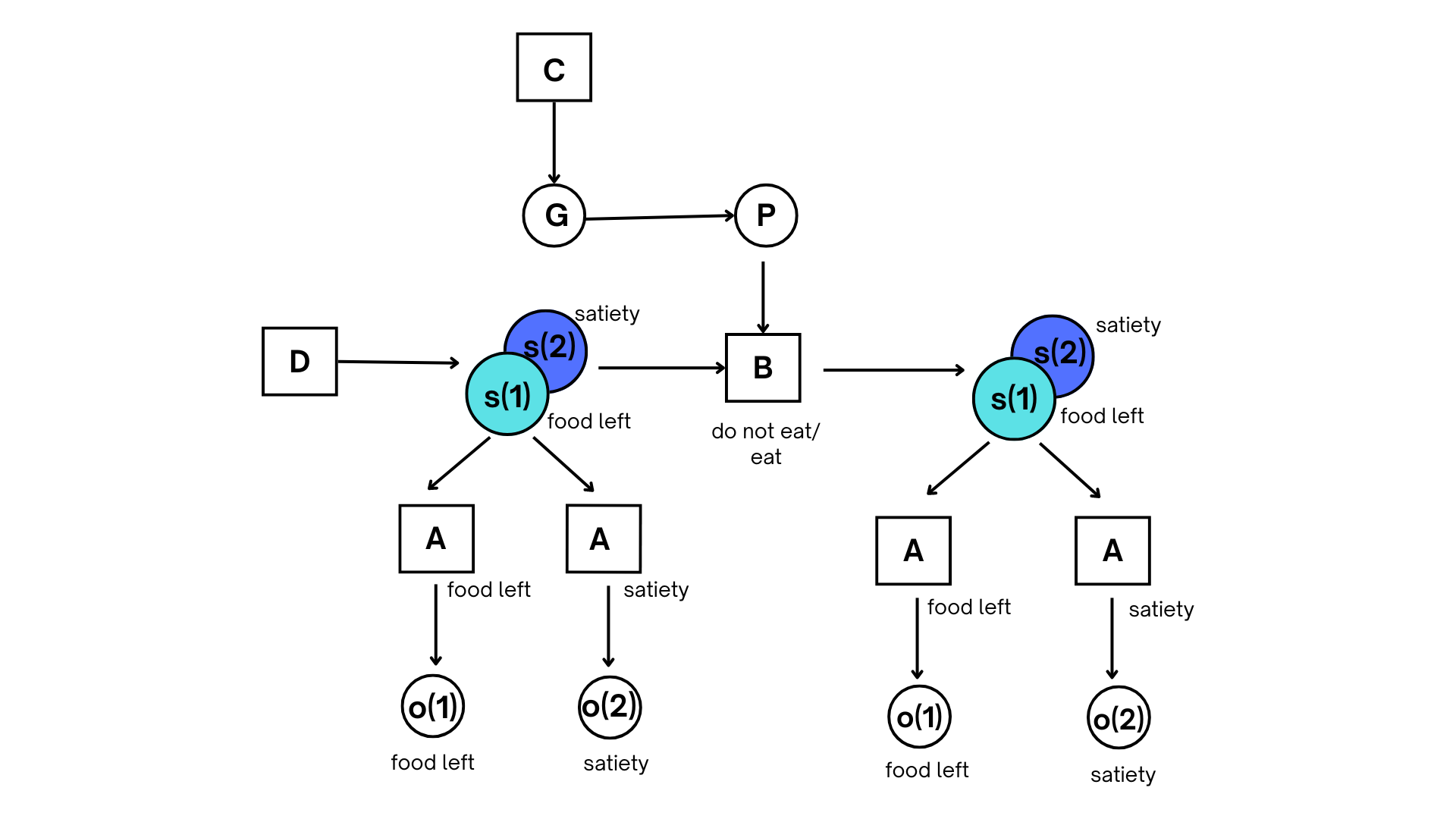
- The agent uses active inference to minimize variational free energy, balancing prior preferences (e.g., hunger reduction) with environmental beliefs.
- A generative model encodes the agent’s beliefs about environmental dynamics, including resource depletion and replenishment rates.
- The agent’s policy is optimized through Bayesian inference, updating its internal model based on sensory inputs and prediction errors.
- Two simulation cases are used: Case 1 (static environment) tests baseline consumption behavior; Case 2 (dynamic environment) introduces feedback between consumption and resource regeneration.
- Learning is implemented via policy optimization over time, with performance evaluated based on survival and sustained well-being.
- The model incorporates precision weighting to modulate sensitivity to prediction errors, enabling adaptive responses to environmental change.
Experimental results
Research questions
- RQ1How can active inference support the emergence of sustainable consumption behaviors in a single agent?
- RQ2What role does learning play in enabling agents to adapt to dynamic environmental conditions with delayed resource feedback?
- RQ3How does temporary increases in free energy (e.g., hunger) contribute to long-term sustainability?
- RQ4In what ways does the agent’s behavior reflect resilience, elasticity, and plasticity under environmental perturbations?
- RQ5How do the limitations of a single-agent, single-resource model constrain the model’s applicability to real-world sustainability challenges?
Key findings
- In the static environment, the agent consistently consumes resources to satisfy immediate needs, demonstrating baseline behavioral inertia.
- In the dynamic environment, the agent learns to moderate consumption, enduring temporary increases in free energy (hunger) to preserve long-term resource availability.
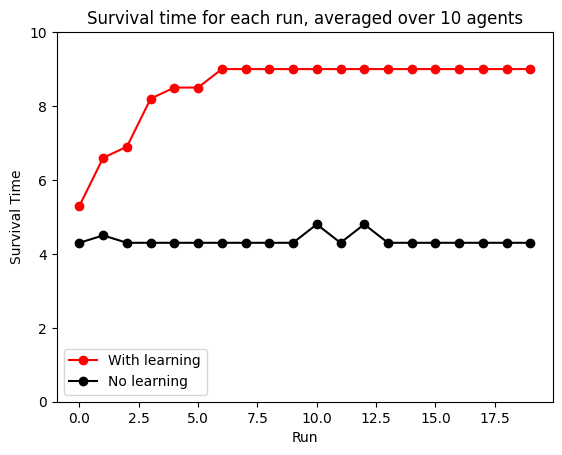
- With a policy length of 1 and no learning, the agent dies within the first step, highlighting the necessity of learning for survival in complex environments.
- With learning, the agent gradually develops a stable strategy that balances consumption and replenishment, enabling long-term survival.
- The agent’s behavior reflects elasticity by tolerating short-term discomfort and plasticity by updating its internal model in response to new environmental feedback.
- The model demonstrates that active inference can give rise to sustainable and resilient behaviors through the optimization of free energy under prior preferences and environmental constraints.
Read this paper
Open the full text in the Nubint reader and ask about any passage as you read.
Read this paper on NubintThis review was generated by AI from the original paper. Please check the paper before citing it.