
[Paper Review] modOpt: A modular development environment and library for optimization algorithms
modOpt is an open-source Python framework that enables building and testing optimization algorithms from modular components, with interfaces to multiple modeling languages and built-in educational algorithms, visualization, and benchmarking tools.
Recent advances in computing hardware and modeling software have given rise to new applications for numerical optimization. These new applications occasionally uncover bottlenecks in existing optimization algorithms and necessitate further specialization of the algorithms. However, such specialization requires expert knowledge of the underlying mathematical theory and the software implementation of existing algorithms. To address this challenge, we present modOpt, an open-source software framework that facilitates the construction of optimization algorithms from modules. The modular environment provided by modOpt enables developers to tailor an existing algorithm for a new application by only altering the relevant modules. modOpt is designed as a platform to support students and beginner developers in quickly learning and developing their own algorithms. With that aim, the entirety of the framework is written in Python, and it is well-documented, well-tested, and hosted open-source on GitHub. Several additional features are embedded into the framework to assist both beginner and advanced developers. In addition to providing stock modules, the framework also includes fully transparent implementations of pedagogical optimization algorithms in Python. To facilitate testing and benchmarking of new algorithms, the framework features built-in visualization and recording capabilities, interfaces to modeling frameworks such as OpenMDAO and CSDL, interfaces to general-purpose optimization algorithms such as SNOPT and SLSQP, an interface to the CUTEst test problem set, etc. In this paper, we present the underlying software architecture of modOpt, review its various features, discuss several educational and performance-oriented algorithms within modOpt, and present numerical studies illustrating its unique benefits.
Motivation & Objective
- Lower the barrier to developing optimization algorithms by modularizing components (e.g., line searches, Hessian updates, merit functions).
- Provide a unified, beginner-friendly interface to multiple optimizers and models across languages.
- Facilitate testing, benchmarking, visualization, and learning for students and researchers new to optimization.
- Offer pathways to integrate with existing modeling frameworks (OpenMDAO, CSDL, CasADi, Jax) and standard test problems (CUTEst).
- Promote rapid prototyping and specialization of algorithms for new applications.
Proposed method
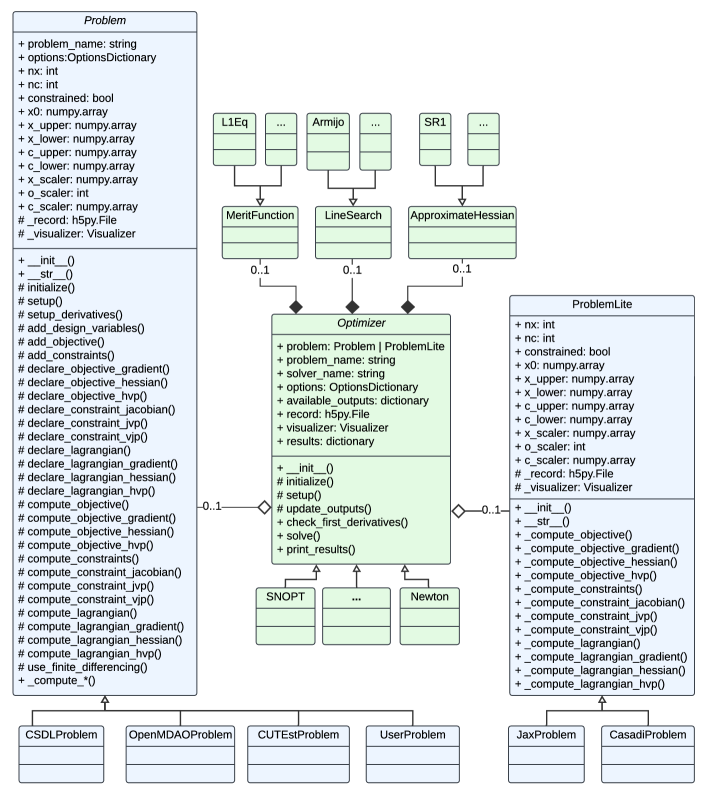
- Describe a modular object-oriented software architecture with Problem/ProblemLite classes for problem definition and an Optimizer base class for algorithms.
- Implement modules for Hessian approximations, line searches, and merit functions that can be composed by optimizers.
- Provide interfaces to external optimizers (e.g., SNOPT, IPOPT) and to modeling languages (OpenMDAO, CSDL, Jax, CasADi).
- Include a procedural interface (optimize) for non-object-oriented usage and built-in visualization/recording tools.
- Support numerical differentiation when analytic derivatives are unavailable, including JVPs, VJPs, and HVPs, and enable scaling and hot-starting.
Experimental results
Research questions
- RQ1How can optimization algorithms be constructed from modular components to enable rapid prototyping and specialization?
- RQ2What is the impact of a unified interface on switching models and optimizers for a given problem?
- RQ3How does modOpt integrate with multiple modeling languages and legacy optimizer packages?
- RQ4What educational and benchmarking benefits arise from built-in pedagogical algorithms and visualization tools?
- RQ5Can modOpt support a broad class of problems (QP, convex, NLP) with scalable derivative handling?
Key findings
- modOpt provides a unified, modular architecture that couples Problem/ProblemLite models with Optimizer implementations.
- It includes modules for line searches, Hessian approximations, and multiple merit functions, enabling flexible algorithm construction.
- The framework offers interfaces to OpenMDAO, CSDL, Jax, CasADi, and external optimizers like SNOPT and SLSQP.
- A procedural optimize interface and built-in visualization/recording support facilitate learning, testing, and benchmarking.
- Pedagogical algorithms and transparent Python implementations support education and rapid experimentation.
- HDF5-based recording and hot-starting features enhance reproducibility and iterative refinement.
Read this paper
Open the full text in the Nubint reader and ask about any passage as you read.
Read this paper on NubintThis review was generated by AI from the original paper. Please check the paper before citing it.