
[Paper Review] MoE-LLaVA: Mixture of Experts for Large Vision-Language Models
MoE-LLaVA introduces a three-stage MoE-Tuning strategy and a sparse MoE-based LVLM, enabling large parameter counts with constant compute and competitive vision-language performance using only a small fraction of activated parameters.
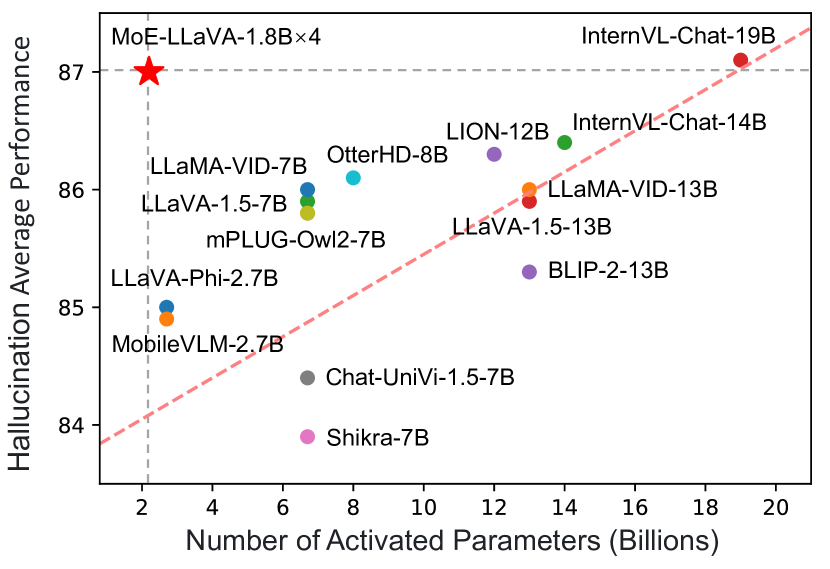
Recent advances demonstrate that scaling Large Vision-Language Models (LVLMs) effectively improves downstream task performances. However, existing scaling methods enable all model parameters to be active for each token in the calculation, which brings massive training and inferring costs. In this work, we propose a simple yet effective training strategy MoE-Tuning for LVLMs. This strategy innovatively addresses the common issue of performance degradation in multi-modal sparsity learning, consequently constructing a sparse model with an outrageous number of parameters but a constant computational cost. Furthermore, we present the MoE-LLaVA, a MoE-based sparse LVLM architecture, which uniquely activates only the top-k experts through routers during deployment, keeping the remaining experts inactive. Extensive experiments show the significant performance of MoE-LLaVA in a variety of visual understanding and object hallucination benchmarks. Remarkably, with only approximately 3B sparsely activated parameters, MoE-LLaVA demonstrates performance comparable to the LLaVA-1.5-7B on various visual understanding datasets and even surpasses the LLaVA-1.5-13B in object hallucination benchmark. Through MoE-LLaVA, we aim to establish a baseline for sparse LVLMs and provide valuable insights for future research in developing more efficient and effective multi-modal learning systems. Code is released at https://github.com/PKU-YuanGroup/MoE-LLaVA.
Motivation & Objective
- Motivate reducing computation while scaling LVLM capacity through sparse mixtures of experts.
- Propose MoE-Tuning to adapt MoE for LVLMs without performance degradation.
- Introduce MoE-LLaVA, an MoE-based sparse LVLM that activates only top-k experts during inference.
Proposed method
- Three-stage MoE-Tuning training: Stage I trains an MLP to adapt image tokens to the LLM; Stage II trains the LLM backend for multi-modal understanding; Stage III initializes MoE experts from FFN weights and trains only MoE layers.
- MoE-LLaVA architecture stacks MoE encoder layers with a vision encoder, a visual projection MLP, and a text embedding layer feeding an LLM.
- Hard/router design details: soft routers assign tokens to top-k experts; router weights W map x to expert probabilities via softmax.
- Auxiliary load-balancing loss is used to encourage balanced expert utilization across tokens.
- Auto-regressive loss trains the LLM output on image and text inputs; auxiliary load-balancing loss complements with balancing terms.
Experimental results
Research questions
- RQ1Can a sparse MoE LVLM match or surpass dense LVLMs with far fewer activated parameters?
- RQ2Does a three-stage MoE-Tuning workflow stabilize training and enable effective sparsification of LVLMs?
- RQ3How does MoE-LLaVA perform on image understanding and object hallucination benchmarks compared to dense baselines?
- RQ4What are the routing patterns and expert workloads in a multimodal MoE-LLaVA model?
Key findings
- MoE-LLaVA with about 3B activated parameters achieves comparable performance to LLaVA-1.5-7B on visual understanding benchmarks.
- MoE-LLaVA with 2.2B activated parameters can surpass LLaVA-1.5-13B in the POPE object hallucination benchmark.
- With 3.6B activated parameters, MoE-LLaVA outperforms LLaVA-1.5-7B across multiple benchmarks (ScienceQA, POPE, MMBench, LLaVA-W, MM-Vet).
- MoE-LLaVA's routing distributes tokens roughly evenly across experts in early layers and shows modality-agnostic routing preferences, with experts developing specific workload patterns in deeper layers.
- A three-stage training strategy is essential; naïve replacement of FFN with MoE without proper instruction-tuning initialization underperforms.

Read this paper
Open the full text in the Nubint reader and ask about any passage as you read.
Read this paper on NubintThis review was generated by AI from the original paper. Please check the paper before citing it.