
[Paper Review] Monocular Depth Estimation using Diffusion Models
The paper introduces DepthGen, a diffusion-model based approach for monocular depth estimation that leverages self-supervised pre-training and supervised fine-tuning, achieving state-of-the-art results on NYU and competitive results on KITTI, while enabling multimodal depth inference and depth imputation for text-to-3D tasks.
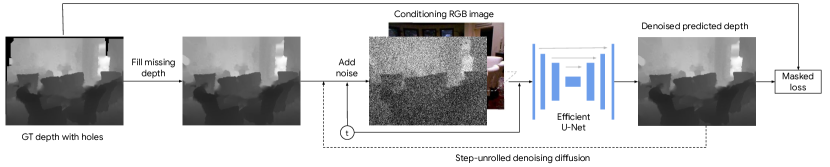
We formulate monocular depth estimation using denoising diffusion models, inspired by their recent successes in high fidelity image generation. To that end, we introduce innovations to address problems arising due to noisy, incomplete depth maps in training data, including step-unrolled denoising diffusion, an $L_1$ loss, and depth infilling during training. To cope with the limited availability of data for supervised training, we leverage pre-training on self-supervised image-to-image translation tasks. Despite the simplicity of the approach, with a generic loss and architecture, our DepthGen model achieves SOTA performance on the indoor NYU dataset, and near SOTA results on the outdoor KITTI dataset. Further, with a multimodal posterior, DepthGen naturally represents depth ambiguity (e.g., from transparent surfaces), and its zero-shot performance combined with depth imputation, enable a simple but effective text-to-3D pipeline. Project page: https://depth-gen.github.io
Motivation & Objective
- Motivate monocular depth estimation as a diffusion modeling problem and leverage recent diffusion model successes.
- Mitigate training data challenges (noisy/incomplete depths) via infilling, L1 loss, and step-unrolled denoising diffusion.
- Integrate self-supervised pre-training to cope with limited labeled data and enable zero-shot depth completion.
- Demonstrate state-of-the-art performance on indoor NYU and competitive results on outdoor KITTI.
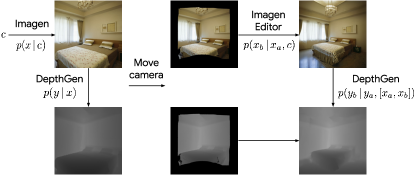
- Showcase multimodal depth inference and potential for text-to-3D and novel view synthesis.
Proposed method
- Use conditional diffusion models to learn p(y|x) where x is RGB and y is depth.
- Pre-train a self-supervised Palette-style diffusion model on image-to-image translation tasks (colorization, inpainting, uncropping, JPEG artifact removal).
- Fine-tune with supervised RGB-D data using L1 loss to improve robustness to noisy depth.
- Address missing depth via depth infilling (nearest-neighbor; sky handling for outdoor data) and step-unrolled denoising diffusion (SUD) during fine-tuning.
- During training, infill holes in depth maps and compute loss only on known pixels; during inference, optionally unroll one forward step to align training/inference distributions (SUD).
- Evaluation follows standard metrics for NYU (REL, RMS, δ1/δ2/δ3, log10) and KITTI (REL, Sq-rel, RMS, RMS log).
Experimental results
Research questions
- RQ1Can diffusion models be effectively adapted to monocular depth estimation from RGB images?
- RQ2How can training with noisy, incomplete depth data be made robust (e.g., infilling, L1 loss, SUD) to close training-inference distribution gaps?
- RQ3Does self-supervised pre-training improve depth estimation when labeled data is scarce, and how does it combine with supervised fine-tuning?
- RQ4Can the diffusion-based depth model support multimodal depth representations and zero-shot depth completion for downstream tasks like text-to-3D and novel view synthesis?
Key findings
- DepthGen achieves state-of-the-art relative error (REL) of 0.074 on NYU Depth v2.
- DepthGen is competitive on KITTI, surpassing several baselines in reported metrics.
- Ablations show that self-supervised pre-training and supervised depth pre-training both significantly improve performance (supervised pre-training contributing more).
- Depth infilling is crucial for outdoor KITTI and helps mitigate holes; SUD further improves results, especially when holes are present.
- An L1 loss outperforms L2 for robustness to noisy depth data.
- DepthGen supports multimodal depth predictions, capturing depth ambiguity (e.g., through transparent/reflective regions).
- The model enables zero-shot depth completion and can be integrated with text-to-3D pipelines via diffusion-based imputation.
Read this paper
Open the full text in the Nubint reader and ask about any passage as you read.
Read this paper on NubintThis review was generated by AI from the original paper. Please check the paper before citing it.