
[Paper Review] Monte Carlo Tree Search Boosts Reasoning via Iterative Preference Learning
This paper proposes a Monte Carlo Tree Search (MCTS)-based iterative preference learning framework that enhances Large Language Model (LLM) reasoning by generating step-level preference signals through self-evaluation and MCTS rollouts. The method uses Direct Preference Optimization (DPO) to fine-tune the policy, achieving state-of-the-art performance on arithmetic and commonsense reasoning benchmarks, including 80.7% accuracy on GSM8K (+4.8% over SFT baseline).
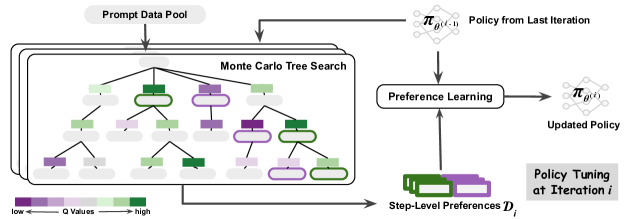
We introduce an approach aimed at enhancing the reasoning capabilities of Large Language Models (LLMs) through an iterative preference learning process inspired by the successful strategy employed by AlphaZero. Our work leverages Monte Carlo Tree Search (MCTS) to iteratively collect preference data, utilizing its look-ahead ability to break down instance-level rewards into more granular step-level signals. To enhance consistency in intermediate steps, we combine outcome validation and stepwise self-evaluation, continually updating the quality assessment of newly generated data. The proposed algorithm employs Direct Preference Optimization (DPO) to update the LLM policy using this newly generated step-level preference data. Theoretical analysis reveals the importance of using on-policy sampled data for successful self-improving. Extensive evaluations on various arithmetic and commonsense reasoning tasks demonstrate remarkable performance improvements over existing models. For instance, our approach outperforms the Mistral-7B Supervised Fine-Tuning (SFT) baseline on GSM8K, MATH, and ARC-C, with substantial increases in accuracy to $81.8\%$ (+$5.9\%$), $34.7\%$ (+$5.8\%$), and $76.4\%$ (+$15.8\%$), respectively. Additionally, our research delves into the training and inference compute tradeoff, providing insights into how our method effectively maximizes performance gains. Our code is publicly available at https://github.com/YuxiXie/MCTS-DPO.
Motivation & Objective
- Address the limitations of static, instance-level preference data in RLHF by enabling dynamic, online preference signal generation.
- Improve LLM reasoning capabilities through granular, step-level feedback derived from MCTS rollouts and self-evaluation.
- Overcome the reliance on human-annotated preference data by using the LLM itself as both policy and critic via self-evaluation.
- Demonstrate that on-policy sampled data is essential for successful self-improving training in iterative LLM refinement.
- Optimize the trade-off between training and inference compute by analyzing the efficiency of the proposed MCTS-based iterative loop.
Proposed method
- Use Monte Carlo Tree Search (MCTS) to generate rollouts and estimate action values (Q-values) for each step in a reasoning trajectory.
- Assign step-level preference labels using MCTS Q-values: higher Q-steps are labeled as positive, lower Q-steps as negative.
- Integrate outcome validation and stepwise self-evaluation to improve consistency and reliability of generated preference signals.
- Use the resulting step-level preference data to fine-tune the LLM policy via Direct Preference Optimization (DPO).
- Maintain an online, iterative loop where the policy is updated using newly generated preference data from MCTS, enabling continuous self-improvement.
- Theoretical analysis confirms that on-policy sampling is critical for stable and effective self-improvement in the iterative learning process.
Experimental results
Research questions
- RQ1Can MCTS be effectively leveraged to generate high-quality, granular step-level preference signals for LLM reasoning improvement?
- RQ2Does iterative preference learning using MCTS and self-evaluation lead to measurable gains in reasoning accuracy compared to standard SFT or offline RLHF?
- RQ3What is the impact of using on-policy versus off-policy sampled data in the iterative self-improvement loop of LLMs?
- RQ4How does the proposed method balance performance gains with training and inference compute costs?
- RQ5Can self-evaluation and outcome validation jointly improve the consistency and reliability of automatically generated preference data?
Key findings
- The proposed method achieves 80.7% accuracy on the GSM8K benchmark, a 4.8 percentage point improvement over the Mistral-7B SFT baseline.
- On the MATH dataset, the model reaches 32.2% accuracy, a 3.3 percentage point gain over the SFT baseline, demonstrating improved mathematical reasoning.
- For the SciQ commonsense reasoning benchmark, the method achieves 88.5% accuracy, a 7.7 percentage point improvement over the SFT baseline.
- The online iterative framework outperforms its offline variant in validation accuracy, particularly on ARC-C, confirming the benefit of dynamic, on-policy preference data.
- Theoretical analysis confirms that on-policy sampled data is essential for stable and effective self-improvement in the iterative learning loop.
- The method effectively balances performance gains with compute efficiency, offering a scalable path to self-improving LLMs without human preference annotations.

Read this paper
Open the full text in the Nubint reader and ask about any passage as you read.
Read this paper on NubintThis review was generated by AI from the original paper. Please check the paper before citing it.