
[Paper Review] More Control for Free! Image Synthesis with Semantic Diffusion Guidance
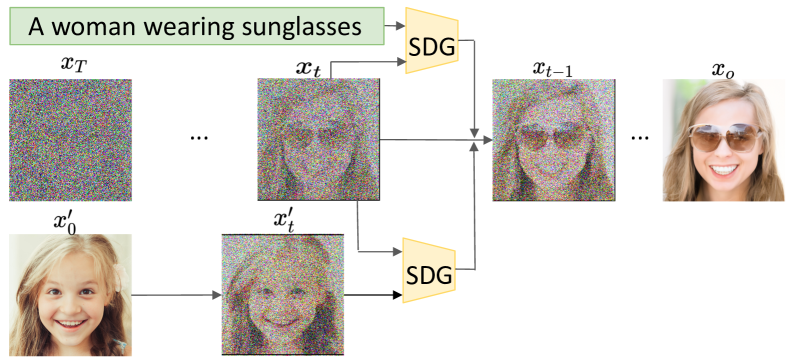
The paper introduces Semantic Diffusion Guidance (SDG), a unified, non-retraining framework that injects language and image guidance into unconditional diffusion models for controllable image synthesis, with a self-supervised CLIP finetuning step.
Controllable image synthesis models allow creation of diverse images based on text instructions or guidance from a reference image. Recently, denoising diffusion probabilistic models have been shown to generate more realistic imagery than prior methods, and have been successfully demonstrated in unconditional and class-conditional settings. We investigate fine-grained, continuous control of this model class, and introduce a novel unified framework for semantic diffusion guidance, which allows either language or image guidance, or both. Guidance is injected into a pretrained unconditional diffusion model using the gradient of image-text or image matching scores, without re-training the diffusion model. We explore CLIP-based language guidance as well as both content and style-based image guidance in a unified framework. Our text-guided synthesis approach can be applied to datasets without associated text annotations. We conduct experiments on FFHQ and LSUN datasets, and show results on fine-grained text-guided image synthesis, synthesis of images related to a style or content reference image, and examples with both textual and image guidance.
Motivation & Objective
- Enable fine-grained, continuous control of image synthesis using text, image, or both guidance within a pretrained unconditional diffusion model.
- Support text-guided synthesis on datasets without language annotations.
- Enable image-guided synthesis using content or style guidance from a reference image.
- Provide a unified framework for multimodal guidance combining language and image signals.
Proposed method
- Inject guidance into an off-the-shelf unconditional diffusion model through a gradient-based guidance function.
- Use CLIP-based language guidance via a time-dependent image encoder to handle noisy diffusion timesteps.
- Define two image guidance modes: content guidance (semantic similarity of embeddings) and style guidance (Gram-matrix alignment of feature maps).
- Allow multimodal guidance by linearly combining language and image guidance signals with adjustable weights.
- Fine-tune a CLIP image encoder on noised images using a self-supervised contrastive objective to avoid text annotations.
Experimental results
Research questions
- RQ1Can SDG provide fine-grained and diverse text-to-image synthesis without requiring image-text paired data?
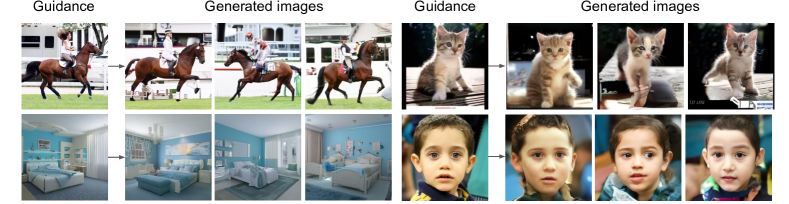
- RQ2Can SDG deliver meaningful image guidance that preserves content or style while allowing structural variation?
- RQ3How does multimodal (text + image) guidance compare to single-modality guidance in terms of quality, diversity, and alignment with guidance?
Key findings
- SDG achieves higher image quality and diversity than prior image-guided methods (FID and LPIPS) while enabling semantic alignment with guidance.
- In image-guided synthesis, SDG outperforms ILVR in both quality (lower FID) and diversity (higher LPIPS) across LSUN and FFHQ subsets.
- In text-guided synthesis, SDG attains competitive results against StyleGAN+CLIP in alignment with prompts while maintaining better diversity.
- Multimodal guidance enables images that satisfy both language instructions and reference-image cues, offering flexible control over content and style.
Read this paper
Open the full text in the Nubint reader and ask about any passage as you read.
Read this paper on NubintThis review was generated by AI from the original paper. Please check the paper before citing it.