
[Paper Review] Motif-aware Attribute Masking for Molecular Graph Pre-training
This paper proposes MoAMa, a motif-aware attribute masking strategy for molecular graph pre-training that masks all node features within chemically meaningful motifs to enhance inter-motif knowledge transfer. By forcing the model to reconstruct features using cross-motif information, MoAMa improves predictive performance by 1.3% on average over state-of-the-art baselines across eight molecular property prediction datasets.
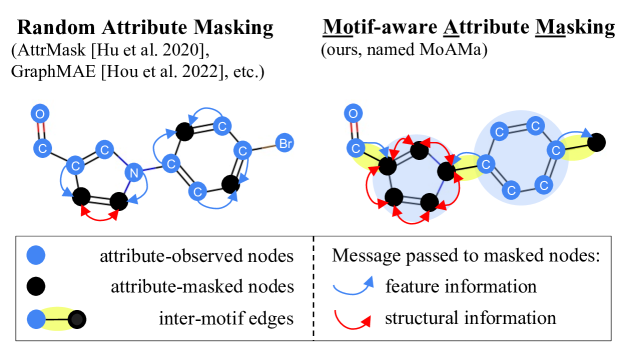
Attribute reconstruction is used to predict node or edge features in the pre-training of graph neural networks. Given a large number of molecules, they learn to capture structural knowledge, which is transferable for various downstream property prediction tasks and vital in chemistry, biomedicine, and material science. Previous strategies that randomly select nodes to do attribute masking leverage the information of local neighbors However, the over-reliance of these neighbors inhibits the model's ability to learn from higher-level substructures. For example, the model would learn little from predicting three carbon atoms in a benzene ring based on the other three but could learn more from the inter-connections between the functional groups, or called chemical motifs. In this work, we propose and investigate motif-aware attribute masking strategies to capture inter-motif structures by leveraging the information of atoms in neighboring motifs. Once each graph is decomposed into disjoint motifs, the features for every node within a sample motif are masked. The graph decoder then predicts the masked features of each node within the motif for reconstruction. We evaluate our approach on eight molecular property prediction datasets and demonstrate its advantages.
Motivation & Objective
- To address the limitation of random attribute masking in pre-training graph neural networks, which over-relies on local neighbor features and fails to capture inter-motif structural knowledge.
- To improve molecular property prediction by explicitly transferring knowledge across chemical motifs during pre-training.
- To reduce reliance on intra-motif feature propagation and alleviate the message passing bottleneck in GNNs.
- To design a pre-training strategy that leverages both intra-motif structural patterns and inter-motif dependencies.
- To evaluate the effectiveness of motif-aware masking on diverse molecular property prediction benchmarks.
Proposed method
- The method decomposes each molecular graph into disjoint chemical motifs using a predefined motif vocabulary.
- All node features within each motif are masked using a learnable mask token, forcing the model to reconstruct them using cross-motif information.
- A graph decoder predicts the masked node features based on the context from neighboring motifs and internal motif structure.
- The model is pre-trained using a masked autoencoder objective that reconstructs masked attributes across motifs.
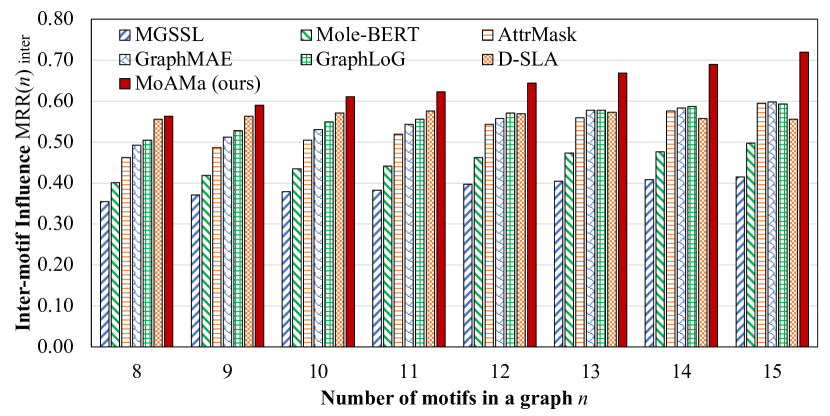
- Inter-motif knowledge transfer is quantified using MRR-based metrics, with lower scores indicating stronger inter-motif influence.
- The approach is evaluated on eight molecular property prediction datasets using AUC as the primary metric.
Experimental results
Research questions
- RQ1Can motif-aware attribute masking improve inter-motif knowledge transfer in molecular graph pre-training compared to random masking?
- RQ2Does explicit masking of all features within a motif reduce reliance on local neighbor features and alleviate the message passing bottleneck?
- RQ3To what extent does MoAMa’s pre-training strategy enhance downstream molecular property prediction performance?
- RQ4How does inter-motif knowledge transfer correlate with predictive performance across different models?
- RQ5Can the proposed method achieve competitive results with state-of-the-art pre-training methods without relying on Tanimoto similarity or domain-specific heuristics?
Key findings
- MoAMa achieved an average test AUC of 75.3 across eight molecular property prediction datasets, outperforming the best baseline by 1.3%.
- The model demonstrated the highest inter-motif influence ratio (0.80 for node-level, 0.51 for graph-level), indicating stronger transfer of knowledge across motifs.
- MoAMa recorded the lowest MRR scores (0.59 for node, 0.55 for graph, 0.41 for motif-level), confirming reduced dependence on intra-motif features and enhanced inter-motif knowledge transfer.
- A moderate positive correlation (r = 0.52–0.55) was observed between predictive AUC and inter-motif influence ratio, supporting the link between inter-motif learning and performance.
- A moderate negative correlation (r = -0.39 to -0.44) between AUC and MRR scores further confirms that reduced intra-motif reliance improves downstream accuracy.
- The method effectively mitigates training collapse and improves model expressivity by explicitly encoding both intra-motif structure and inter-motif dependencies.
Read this paper
Open the full text in the Nubint reader and ask about any passage as you read.
Read this paper on NubintThis review was generated by AI from the original paper. Please check the paper before citing it.