
[Paper Review] Motif: Intrinsic Motivation from Artificial Intelligence Feedback
Motif proposes a method to derive intrinsic reward signals from Large Language Models (LLMs) by eliciting preferences over event captions, enabling agents to learn in rich, sparse-reward environments like NetHack without demonstrations. Surprisingly, agents trained solely on Motif's intrinsic reward outperform those trained directly on the environment's sparse reward, and combining both rewards yields state-of-the-art performance on previously intractable tasks.
Exploring rich environments and evaluating one's actions without prior knowledge is immensely challenging. In this paper, we propose Motif, a general method to interface such prior knowledge from a Large Language Model (LLM) with an agent. Motif is based on the idea of grounding LLMs for decision-making without requiring them to interact with the environment: it elicits preferences from an LLM over pairs of captions to construct an intrinsic reward, which is then used to train agents with reinforcement learning. We evaluate Motif's performance and behavior on the challenging, open-ended and procedurally-generated NetHack game. Surprisingly, by only learning to maximize its intrinsic reward, Motif achieves a higher game score than an algorithm directly trained to maximize the score itself. When combining Motif's intrinsic reward with the environment reward, our method significantly outperforms existing approaches and makes progress on tasks where no advancements have ever been made without demonstrations. Finally, we show that Motif mostly generates intuitive human-aligned behaviors which can be steered easily through prompt modifications, while scaling well with the LLM size and the amount of information given in the prompt.
Motivation & Objective
- To enable agents to explore and learn in complex, open-ended environments without prior task-specific reward shaping.
- To bridge the gap between high-level common sense from LLMs and low-level sensorimotor decision-making in agents.
- To develop a scalable, general-purpose method for intrinsic motivation using LLMs that avoids direct policy supervision.
- To evaluate whether LLM-derived intrinsic rewards can lead to human-aligned, generalizable behaviors in challenging environments.
- To investigate the robustness and scalability of the method under varying LLM size, prompt information, and dataset diversity.
Proposed method
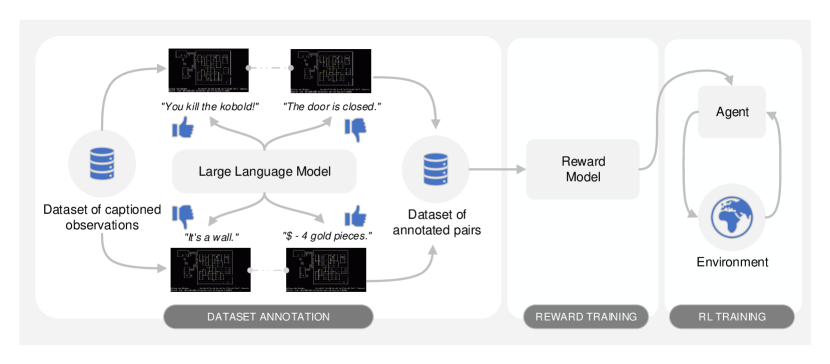
- Collect a diverse dataset of observations from agents with varying performance levels in the NetHack environment.
- Generate coarse event captions from observations to describe key environmental events.
- Use a pretrained LLM (e.g., Llama 2) to express pairwise preferences between captions, indicating which event is more desirable.
- Distill the LLM’s preference signals into a dense, differentiable intrinsic reward function for reinforcement learning.
- Train agents using PPO or similar RL algorithms to maximize the intrinsic reward, or combine it with the environment’s sparse reward.
- Enable prompt-based steering of behavior by modifying the LLM’s instruction prompt, allowing control over intrinsic reward semantics.
Experimental results
Research questions
- RQ1Can LLMs provide effective intrinsic rewards for RL agents in sparse-reward, open-ended environments like NetHack?
- RQ2Does an agent trained solely on LLM-derived intrinsic rewards outperform one trained on the environment’s sparse extrinsic reward?
- RQ3How does the performance of the intrinsic reward scale with LLM size and prompt information content?
- RQ4How robust is the method to variations in dataset diversity and performance levels of the collected trajectories?
- RQ5What behavioral properties emerge from the intrinsic reward, and can they be steered via prompt engineering?
Key findings
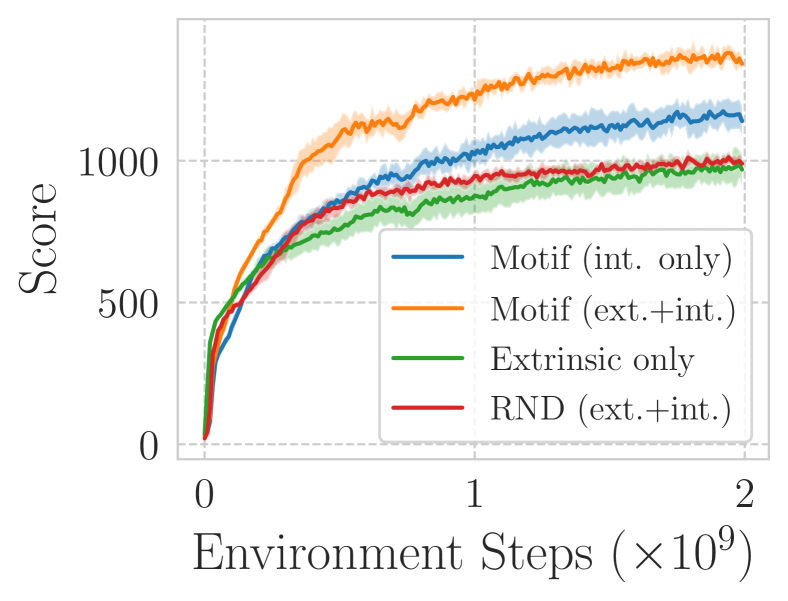
- Agents trained exclusively on Motif’s intrinsic reward achieved a higher average NetHack score than agents trained directly on the environment’s sparse reward signal.
- When combined with the environment reward, Motif significantly outperformed existing methods and made progress on the oracle task, which had not been solved without demonstrations.
- Motif-generated behaviors were qualitatively aligned with human gameplay, showing anticipatory and common-sense reasoning patterns.
- The method scaled favorably with both LLM size and the amount of information in the prompt, with performance remaining robust even when the LLM was larger or the prompt more detailed.
- The intrinsic reward remained effective even when the training dataset was restricted to lower-return or less diverse trajectories, with performance degrading only under extreme data pruning (e.g., ≤100k pairs).
- A novel phenomenon—misalignment by composition—was observed, where joint optimization of intrinsic and extrinsic rewards led to misaligned behavior with respect to the task reward.
Read this paper
Open the full text in the Nubint reader and ask about any passage as you read.
Read this paper on NubintThis review was generated by AI from the original paper. Please check the paper before citing it.