
[Paper Review] mPLUG-2: A Modularized Multi-modal Foundation Model Across Text, Image and Video
mPLUG-2 introduces a modularized transformer framework for unified pretraining across text, image, and video, disentangling modality-specific components from shared universal modules to enable flexible task-specific module assembly and strong cross-modal performance.
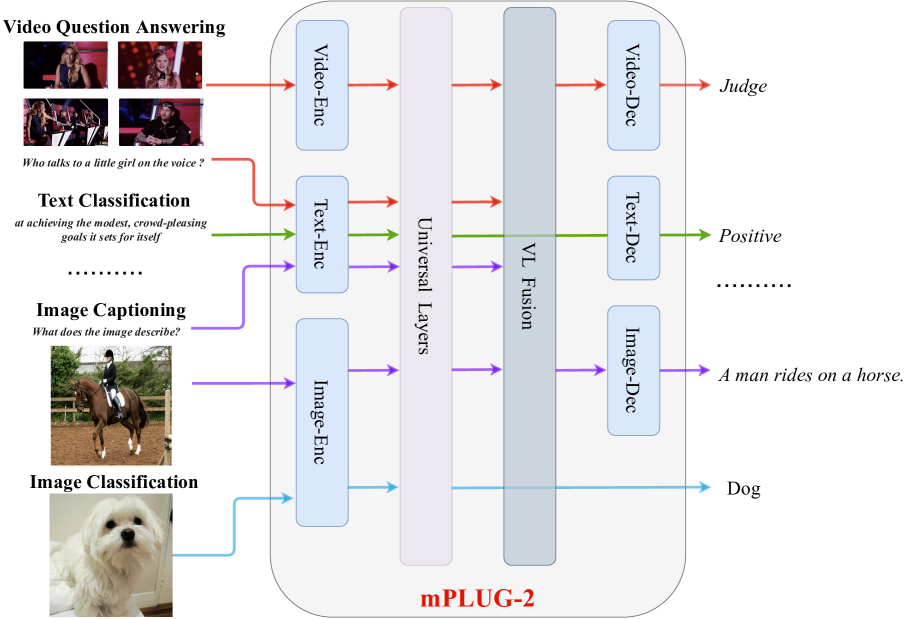
Recent years have witnessed a big convergence of language, vision, and multi-modal pretraining. In this work, we present mPLUG-2, a new unified paradigm with modularized design for multi-modal pretraining, which can benefit from modality collaboration while addressing the problem of modality entanglement. In contrast to predominant paradigms of solely relying on sequence-to-sequence generation or encoder-based instance discrimination, mPLUG-2 introduces a multi-module composition network by sharing common universal modules for modality collaboration and disentangling different modality modules to deal with modality entanglement. It is flexible to select different modules for different understanding and generation tasks across all modalities including text, image, and video. Empirical study shows that mPLUG-2 achieves state-of-the-art or competitive results on a broad range of over 30 downstream tasks, spanning multi-modal tasks of image-text and video-text understanding and generation, and uni-modal tasks of text-only, image-only, and video-only understanding. Notably, mPLUG-2 shows new state-of-the-art results of 48.0 top-1 accuracy and 80.3 CIDEr on the challenging MSRVTT video QA and video caption tasks with a far smaller model size and data scale. It also demonstrates strong zero-shot transferability on vision-language and video-language tasks. Code and models will be released in https://github.com/alibaba/AliceMind.
Motivation & Objective
- Motivate a unified yet modular approach to multi-modal pretraining to balance modality collaboration and entanglement.
- Develop a network of shared universal modules plus modality-specific components to support diverse uni- and cross-modal tasks.
- Enable flexible task-specific module selection for text, image, and video understanding and generation.
- Demonstrate strong performance across 30+ downstream tasks including image-text and video-text understanding and generation.
- Show strong zero-shot transferability and efficiency with limited pretraining data.
Proposed method
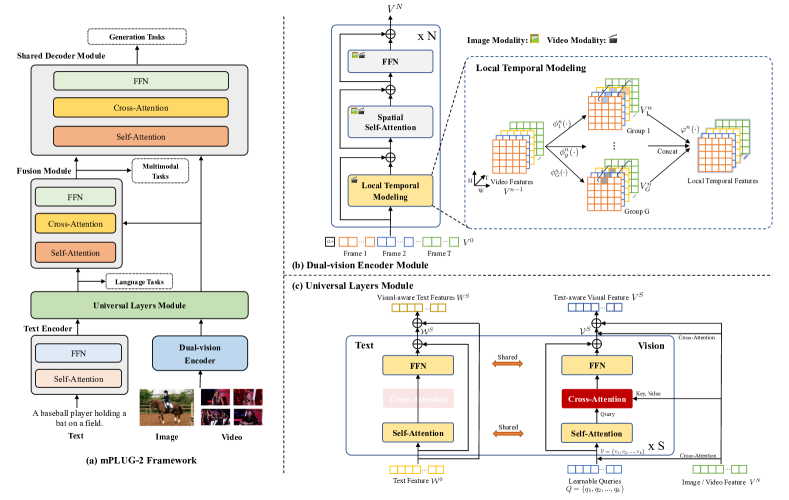
- Propose a dual-vision encoder for image and video with spatial and local temporal modeling.
- Introduce universal layers that map vision and language into a shared semantic space via self-attention and cross-attention operations.
- Add a cross-modal fusion module to integrate cross-modal representations for generation tasks.
- Employ a shared Transformer-based decoder for both uni-modal and cross-modal generation tasks.
- Pre-train with language MLM, cross-modal matching losses, and instruction-based language modeling objectives inspired by Flamingo and OFA.
Experimental results
Research questions
- RQ1Can modularization mitigate modality entanglement while enabling modality collaboration across text, image, and video tasks?
- RQ2How do shared universal modules and modality-specific components impact performance on uni-modal and cross-modal benchmarks?
- RQ3What are the gains in efficiency and transferability when using a modularized multi-modal foundation model compared to single-network approaches?
- RQ4To what extent can the model achieve state-of-the-art or competitive results across 30+ tasks including retrieval, QA, captioning, and generation in both vision-language and video-language settings?
Key findings
- Achieves state-of-the-art or competitive results across 30+ downstream tasks spanning image-text and video-text understanding and generation.
- Shows new state-of-the-art results on MSRVTT video QA and video caption tasks with a smaller model and data footprint (top-1 48.0, CIDEr 80.3).
- Demonstrates strong zero-shot transferability on vision-language and video-language tasks.
- mPLUG-2 Base and full versions outperform several prior methods on video-to-text retrieval and video QA benchmarks with significantly less pretraining data.
- The modular design enables flexible task-specific module assembly, improving both uni-modal and cross-modal performance without excessive model size.
Read this paper
Open the full text in the Nubint reader and ask about any passage as you read.
Read this paper on NubintThis review was generated by AI from the original paper. Please check the paper before citing it.