
[Paper Review] mPLUG-Owl2: Revolutionizing Multi-modal Large Language Model with Modality Collaboration
mPLUG-Owl2 introduces a modality-adaptive language decoder and a visual abstractor to enable modality collaboration while preserving modality-specific features, achieving state-of-the-art results on both text and multi-modal tasks with a single generic model.
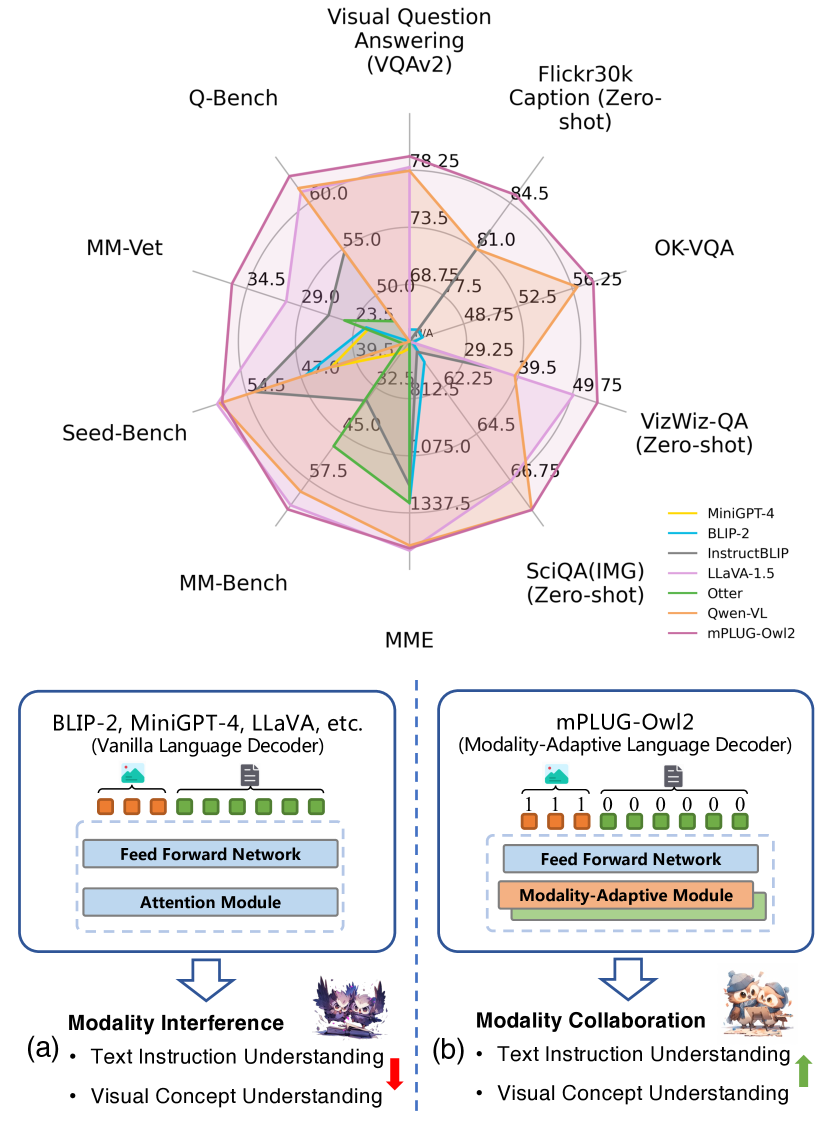
Multi-modal Large Language Models (MLLMs) have demonstrated impressive instruction abilities across various open-ended tasks. However, previous methods primarily focus on enhancing multi-modal capabilities. In this work, we introduce a versatile multi-modal large language model, mPLUG-Owl2, which effectively leverages modality collaboration to improve performance in both text and multi-modal tasks. mPLUG-Owl2 utilizes a modularized network design, with the language decoder acting as a universal interface for managing different modalities. Specifically, mPLUG-Owl2 incorporates shared functional modules to facilitate modality collaboration and introduces a modality-adaptive module that preserves modality-specific features. Extensive experiments reveal that mPLUG-Owl2 is capable of generalizing both text tasks and multi-modal tasks and achieving state-of-the-art performances with a single generic model. Notably, mPLUG-Owl2 is the first MLLM model that demonstrates the modality collaboration phenomenon in both pure-text and multi-modal scenarios, setting a pioneering path in the development of future multi-modal foundation models.
Motivation & Objective
- Motivate a general-purpose multi-modal foundation model that improves both text and multi-modal tasks through modality collaboration.
- Develop a modular architecture that separates modalities yet enables cross-modal interaction via shared interfaces.
- Propose a modality-adaptive module to preserve modality-specific features while enabling collaboration.
- Introduce a two-stage training paradigm incorporating vision-language pre-training and joint vision-language instruction tuning.
- Demonstrate strong generalization across standard vision-language benchmarks and pure-text tasks.
Proposed method
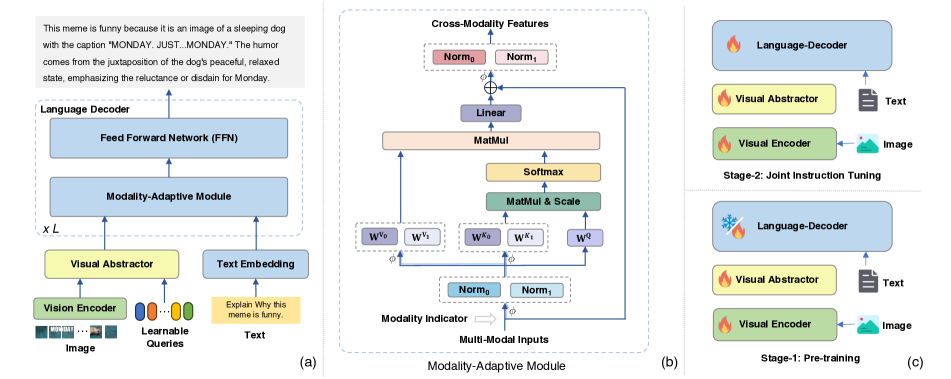
- Use a modular architecture with a vision encoder, visual abstractor, text embedding layer, and a language decoder as a universal interface.
- Introduce a visual abstractor with learnable queries to compress visual tokens and reduce computation.
- Propose a Modality-Adaptive Module (MAM) that separates modality-specific projections for keys and values while sharing queries, enabling cross-modal collaboration without-granularity interference.
- Project visual and language features into a shared semantic space while preserving modality characteristics through separate value projections and distinct layer normalizations.
- Adopt a two-stage training paradigm: (i) vision-language pre-training with a trainable vision encoder, (ii) joint vision-language instruction tuning.
- Use a fixed, learnable set of queries in the visual abstractor to extract high-level semantic features and reduce sequence length before decoding.
Experimental results
Research questions
- RQ1Can modality collaboration improve performance on both text-only and multi-modal tasks within a single generic model?
- RQ2How can we design a decoder and attention mechanism that mitigate modality interference while preserving modality-specific information?
- RQ3What training regimen best supports joint optimization of vision-language capabilities and pure-text competencies?
- RQ4Does increasing visual resolution and the number of learnable queries in the visual abstractor enhance performance on OCR-heavy and fine-grained tasks?
- RQ5How does the proposed modality-adaptive module affect zero-shot and instruction-tuned performance across benchmarks?
Key findings
- mPLUG-Owl2 achieves state-of-the-art performance on eight vision-language benchmarks with a single generic model.
- The model shows strong zero-shot performance on multi-modal benchmarks such as MMBench, MM-Vet, and Q-Bench, and competitive results on MME.
- Pure-text benchmarks also improve, with notable gains in MMLU and BBH compared to other instruction-tuned LLMs.
- The Modality-Adaptive Module (MAM) enables modality collaboration while reducing modality interference, demonstrated by attention visualization and ablation studies.
- Joint vision-language instruction tuning with a trainable vision encoder yields strong multi-modal and text performance, and MAM further stabilizes gains when both modalities are trained together.
- Increasing image resolution and the number of learnable queries in the visual abstractor significantly boosts performance on OCR-heavy and fine-grained vision-language tasks.
Read this paper
Open the full text in the Nubint reader and ask about any passage as you read.
Read this paper on NubintThis review was generated by AI from the original paper. Please check the paper before citing it.