
[Paper Review] MSTL: A Seasonal-Trend Decomposition Algorithm for Time Series with Multiple Seasonal Patterns
MSTL is a fast, automated time series decomposition algorithm that extends STL to handle multiple seasonal patterns by iteratively applying Loess smoothing to extract trend, multiple seasonal components, and remainder. It outperforms STR, TBATS, and Prophet in accuracy and computational efficiency on real-world electricity demand data, with lower RMSE and execution time.
The decomposition of time series into components is an important task that helps to understand time series and can enable better forecasting. Nowadays, with high sampling rates leading to high-frequency data (such as daily, hourly, or minutely data), many real-world datasets contain time series data that can exhibit multiple seasonal patterns. Although several methods have been proposed to decompose time series better under these circumstances, they are often computationally inefficient or inaccurate. In this study, we propose Multiple Seasonal-Trend decomposition using Loess (MSTL), an extension to the traditional Seasonal-Trend decomposition using Loess (STL) procedure, allowing the decomposition of time series with multiple seasonal patterns. In our evaluation on synthetic and a perturbed real-world time series dataset, compared to other decomposition benchmarks, MSTL demonstrates competitive results with lower computational cost. The implementation of MSTL is available in the R package forecast.
Motivation & Objective
- To address the challenge of decomposing high-frequency time series with multiple seasonal patterns, such as daily, weekly, and yearly cycles.
- To develop a computationally efficient alternative to existing methods like TBATS and Prophet, which are based on forecasting models and may sacrifice decomposition accuracy.
- To extend the STL algorithm to handle multiple seasonalities by iteratively estimating seasonal components in ascending order of period length.
- To minimize seasonal confounding, where higher-frequency seasonal patterns absorb lower-frequency components, by processing cycles in order of increasing period.
- To provide a fully automated, additive decomposition framework that uses both past and future data, unlike prediction-based methods.
Proposed method
- MSTL extends STL by applying the Loess-based decomposition iteratively to extract multiple seasonal components in order of increasing period length.
- The algorithm first identifies all distinct seasonal cycles in the time series, then sorts them by period length in ascending order to reduce seasonal confounding.
- For each seasonal cycle, MSTL applies STL decomposition to extract the seasonal component, using a robust smoothing parameter to control the smoothness of seasonal changes.
- The trend component is estimated by applying STL to the residual after removing the seasonal components, using a larger smoothing span.
- The remainder component is obtained as the residual after subtracting the trend and all seasonal components from the original series.
- To assess robustness, MSTL uses the Moving Block Bootstrap (MBB) to generate 100 perturbed versions of the original time series, preserving temporal dependence in the remainder.
Experimental results
Research questions
- RQ1Can a modified STL algorithm effectively decompose time series with multiple seasonal patterns while maintaining computational efficiency?
- RQ2How does MSTL compare to STR, TBATS, and Prophet in terms of decomposition accuracy for real-world high-frequency time series?
- RQ3Does the iterative, period-sorted approach in MSTL reduce seasonal confounding compared to single-pass decomposition methods?
- RQ4What is the computational cost of MSTL relative to other state-of-the-art decomposition techniques on long time series?
- RQ5Can MSTL provide reliable decomposition on perturbed real-world data while preserving the true component structure?
Key findings
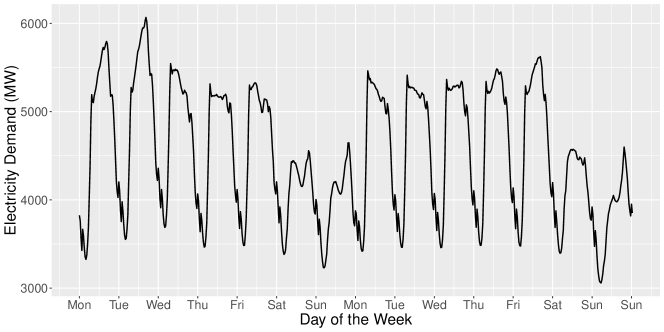
- MSTL achieved the lowest overall RMSE across all components (trend, daily, weekly, remainder) on the perturbed electricity demand dataset, with 207.6, 149.2, 180.5, and 312.7 respectively.
- MSTL significantly outperformed STR, TBATS, and Prophet in estimating all components, with p-values indicating statistical significance in the RMSE differences.
- MSTL had the lowest total execution time (7 seconds) on the 149-day hourly dataset, outperforming STL (7s), STR (612s), Prophet (936s), and TBATS (2521s).
- The use of MBB for perturbation testing confirmed that MSTL maintains stable and accurate decomposition performance across multiple bootstrapped time series versions.
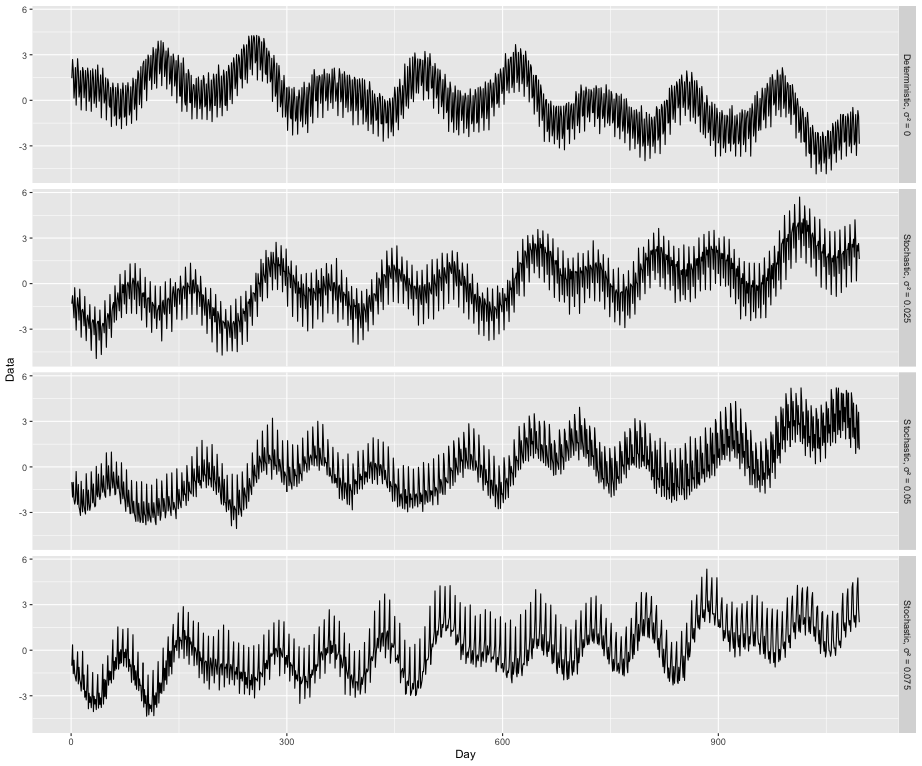
- MSTL's iterative, period-sorted approach successfully minimized seasonal confounding, allowing clearer separation of deterministic and stochastic seasonal patterns.
- The implementation of MSTL in the R forecast package (via the mstl function) enables easy access and integration into existing time series workflows.
Read this paper
Open the full text in the Nubint reader and ask about any passage as you read.
Read this paper on NubintThis review was generated by AI from the original paper. Please check the paper before citing it.