
[Paper Review] Multi-agent Reinforcement Learning: A Comprehensive Survey
A comprehensive survey of multi-agent reinforcement learning (MARL), covering MAS foundations, game-theoretic concepts, deep learning integration, learning dynamics, and open challenges.
Multi-agent systems (MAS) are widely prevalent and crucially important in numerous real-world applications, where multiple agents must make decisions to achieve their objectives in a shared environment. Despite their ubiquity, the development of intelligent decision-making agents in MAS poses several open challenges to their effective implementation. This survey examines these challenges, placing an emphasis on studying seminal concepts from game theory (GT) and machine learning (ML) and connecting them to recent advancements in multi-agent reinforcement learning (MARL), i.e. the research of data-driven decision-making within MAS. Therefore, the objective of this survey is to provide a comprehensive perspective along the various dimensions of MARL, shedding light on the unique opportunities that are presented in MARL applications while highlighting the inherent challenges that accompany this potential. Therefore, we hope that our work will not only contribute to the field by analyzing the current landscape of MARL but also motivate future directions with insights for deeper integration of concepts from related domains of GT and ML. With this in mind, this work delves into a detailed exploration of recent and past efforts of MARL and its related fields and describes prior solutions that were proposed and their limitations, as well as their applications.
Motivation & Objective
- Define multi-agent systems (MAS) and MARL and motivate learning control in shared environments.
- Present a unified view by integrating game theory and machine learning perspectives to MARL.
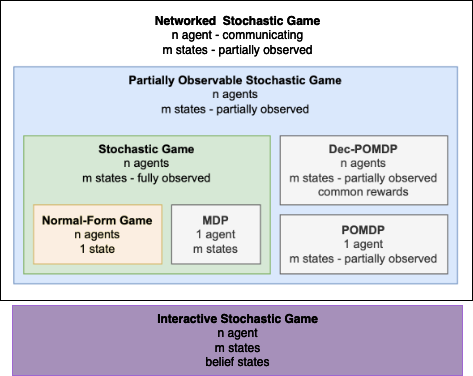
- Survey foundational models (e.g., stochastic games, POSG) and learning objectives for agents in MAS.
- Discuss deep learning and RL foundations as they apply to MARL, including value-based, policy-based, and model-based approaches.
- Highlight challenges, paradigms, and directions for future MARL research.
Proposed method
- Formulate MARL within stochastic games and POSG to capture imperfect information and joint policies.
- Survey game-theoretic solution concepts (Nash equilibrium, CE, CCE, Pareto efficiency) and their implications for MARL.
- Explain learning dynamics (best-response, no-regret) and their relevance to convergence in MARL.
- Review deep learning integration for MARL, including value-function approximation, policy gradients, actor-critic, and model-based methods.
- Discuss reinforcement learning foundations (Q-learning, policy gradient, actor-critic, model-based planning) and their adaptations to MAS.
- Outline MARL-specific aspects such as simulation, communication, ad-hoc team-play, knowledge transfer, and agent modeling.

Experimental results
Research questions
- RQ1What are the fundamental problem formulations for learning control in multi-agent environments?
- RQ2How do game theory and deep learning contribute to understanding and solving MARL problems?
- RQ3What are the principal learning paradigms and algorithms applicable to MARL (value-based, policy-based, actor-critic, model-based)?
- RQ4What challenges arise in MARL (non-stationarity, partial observability, communication, team formation, knowledge transfer) and how are they addressed?
- RQ5What are the open questions and future directions for MARL research?
Key findings
- MARL is framed within stochastic games and POSG to model multi-agent interactions under uncertainty and partial observability.
- Equilibrium concepts (NE, CE/CCE, Pareto efficiency) and their learning dynamics provide a theoretical lens for MARL stability and convergence.
- Deep learning enables scalable end-to-end MARL solutions but requires large data and computational resources.
- RL foundations (value-based, policy-based, actor-critic, model-based) adapt to MARL with specialized techniques (experience replay, target networks, exploration, offline learning).
- Model-based MARL introduces planning with learned transition dynamics and uncertainty estimation to complement model-free methods.
- The survey identifies MARL-specific challenges (communication, ad-hoc teamwork, knowledge transfer, agent modeling) and sketches open research directions.
Read this paper
Open the full text in the Nubint reader and ask about any passage as you read.
Read this paper on NubintThis review was generated by AI from the original paper. Please check the paper before citing it.