
[Paper Review] Multi-Concept Customization of Text-to-Image Diffusion
Custom Diffusion fine-tunes a small subset of cross-attention weights to learn new concepts from few examples, enabling compositional generation and efficient multi-concept merging with existing diffusion models.
While generative models produce high-quality images of concepts learned from a large-scale database, a user often wishes to synthesize instantiations of their own concepts (for example, their family, pets, or items). Can we teach a model to quickly acquire a new concept, given a few examples? Furthermore, can we compose multiple new concepts together? We propose Custom Diffusion, an efficient method for augmenting existing text-to-image models. We find that only optimizing a few parameters in the text-to-image conditioning mechanism is sufficiently powerful to represent new concepts while enabling fast tuning (~6 minutes). Additionally, we can jointly train for multiple concepts or combine multiple fine-tuned models into one via closed-form constrained optimization. Our fine-tuned model generates variations of multiple new concepts and seamlessly composes them with existing concepts in novel settings. Our method outperforms or performs on par with several baselines and concurrent works in both qualitative and quantitative evaluations while being memory and computationally efficient.
Motivation & Objective
- Motivate personalization of large-scale text-to-image models for user-specific concepts (e.g., pets, objects) unseen during pretraining.
- Develop a concise fine-tuning method that preserves existing concept knowledge while learning new ones.
- Enable composition of multiple new concepts in a single image generation without catastrophic forgetting.
- Minimize training time and memory footprint to practical levels.
Proposed method
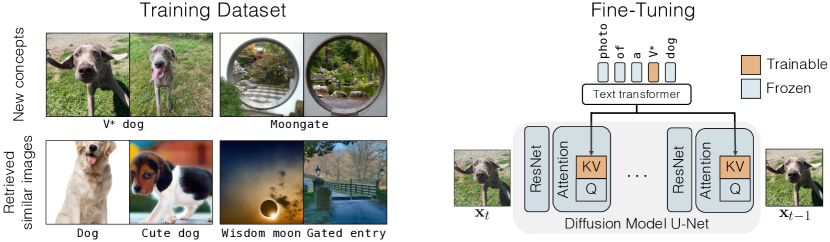
- Identify a minimal, impactful parameter subset in cross-attention layers (key and value projections) to update during fine-tuning.
- Use a new modifier token V* to denote personalized concepts and optimize its embedding alongside cross-attention matrices.
- Incorporate a regularization dataset of real images with similar captions to prevent language drift and overfitting.
- Apply augmentation during fine-tuning (image resizing and related prompts) to improve convergence.
- For multiple concepts, train jointly or merge concepts via a closed-form constrained optimization (least-squares) to enable composition.
- Ground the composition with a constrained optimization objective that aligns target concept mappings with precomputed regularization mappings.
Experimental results
Research questions
- RQ1Can a small subset of cross-attention weights suffice to learn new concepts with few examples?
- RQ2Does updating only cross-attention keys and values preserve existing knowledge while enabling new concept learning?
- RQ3Can multiple new concepts be learned jointly and composed coherently in novel prompts?
- RQ4How effective is closed-form constrained optimization for merging multiple fine-tuned concepts?
Key findings
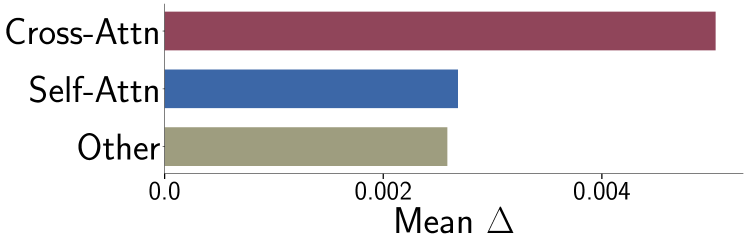
- Cross-attention weight updates are disproportionately impactful, enabling concept learning with only ~3% of model parameters updated.
- Fine-tuning with a regularization set reduces overfitting and language drift, improving image- and text-alignment.
- The method achieves faster fine-tuning (~6 minutes on 2 A100 GPUs) with smaller storage (~75 MB per concept) compared to baselines.
- Multi-concept training and closed-form composition yield coherent generations in shared scenes, outperforming or matching baselines in most cases.
- Compared to DreamBooth and Textual Inversion, Custom Diffusion delivers higher text- and image-alignment and lower KID in single-concept scenarios.
Read this paper
Open the full text in the Nubint reader and ask about any passage as you read.
Read this paper on NubintThis review was generated by AI from the original paper. Please check the paper before citing it.