
[Paper Review] Multi-Content Time-Series Popularity Prediction with Multiple-Model Transformers in MEC Networks
This paper proposes the Multiple-model Transformer-based Edge Caching (MTEC) framework to predict multi-content time-series popularity in Mobile Edge Computing (MEC) networks, using a hybrid Transformer architecture to jointly predict Top-K popular contents and their request probabilities for optimal coded/uncoded content placement. The MTEC model achieves higher cache-hit ratio and transferred byte volume performance than state-of-the-art methods, demonstrating superior generalization across diverse content dynamics.
Coded/uncoded content placement in Mobile Edge Caching (MEC) has evolved as an efficient solution to meet the significant growth of global mobile data traffic by boosting the content diversity in the storage of caching nodes. To meet the dynamic nature of the historical request pattern of multimedia contents, the main focus of recent researches has been shifted to develop data-driven and real-time caching schemes. In this regard and with the assumption that users' preferences remain unchanged over a short horizon, the Top-K popular contents are identified as the output of the learning model. Most existing datadriven popularity prediction models, however, are not suitable for the coded/uncoded content placement frameworks. On the one hand, in coded/uncoded content placement, in addition to classifying contents into two groups, i.e., popular and nonpopular, the probability of content request is required to identify which content should be stored partially/completely, where this information is not provided by existing data-driven popularity prediction models. On the other hand, the assumption that users' preferences remain unchanged over a short horizon only works for content with a smooth request pattern. To tackle these challenges, we develop a Multiple-model (hybrid) Transformer-based Edge Caching (MTEC) framework with higher generalization ability, suitable for various types of content with different time-varying behavior, that can be adapted with coded/uncoded content placement frameworks. Simulation results corroborate the effectiveness of the proposed MTEC caching framework in comparison to its counterparts in terms of the cache-hit ratio, classification accuracy, and the transferred byte volume.
Motivation & Objective
- To address the limitation of existing data-driven popularity prediction models in supporting coded/uncoded content placement, which requires request probability estimates beyond just Top-K classification.
- To develop a real-time, generalizable popularity prediction framework that adapts to time-varying content request patterns, including those with non-smooth dynamics.
- To enhance cache-hit ratio and reduce data transmission volume in MEC networks by accurately predicting both content popularity and request probabilities.
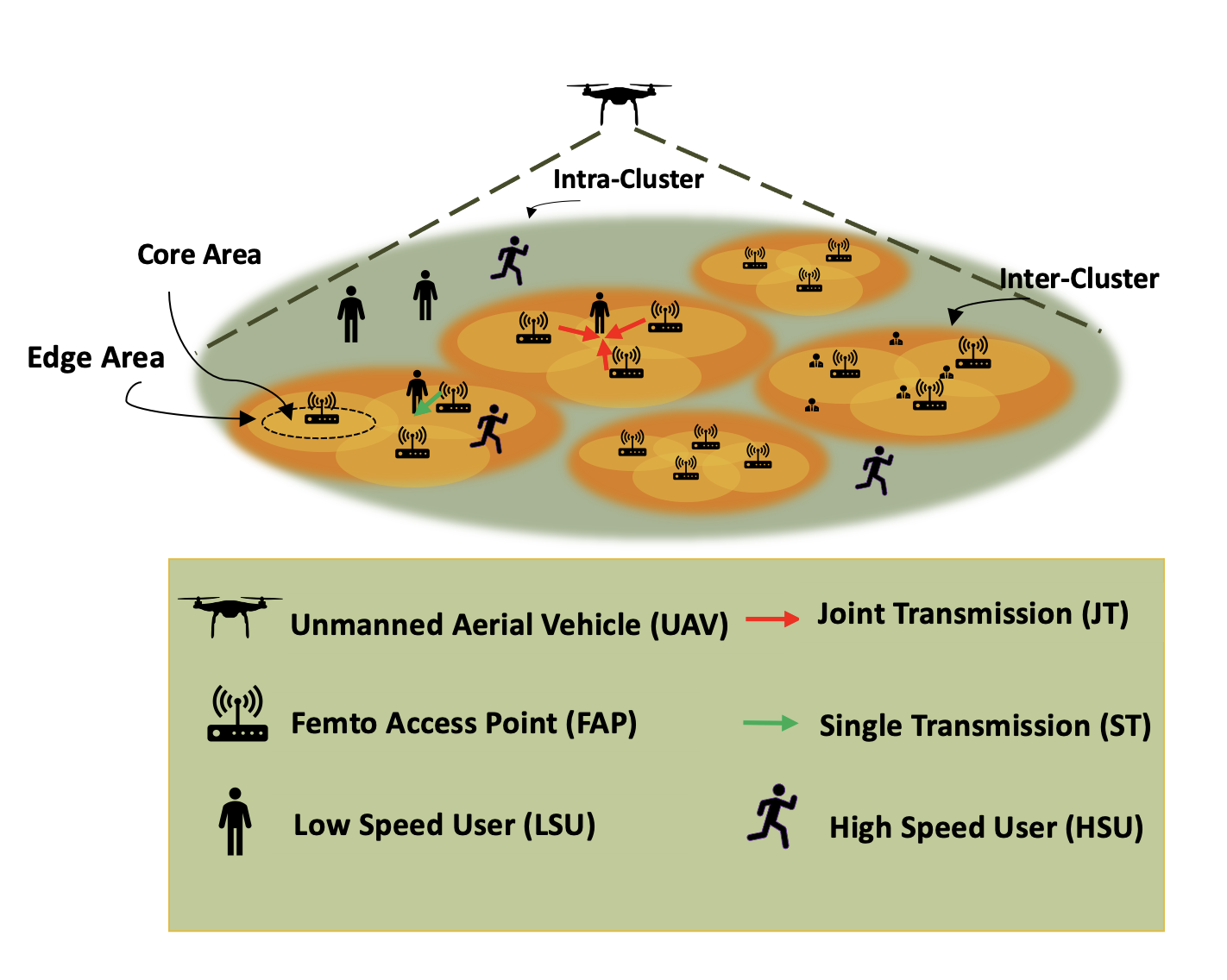
- To enable effective integration of the prediction model with both uncoded and coded content placement strategies in cluster-centric MEC architectures.
- To overcome the cold-start and sparsity issues common in traditional statistical and ML-based popularity prediction models.
Proposed method
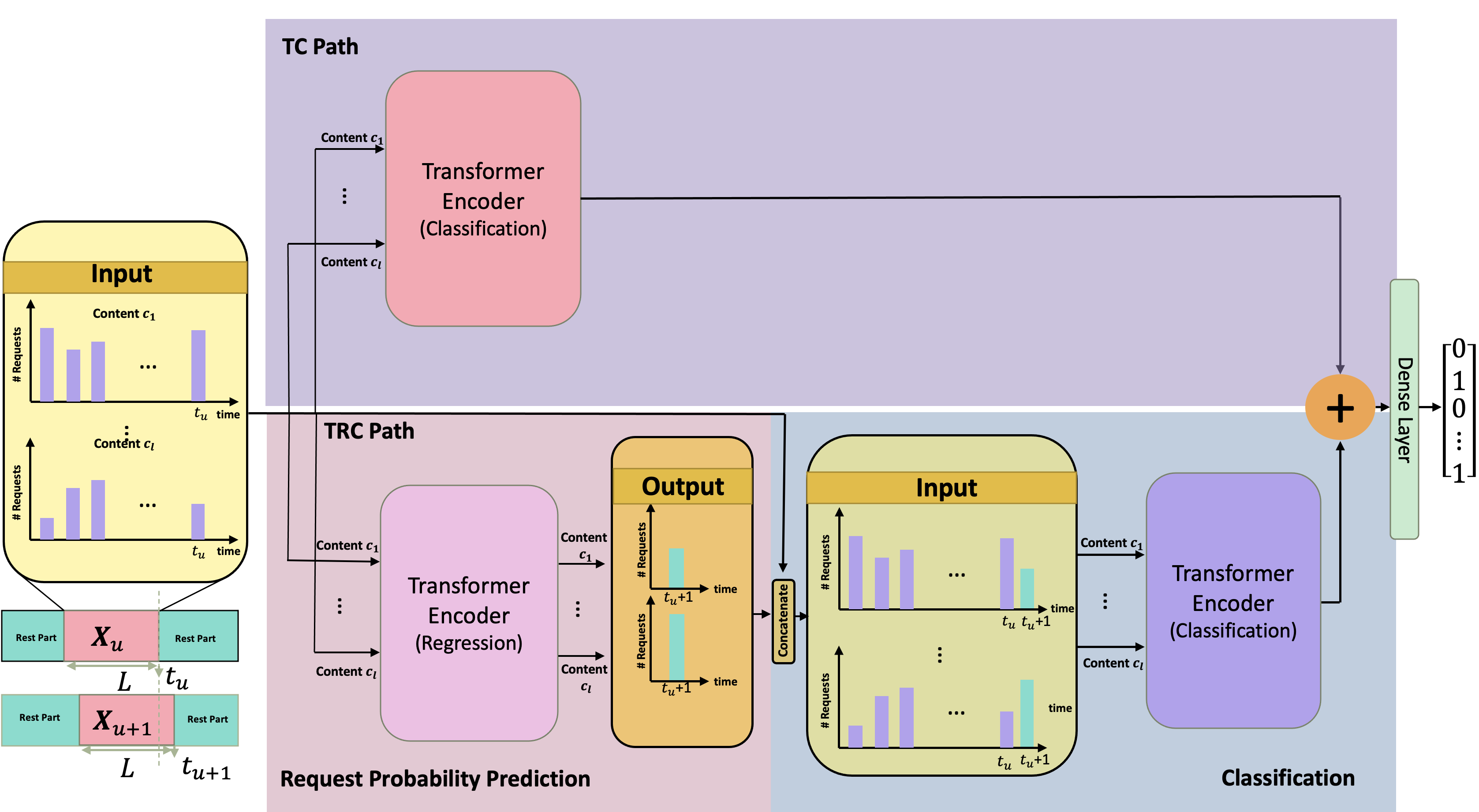
- The MTEC framework employs a multiple-model (hybrid) Transformer architecture with two parallel streams: one for sequence modeling of time-series request patterns and another for content-specific feature encoding.
- Each stream processes content request data using multi-head self-attention mechanisms to capture long-range temporal dependencies and inter-content relationships.
- The outputs of the two streams are fused via a fully connected layer to generate joint predictions of Top-K popular contents and their request probabilities.
- The framework is trained end-to-end using a multi-task loss function combining classification loss for popularity ranking and regression loss for request probability estimation.
- The architecture is designed to be compatible with both uncoded and coded/uncoded content placement by providing probabilistic request predictions for partial or full caching decisions.
- The model is evaluated on the Movielens dataset using metrics including cache-hit ratio, transferred byte volume, and classification accuracy.
Experimental results
Research questions
- RQ1Can a deep learning model jointly predict both the Top-K popular contents and their request probabilities to support coded/uncoded content placement in MEC networks?
- RQ2How does a hybrid Transformer architecture outperform single-architecture models in predicting time-varying popularity patterns across diverse content types?
- RQ3To what extent does the proposed MTEC framework improve cache-hit ratio and reduce data transmission volume compared to state-of-the-art caching schemes?
- RQ4Does the MTEC model generalize better than existing models in handling non-smooth, dynamic request patterns common in real-world MEC deployments?
- RQ5How does the fusion of multiple Transformer streams enhance prediction accuracy and robustness in multi-content popularity forecasting?
Key findings
- The MTEC framework achieves the highest cache-hit ratio among all compared baselines, including LRU, LFU, PopCaching, LSTM-C, TC, RCT, and TEDGE, on the Movielens dataset.
- The MTEC model outperforms the RCT and TEDGE baselines in transferred byte volume, indicating more efficient data delivery due to better prediction accuracy.
- The MTEC architecture with a fully connected fusion layer (MTEC-AT) achieves higher classification accuracy than single-Transformer models like TC and TRC.
- The proposed MTEC framework demonstrates superior generalization across diverse content dynamics, including non-smooth and rapidly changing request patterns.
- The simulation results confirm that the MTEC model’s ability to predict request probabilities enables effective integration with coded/uncoded content placement strategies, improving overall network efficiency.
- The MTEC framework reduces the need for full content replication by accurately identifying which contents should be stored partially or completely based on predicted popularity.
Read this paper
Open the full text in the Nubint reader and ask about any passage as you read.
Read this paper on NubintThis review was generated by AI from the original paper. Please check the paper before citing it.