
[Paper Review] Multi-Echo Denoising in Adverse Weather
This paper proposes multi-echo denoising for LiDAR in adverse weather, using a self-supervised deep learning method (SMEDNet) with characteristics similarity regularization to identify and recover useful echoes from noise-corrupted signals. The method achieves a 23% improvement over state-of-the-art self-supervised approaches on a semi-synthetic dataset and demonstrates strong qualitative performance on real adverse weather data.
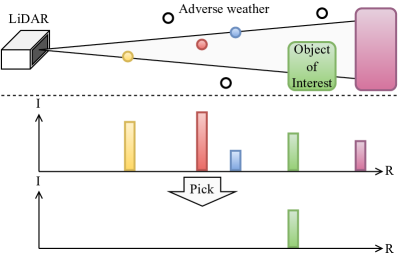
Adverse weather can cause noise to light detection and ranging (LiDAR) data. This is a problem since it is used in many outdoor applications, e.g. object detection and mapping. We propose the task of multi-echo denoising, where the goal is to pick the echo that represents the objects of interest and discard other echoes. Thus, the idea is to pick points from alternative echoes that are not available in standard strongest echo point clouds due to the noise. In an intuitive sense, we are trying to see through the adverse weather. To achieve this goal, we propose a novel self-supervised deep learning method and the characteristics similarity regularization method to boost its performance. Based on extensive experiments on a semi-synthetic dataset, our method achieves superior performance compared to the state-of-the-art in self-supervised adverse weather denoising (23% improvement). Moreover, the experiments with a real multi-echo adverse weather dataset prove the efficacy of multi-echo denoising. Our work enables more reliable point cloud acquisition in adverse weather and thus promises safer autonomous driving and driving assistance systems in such conditions. The code is available at https://github.com/alvariseppanen/SMEDNet
Motivation & Objective
- Address the critical challenge of LiDAR point cloud degradation in adverse weather conditions such as fog, rain, and snow.
- Overcome the limitations of single-echo LiDAR systems, which discard potentially useful information from weaker or later echoes due to noise.
- Enable reliable object detection and mapping in adverse weather by recovering valid points from alternative echoes not captured in standard strongest-echo point clouds.
- Develop a self-supervised method that avoids costly point-wise annotations, especially for multi-echo data.
- Improve model generalization and performance through a novel characteristics similarity regularization technique.
Proposed method
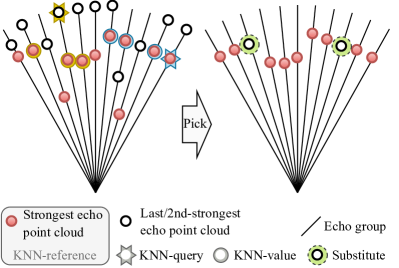
- Propose SMEDNet, a self-supervised deep learning framework that leverages neighborhood correlation and a blind spot mechanism to identify the most informative echo for each laser pulse.
- Use a multi-echo point cloud as input, where each pulse generates multiple echoes, and learn to select the echo most likely representing a physical object.
- Introduce characteristics similarity regularization to encourage feature consistency across different echoes of the same point, improving convergence and test-time performance.
- Apply a neighbor encoder with KNN or grid-based neighbor search to extract local geometric features from the point cloud.
- Train the model without ground-truth labels by leveraging the geometric consistency of valid points across echoes, using a contrastive learning-like objective.
- Output a single-echo point cloud per observation angle, compatible with standard downstream perception pipelines.
Experimental results
Research questions
- RQ1Can multi-echo LiDAR data be leveraged to recover object points lost in the strongest echo due to adverse weather?
- RQ2How effective is a self-supervised deep learning approach in identifying the correct echo among multiple noisy echoes without point-wise annotations?
- RQ3To what extent does characteristics similarity regularization improve the robustness and performance of multi-echo denoising models?
- RQ4How does the proposed method compare to classical methods like DROR in handling high levels of weather-induced noise?
- RQ5Can the method generalize to real-world adverse weather scenarios beyond synthetic data?
Key findings
- SMEDNet achieves a 23% improvement in mean IoU over the state-of-the-art self-supervised method on a semi-synthetic adverse weather dataset.
- On the STF real-world dataset, SMEDNet successfully recovers substitute points in all noise levels, including heavy fog and snow, outperforming the classical MEDROR baseline.
- The MEDROR baseline fails to recover sufficient substitute points in high-noise conditions, producing many false negatives and being sensitive to threshold tuning.
- Qualitative results show that SMEDNet identifies viable substitute points from alternative echoes (e.g., second or last echo), even when the strongest echo is corrupted.
- The characteristics similarity regularization significantly boosts model convergence and test-time performance, especially in challenging weather conditions.
- The method demonstrates strong generalization, maintaining high performance across light, medium, and heavy adverse weather conditions in both synthetic and real data.
Read this paper
Open the full text in the Nubint reader and ask about any passage as you read.
Read this paper on NubintThis review was generated by AI from the original paper. Please check the paper before citing it.