
[Paper Review] MuLTI: Efficient Video-and-Language Understanding with Text-Guided MultiWay-Sampler and Multiple Choice Modeling
MuLTI proposes an efficient video-and-language understanding framework using a MultiWay-Sampler for memory-efficient, attention-based feature fusion and an attention-based adapter to fine-tune shallow features with low GPU cost. It further introduces Multiple Choice Modeling as a pretraining task to bridge the gap between pretraining and downstream videoQA tasks, achieving state-of-the-art performance across seven benchmarks with reduced memory usage.
Video-and-language understanding has a variety of applications in the industry, such as video question answering, text-video retrieval, and multi-label classification. Existing video-and-language understanding methods generally adopt heavy multi-modal encoders and feature fusion modules, which consume high computational costs. Specially, they have difficulty dealing with dense video frames or long text prevalent in industrial applications. This paper proposes MuLTI, a highly accurate and efficient video-and-language understanding model that achieves efficient and effective feature fusion and rapid adaptation to downstream tasks. Specifically, we design a Text-Guided MultiWay-Sampler based on adapt-pooling residual mapping and self-attention modules to sample long sequences and fuse multi-modal features, which reduces the computational costs and addresses performance degradation caused by previous samplers. Therefore, MuLTI can handle longer sequences with limited computational costs. Then, to further enhance the model's performance and fill in the lack of pretraining tasks in the video question answering, we propose a new pretraining task named Multiple Choice Modeling. This task bridges the gap between pretraining and downstream tasks and improves the model's ability to align video and text features. Benefiting from the efficient feature fusion module and the new pretraining task, MuLTI achieves state-of-the-art performance on multiple datasets. Implementation and pretrained models will be released.
Motivation & Objective
- To address high GPU memory consumption in video-and-language models caused by full-parameter fine-tuning and long sequence processing.
- To improve feature fusion efficiency and effectiveness between video and text modalities without sacrificing performance.
- To reduce the task gap between pretraining and downstream videoQA tasks through a new pretraining objective.
- To enable effective fine-tuning of shallow features with minimal memory overhead using an attention-based adapter.
- To support long text and sparse video frames efficiently within limited GPU memory.
Proposed method
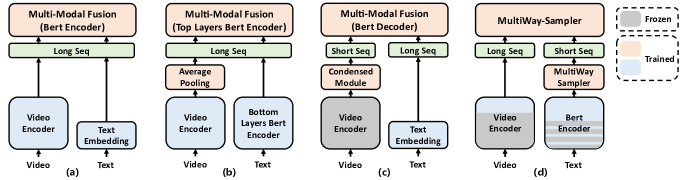
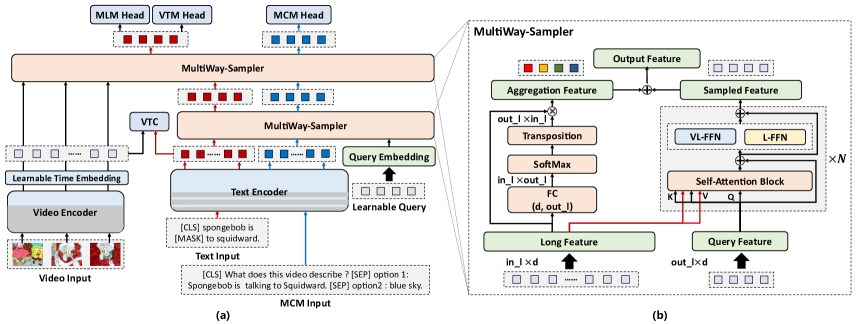
- The MultiWay-Sampler uses learnable query vectors and self-attention to sample and condense text features, followed by an attention-based residual aggregation to preserve key information.
- The sampler applies shared self-attention modules but uses modality-specific feed-forward networks to handle video and text features separately.
- The attention-based adapter is inserted into the encoders to fine-tune shallow features, reducing memory cost compared to full fine-tuning.
- The Partially Frozen Encoder (PFE) strategy freezes some encoder layers, improving training efficiency and mitigating overfitting.
- Multiple Choice Modeling (MCM) is introduced as a pretraining task where the model selects the best text description for a given video, enhancing cross-modal alignment.
- The model combines MultiWay-Sampler, attention adapter, and MCM pretraining to achieve high performance with low memory consumption.
Experimental results
Research questions
- RQ1Can a multi-modal feature fusion module reduce GPU memory usage while maintaining or improving performance in video-and-language tasks?
- RQ2How does an attention-based adapter compare to full fine-tuning in terms of performance and memory efficiency for video-and-language models?
- RQ3To what extent does introducing a Multiple Choice Modeling pretraining task improve downstream videoQA and retrieval performance?
- RQ4Can the model effectively handle long text and sparse video frames without significant performance degradation?
- RQ5Does combining feature sampling, selective fine-tuning, and a new pretraining task lead to state-of-the-art results across diverse video-and-language benchmarks?
Key findings
- MuLTI achieves state-of-the-art performance on seven video-and-language tasks, including MSRVTT-QA (45.71% accuracy) and MSVD-QA (50.63% accuracy), outperforming prior methods.
- The attention-based adapter improves performance by 0.82% on MSVD-QA and 0.17% on MSRVTT-QA compared to baseline models.
- Using the MultiWay-Sampler with attention-based residual aggregation improves accuracy by 0.38% on MSRVTT-QA compared to a baseline with no aggregation.
- The Partially Frozen Encoder strategy reduces GPU memory usage from 6109 MB to 10283 MB while improving accuracy on MSVD-QA by 3.03% compared to full fine-tuning.
- Multiple Choice Modeling (MCM) significantly enhances performance on videoQA and retrieval tasks by narrowing the task gap between pretraining and downstream tasks.
- The combination of MultiWay-Sampler, attention adapter, and MCM pretraining leads to consistent improvements across all evaluated datasets and tasks.
Read this paper
Open the full text in the Nubint reader and ask about any passage as you read.
Read this paper on NubintThis review was generated by AI from the original paper. Please check the paper before citing it.