
[Paper Review] Multi-functional OFDM Signal Design for Integrated Sensing, Communications, and Power Transfer
This paper proposes a multi-functional OFDM signal design for integrated sensing, communications, and power transfer (ISCAP), optimizing the non-zero mean asymmetric Gaussian input distribution across subcarriers to maximize harvested power while satisfying rate and sensing performance constraints. The optimized waveform achieves a larger performance region than conventional coexisting or symmetric signal designs, demonstrating superior trade-offs among the three functions through adaptive power and mean allocation.
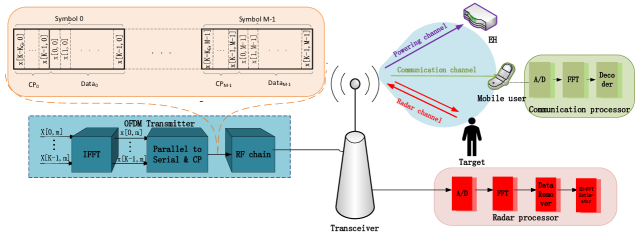
The wireless domain is witnessing a flourishing of integrated systems, e.g. (a) integrated sensing and communications, and (b) simultaneous wireless information and power transfer, due to their potential to use resources (spectrum, power) judiciously. Inspired by this trend, we investigate integrated sensing, communications and powering (ISCAP), through the design of a wideband OFDM signal to power a sensor while simultaneously performing target-sensing and communication. To characterize the ISCAP performance region, we assume symbols with non-zero mean asymmetric Gaussian distribution (i.e., the input distribution), and optimize its mean and variance at each subcarrier to maximize the harvested power, subject to constraints on the achievable rate (communications) and the average side-to-peak-lobe difference (sensing). The resulting input distribution, through simulations, achieves a larger performance region than that of (i) a symmetric complex Gaussian input distribution with identical mean and variance for the real and imaginary parts, (ii) a zero-mean symmetric complex Gaussian input distribution, and (iii) the superposed power-splitting communication and sensing signal (the coexisting solution). In particular, the optimized input distribution balances the three functions by exhibiting the following features: (a) symbols in subcarriers with strong communication channels have high variance to satisfy the rate constraint, while the other symbols are dominated by the mean, forming a relatively uniform sum of mean and variance across subcarriers for sensing; (b) with looser communication and sensing constraints, large absolute means appear on subcarriers with stronger powering channels for higher harvested power. As a final note, the results highlight the great potential of the co-designed ISCAP system for further efficiency enhancement.
Motivation & Objective
- To design a unified OFDM waveform that simultaneously enables high-rate communication, accurate sensing, and efficient wireless power transfer.
- To characterize the performance region of integrated sensing, communications, and powering (ISCAP) under joint constraints on data rate and sensing accuracy.
- To optimize the input signal distribution (mean and variance) across OFDM subcarriers to maximize harvested power while satisfying communication and sensing requirements.
- To demonstrate the superiority of co-designed ISCAP over coexisting or symmetric signal solutions in terms of performance region and trade-off efficiency.
Proposed method
- The authors model the OFDM input signal using a non-zero mean asymmetric Gaussian distribution per subcarrier, enabling independent optimization of mean and variance.
- A convex optimization problem is formulated to maximize harvested power, subject to constraints on achievable communication rate and average side-to-peak-lobe difference (a proxy for sensing accuracy).
- The problem is cast as a Quadratic Constrained Quadratic Programming (QCQP) problem, solved via Lagrangian relaxation and alternating optimization with bi-section search on the sensing constraint multiplier.
- The solution computes non-diagonal elements of the power covariance matrix directly, while diagonal elements are derived via iterative root-finding on the dual variable associated with the sensing constraint.
- The algorithm alternates between updating the signal covariance matrix and refining the dual variables until convergence is achieved.
- The performance is evaluated via simulations comparing the proposed design against three baselines: symmetric complex Gaussian, zero-mean symmetric Gaussian, and superposed power-splitting signals.
Experimental results
Research questions
- RQ1Can a single OFDM waveform be co-designed to simultaneously support high-rate communication, accurate sensing, and efficient wireless power transfer?
- RQ2How does the performance region of ISCAP compare to that of coexisting or superposed communication, sensing, and power transfer systems?
- RQ3What is the optimal input distribution (mean and variance) across subcarriers to balance the trade-offs between communication rate, sensing accuracy, and harvested power?
- RQ4How does the allocation of mean and variance across subcarriers depend on channel conditions for each function?
Key findings
- The proposed asymmetric Gaussian input distribution achieves a larger ISCAP performance region than symmetric complex Gaussian inputs, zero-mean inputs, and superposed power-splitting solutions.
- Subcarriers with strong communication channels are allocated higher variance to meet rate constraints, while subcarriers with strong sensing or power transfer channels are assigned larger mean values to enhance sensing or harvesting.
- The optimized design exhibits a balanced trade-off by distributing the sum of mean and variance uniformly across subcarriers for consistent sensing performance.
- With looser constraints, subcarriers having stronger power transfer channels are assigned larger absolute mean values to maximize harvested power.
- The results confirm that co-designed ISCAP signals significantly outperform coexisting solutions, highlighting the potential for greater spectral and energy efficiency in future wireless networks.
Better researchstarts right now
From reading papers to final review, dramatically reduce your research time.
No credit card · Free plan available
This review was created by AI and reviewed by human editors.