
[Paper Review] Multi-Grid Tensorized Fourier Neural Operator for High-Resolution PDEs
This paper proposes Multi-Grid Tensorized Fourier Neural Operator (MG-TFNO), a scalable, memory-efficient neural operator for high-resolution PDEs that combines multi-grid domain decomposition with tensorized parameterization in the Fourier domain. By decomposing the input domain into local regions with hierarchical global context and representing weights via low-rank tensor factorization (e.g., Tucker), MG-TFNO achieves over 150× parameter compression and 7× input size reduction with less than half the error of standard FNO on turbulent Navier-Stokes equations.
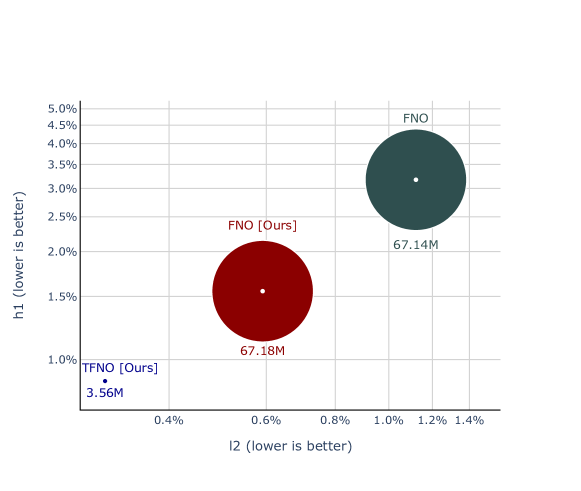
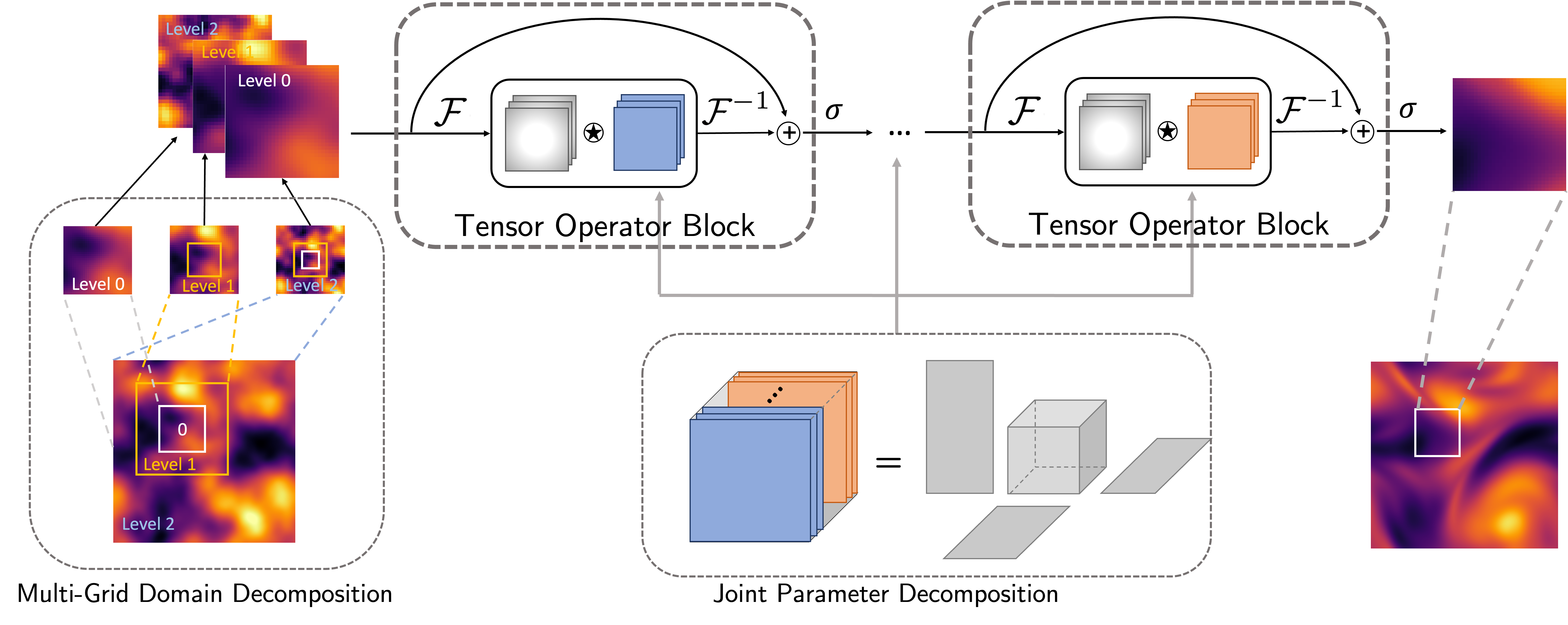
Memory complexity and data scarcity have so far prohibited learning solution operators of partial differential equations (PDEs) at high resolutions. We address these limitations by introducing a new data efficient and highly parallelizable operator learning approach with reduced memory requirement and better generalization, called multi-grid tensorized neural operator (MG-TFNO). MG-TFNO scales to large resolutions by leveraging local and global structures of full-scale, real-world phenomena, through a decomposition of both the input domain and the operator's parameter space. Our contributions are threefold: i) we enable parallelization over input samples with a novel multi-grid-based domain decomposition, ii) we represent the parameters of the model in a high-order latent subspace of the Fourier domain, through a global tensor factorization, resulting in an extreme reduction in the number of parameters and improved generalization, and iii) we propose architectural improvements to the backbone FNO. Our approach can be used in any operator learning setting. We demonstrate superior performance on the turbulent Navier-Stokes equations where we achieve less than half the error with over 150x compression. The tensorization combined with the domain decomposition, yields over 150x reduction in the number of parameters and 7x reduction in the domain size without losses in accuracy, while slightly enabling parallelism.
Motivation & Objective
- Address the high memory complexity and data scarcity limiting operator learning for high-resolution PDEs.
- Overcome the curse of dimensionality and memory growth in Fourier Neural Operators (FNOs) by exploiting local and global structures in physical and parameter spaces.
- Enable parallelization over input samples by decomposing the domain into local regions with multi-grid hierarchical context.
- Reduce model parameters and memory footprint without sacrificing accuracy using high-order tensor factorization in the Fourier domain.
- Improve generalization and scalability for real-world scientific computing problems such as weather forecasting and fluid dynamics.
Proposed method
- Apply a multi-grid domain decomposition strategy that splits the input domain into local regions, each enriched with progressively downsampled global context based on distance from the region of interest.
- Use a hierarchical, multi-resolution representation where local regions are processed at high resolution and distant regions at coarser resolutions to reduce input size by up to 7×.
- Introduce a tensorized Fourier operator (TFNO) that represents the FNO’s convolutional weights in a low-rank tensor format (e.g., Tucker, CP, TT) in the Fourier domain to compress parameters by over 100×.
- Leverage Tucker decomposition for balanced performance and compression at moderate ratios, CP for high compression, and TT for extreme compression with stability.
- Integrate the multi-grid decomposition with tensorized weights into a unified architecture (MG-TFNO) that enables full parallelization across input regions.
- Use a loss function that promotes smoothness in the output to ensure high-quality reconstruction after stitching local predictions.
Experimental results
Research questions
- RQ1Can multi-grid domain decomposition reduce the input size and memory footprint of neural operators while preserving or improving accuracy on high-resolution PDEs?
- RQ2Can high-order tensor factorization of FNO weights in the Fourier domain achieve extreme parameter compression without performance degradation?
- RQ3How do the combined effects of domain decomposition and tensorization impact generalization, inference speed, and memory efficiency in operator learning?
- RQ4To what extent can MG-TFNO scale to real-world, high-resolution scientific problems like turbulent Navier-Stokes or weather forecasting?
- RQ5Does the tensorized parameterization act as a regularizer, improving generalization even with limited training data?
Key findings
- MG-TFNO achieves a 150× reduction in model parameters and 7× reduction in input domain size with no loss in accuracy on the Navier-Stokes equations.
- On the Navier-Stokes benchmark, MG-TFNO reduces relative $L^2$ test error to 0.85%, less than half of the 2.54% error from standard FNO.
- The Tucker-based TFNO variant achieves 10× model compression with 5.5M parameters, while maintaining a 0.85% error rate.
- The CP decomposition enables 482× compression but with a higher error (2.24%) compared to Tucker, indicating trade-offs between compression and accuracy.
- The TT decomposition achieves 574× compression with 117K parameters and a 1.18% error, showing stability at extreme compression ratios.
- Ablation studies confirm that combining multi-grid domain decomposition and tensorized weights yields superior performance and memory savings compared to either technique alone.
Read this paper
Open the full text in the Nubint reader and ask about any passage as you read.
Read this paper on NubintThis review was generated by AI from the original paper. Please check the paper before citing it.