
[Paper Review] Multi-hop Question Answering
This survey provides a formal definition and systematic organization of Multi-Hop Question Answering (MHQA), analyzing existing frameworks, datasets, and evaluation strategies. It identifies key challenges such as reasoning chain construction, commonsense integration, and arithmetic reasoning, and advocates for improved evaluation metrics and generative MHQA methods to advance robust, explainable NLP systems.
The task of Question Answering (QA) has attracted significant research interest for long. Its relevance to language understanding and knowledge retrieval tasks, along with the simple setting makes the task of QA crucial for strong AI systems. Recent success on simple QA tasks has shifted the focus to more complex settings. Among these, Multi-Hop QA (MHQA) is one of the most researched tasks over the recent years. In broad terms, MHQA is the task of answering natural language questions that involve extracting and combining multiple pieces of information and doing multiple steps of reasoning. An example of a multi-hop question would be "The Argentine PGA Championship record holder has won how many tournaments worldwide?". Answering the question would need two pieces of information: "Who is the record holder for Argentine PGA Championship tournaments?" and "How many tournaments did [Answer of Sub Q1] win?". The ability to answer multi-hop questions and perform multi step reasoning can significantly improve the utility of NLP systems. Consequently, the field has seen a surge with high quality datasets, models and evaluation strategies. The notion of 'multiple hops' is somewhat abstract which results in a large variety of tasks that require multi-hop reasoning. This leads to different datasets and models that differ significantly from each other and makes the field challenging to generalize and survey. We aim to provide a general and formal definition of the MHQA task, and organize and summarize existing MHQA frameworks. We also outline some best practices for building MHQA datasets. This book provides a systematic and thorough introduction as well as the structuring of the existing attempts to this highly interesting, yet quite challenging task.
Motivation & Objective
- To establish a formal and general definition of the Multi-Hop Question Answering (MHQA) task to unify diverse interpretations.
- To systematically organize and summarize existing MHQA frameworks, models, and datasets across different knowledge sources.
- To identify and address key challenges in MHQA, including reasoning chain construction, commonsense knowledge integration, and arithmetic reasoning.
- To propose improved evaluation metrics that account for semantic similarity, synonymy, and partial correctness beyond strict lexical matching.
- To highlight the need for generative MHQA and difficulty-controllable question generation to support curriculum learning and real-world applications.
Proposed method
- Proposes a formal definition of MHQA as a task requiring multiple reasoning steps across multiple contexts (text, tables, knowledge graphs) to derive an answer.
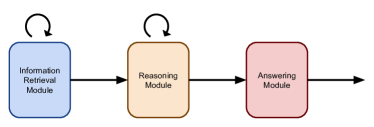
- Classifies MHQA frameworks based on knowledge sources (e.g., Wikipedia, knowledge graphs, tables) and reasoning types (e.g., chain-of-thought, evidence retrieval).
- Introduces a taxonomy of reasoning chains, distinguishing between explicit and implicit intermediate steps in multi-hop reasoning.
- Recommends per-hop evaluation strategies to improve model interpretability and enable granular performance analysis.
- Proposes semantic evaluation metrics such as Word Mover’s Distance and Sentence Mover’s Similarity to handle synonymy and partial correctness.
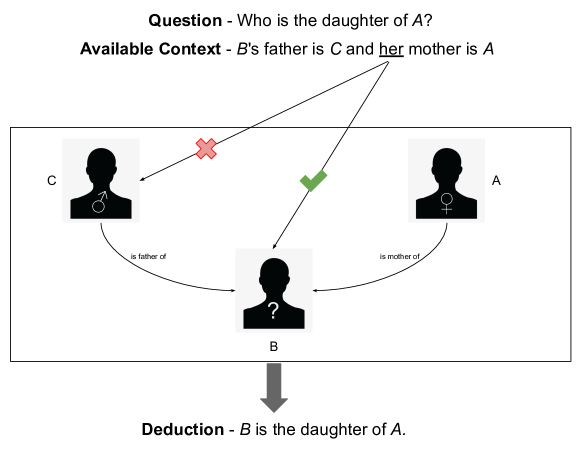
- Advocates for integrating external knowledge bases (e.g., ConceptNet, WordNet) to enhance commonsense reasoning and reduce model failures due to missing background knowledge.
Experimental results
Research questions
- RQ1What constitutes a formal and general definition of Multi-Hop Question Answering that unifies diverse task variants?
- RQ2How do existing MHQA frameworks differ in terms of knowledge sources, reasoning mechanisms, and evaluation protocols?
- RQ3What are the primary failure modes in current MHQA models, and how can they be mitigated through better training data and knowledge integration?
- RQ4How can evaluation metrics be improved to account for semantic similarity and partial correctness beyond exact lexical matching?
- RQ5What role can generative MHQA and difficulty-controllable question generation play in advancing robust, explainable NLP systems?
Key findings
- Current MHQA models frequently fail due to missing commonsense knowledge, with 16% of failures attributed to this in one study.
- Lexical matching-based evaluation metrics often penalize semantically correct but lexically different answers (e.g., 'U.S.' vs. 'United States'), reducing reliability.
- Partial scoring for geographically or temporally close answers (e.g., 'December 1988' vs. 'January 1989') is necessary for robust evaluation in datasets like WikiHop.
- Semantic matching techniques like Word Mover’s Distance and Sentence Mover’s Similarity show promise in improving answer evaluation by capturing meaning over surface form.
- Arithmetic reasoning remains a major challenge, with 45% of comparison questions in HotpotQA being numerical, and models often failing on date comparisons or temporal calculations.
- Targeted improvements on specific question types—such as temporal, geographical, and count-based questions—can significantly boost overall MHQA performance.
Read this paper
Open the full text in the Nubint reader and ask about any passage as you read.
Read this paper on NubintThis review was generated by AI from the original paper. Please check the paper before citing it.