
[Paper Review] Multi-objective generative AI for designing novel brain-targeting small molecules
This study introduces a multi-objective generative AI framework using Monte Carlo Tree Search (MCTS) to design novel, synthesizable small molecules with high blood-brain barrier (BBB) permeability, strong predicted binding affinity to the dopamine D2 receptor (D2R), and favorable safety profiles. The approach integrates graph neural network-based property predictors for BBB permeability, D2R bioactivity, and ADME-Tox, generating a diverse library of 26,581 molecules with top hits showing docking affinity comparable to risperidone, a clinically used antipsychotic.
The strict selectivity of the blood-brain barrier (BBB) represents one of the most formidable challenges to successful central nervous system (CNS) drug delivery. Computational methods to generate BBB permeable drugs in silico may be valuable tools in the CNS drug design pipeline. However, in real-world applications, BBB penetration alone is insufficient; rather, after transiting the BBB, molecules must bind to a specific target or receptor in the brain and must also be safe and non-toxic. To discover small molecules that concurrently satisfy these constraints, we use multi-objective generative AI to synthesize drug-like BBB-permeable small molecules. Specifically, we computationally synthesize molecules with predicted binding affinity against dopamine receptor D2, the primary target for many clinically effective antipsychotic drugs. After training several graph neural network-based property predictors, we adapt SyntheMol (Swanson et al., 2024), a recently developed Monte Carlo Tree Search-based algorithm for antibiotic design, to perform a multi-objective guided traversal over an easily synthesizable molecular space. We design a library of 26,581 novel and diverse small molecules containing hits with high predicted BBB permeability and favorable predicted safety and toxicity profiles, and that could readily be synthesized for experimental validation in the wet lab. We also validate top scoring molecules with molecular docking simulation against the D2 receptor and demonstrate predicted binding affinity on par with risperidone, a clinically prescribed D2-targeting antipsychotic. In the future, the SyntheMol-based computational approach described here may enable the discovery of novel neurotherapeutics for currently intractable disorders of the CNS.
Motivation & Objective
- To address the major challenge of blood-brain barrier (BBB) impermeability in CNS drug development, which limits effective treatment of neurodegenerative and psychiatric disorders.
- To design small molecules that are not only BBB-permeable but also possess high predicted binding affinity to the dopamine D2 receptor (D2R), a key target for antipsychotic drugs.
- To ensure therapeutic viability by incorporating predicted safety and toxicity profiles (ADME-Tox) into the molecular design process.
- To generate a diverse, synthesizable library of novel compounds suitable for experimental validation in wet-lab settings.
- To demonstrate the feasibility of using multi-objective guided molecular generation for discovering neurotherapeutics for currently intractable CNS disorders.
Proposed method
- Employed a modified SyntheMol algorithm, a Monte Carlo Tree Search (MCTS)-based generative framework, to explore a chemically feasible molecular space.
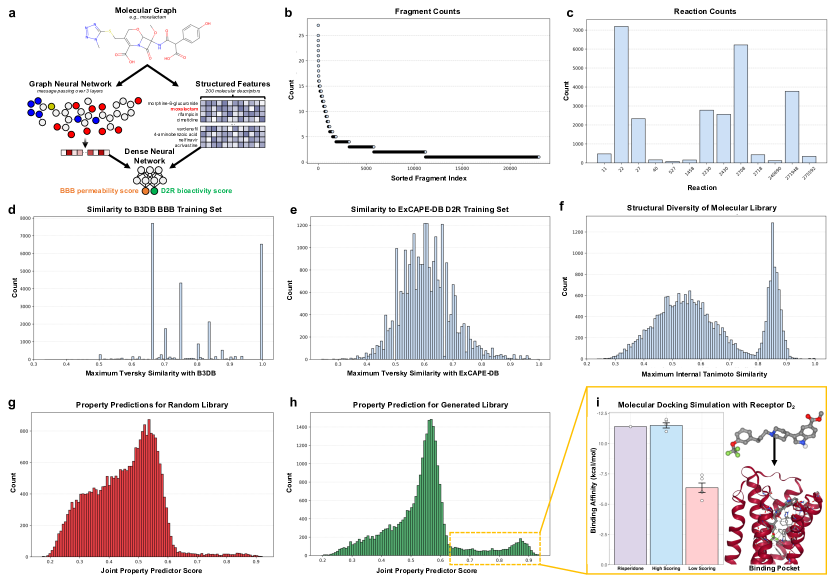
- Integrated three graph neural network (GNN)-based property predictors: one for BBB permeability, one for D2R bioactivity, and one for ADME-Tox profiles.
- Used a multi-objective scoring function P(N) that averages normalized predictions across BBB permeability, D2R binding affinity, and toxicity, balancing exploration and exploitation during MCTS rollouts.
- Constructed molecules iteratively using 132,479 molecular building blocks and 13 chemical reactions, with each node in the search tree representing a potential molecular configuration.
- Applied Tanimoto and Tversky similarity metrics to assess molecular diversity relative to training data and ensure structural novelty.
- Validated top candidates via molecular docking simulations against the D2 receptor to assess binding affinity in silico.
Experimental results
Research questions
- RQ1Can multi-objective generative AI effectively design small molecules that simultaneously achieve high BBB permeability, strong D2R binding affinity, and favorable safety profiles?
- RQ2How does the integration of multiple property predictors (BBB, D2R, ADME-Tox) influence the quality and diversity of generated molecules in a constrained molecular space?
- RQ3To what extent do the generated molecules exhibit structural novelty and diversity compared to training data?
- RQ4How do the predicted binding affinities of top hits compare to clinically used antipsychotics like risperidone?
- RQ5Can MCTS-guided generation with multi-objective scoring produce molecules with high synthetic accessibility suitable for wet-lab validation?
Key findings
- The method generated a library of 26,581 novel and structurally diverse small molecules with high predicted BBB permeability and favorable ADME-Tox profiles.
- Top-performing molecules exhibited predicted binding affinity to the D2 receptor comparable to risperidone, a clinically prescribed antipsychotic, as confirmed by molecular docking simulations.
- The multi-objective scoring function effectively balanced exploration and exploitation, yielding molecules that outperformed a random sampling baseline in combined property scores.
- Molecular diversity was confirmed via maximum internal Tanimoto and Tversky similarity metrics, showing low similarity to training compounds and high structural novelty.
- The property predictors demonstrated strong generalization, with AUROC values above 0.85 for both BBB permeability and D2R bioactivity in 10-fold cross-validation.
- The approach successfully identified molecules that satisfy multiple therapeutic constraints—BBB penetration, target binding, and safety—making them strong candidates for experimental testing.
Read this paper
Open the full text in the Nubint reader and ask about any passage as you read.
Read this paper on NubintThis review was generated by AI from the original paper. Please check the paper before citing it.