
[Paper Review] Multi-Scale Body-Part Mask Guided Attention for Person Re-identification
This paper proposes a multi-scale body-part mask guided attention network (MMGA) that enhances person re-identification by using upper-body and bottom-body masks to guide attention learning during training, enabling precise localization of salient body parts and reducing interference from background clutter and pose variations. The method achieves state-of-the-art performance with 95.0% rank-1 and 87.2% mAP on Market1501, and 89.5% rank-1 and 78.1% mAP on DukeMTMC-reID, outperforming prior attention-based models while requiring masks only at training time.
Person re-identification becomes a more and more important task due to its wide applications. In practice, person re-identification still remains challenging due to the variation of person pose, different lighting, occlusion, misalignment, background clutter, etc. In this paper, we propose a multi-scale body-part mask guided attention network (MMGA), which jointly learns whole-body and part body attention to help extract global and local features simultaneously. In MMGA, body-part masks are used to guide the training of corresponding attention. Experiments show that our proposed method can reduce the negative influence of variation of person pose, misalignment and background clutter. Our method achieves rank-1/mAP of 95.0%/87.2% on the Market1501 dataset, 89.5%/78.1% on the DukeMTMC-reID dataset, outperforming current state-of-the-art methods.
Motivation & Objective
- To address challenges in person re-identification such as pose variation, occlusion, background clutter, and misalignment.
- To improve feature learning by jointly capturing global and local discriminative cues through attention mechanisms.
- To reduce reliance on background regions by guiding attention using body-part masks during training.
- To maintain inference efficiency by eliminating the need for masks at test time.
- To explore the effectiveness of multi-scale, part-specific masks in improving attention-based feature extraction.
Proposed method
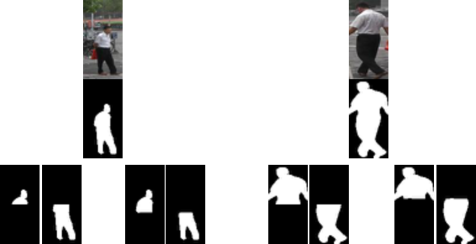
- The method introduces a multi-scale body-part mask guided attention network (MMGA) that uses whole-body, upper-body, and bottom-body masks to guide the training of corresponding attention modules.
- Upper-body and bottom-body masks are generated by splitting the whole-body mask at the midline, enabling part-specific attention learning.
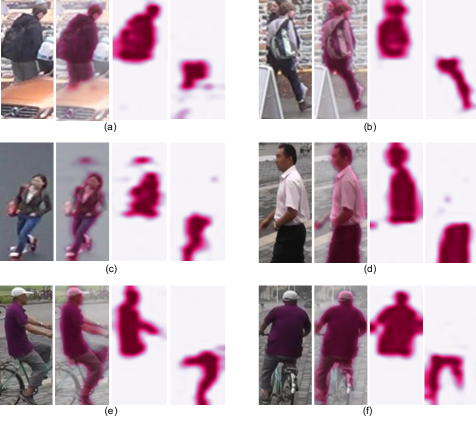
- Attention maps are optimized using supervision from these masks, which guide the network to focus on salient body regions and suppress background noise.
- The attention mechanism is applied during training only, allowing the model to be deployed efficiently at inference without mask input.
- The network architecture integrates global and part-based attention heads that are trained with mask-guided supervision to enhance feature discrimination.
- The method is compatible with standard pre-trained ResNet backbones, avoiding architectural incompatibility issues seen in prior work.
Experimental results
Research questions
- RQ1Can multi-scale body-part masks improve attention-based feature learning in person re-identification?
- RQ2Does part-specific mask guidance reduce the negative impact of background clutter and pose variation?
- RQ3Can attention networks trained with part masks achieve better performance than those trained with whole-body masks alone?
- RQ4Is it possible to maintain high inference efficiency while using mask-guided attention?
- RQ5How does the performance of mask-guided attention compare to state-of-the-art re-identification models?
Key findings
- MMGA achieves 95.0% rank-1 and 87.2% mAP on the Market1501 dataset, outperforming the current state-of-the-art method MGN by +0.3% in mAP.
- On DukeMTMC-reID, MMGA achieves 89.5% rank-1 and 78.1% mAP, exceeding MGN by +0.8% in rank-1 and matching it in mAP.
- The ablation study shows that using upper- and bottom-body masks improves performance by +0.7% in mAP and +0.8% in rank-1 over the whole-body mask baseline (WMGA).
- Compared to a divided-mask baseline (DMGA), MMGA improves mAP by -0.6% on Market1501 and -0.9% on DukeMTMC-reID, demonstrating the superiority of semantic body-part masks.
- The method maintains high accuracy even on images with inaccurate bounding boxes or severe occlusions, as shown in qualitative results with correct top-5 retrieval for challenging queries.
- MMGA achieves state-of-the-art performance while being more efficient than models like MGN, which use three separate ResNet50 branches with no weight sharing.
Read this paper
Open the full text in the Nubint reader and ask about any passage as you read.
Read this paper on NubintThis review was generated by AI from the original paper. Please check the paper before citing it.