
[Paper Review] Multi-scale Speaker Diarization with Dynamic Scale Weighting
This paper proposes a multi-scale speaker diarization system with a dynamic scale weighting mechanism using 1D CNNs to adaptively assign importance to different temporal scales at each time step. By initializing with multi-scale clustering and employing an LSTM-based decoder that estimates speaker labels frame-by-frame, the method achieves state-of-the-art performance with 3.92% DER on CALLHOME and 1.05% DER on AMI MixHeadset, enabling overlap-aware diarization and flexible speaker count estimation without iterative refinement.
Speaker diarization systems are challenged by a trade-off between the temporal resolution and the fidelity of the speaker representation. By obtaining a superior temporal resolution with an enhanced accuracy, a multi-scale approach is a way to cope with such a trade-off. In this paper, we propose a more advanced multi-scale diarization system based on a multi-scale diarization decoder. There are two main contributions in this study that significantly improve the diarization performance. First, we use multi-scale clustering as an initialization to estimate the number of speakers and obtain the average speaker representation vector for each speaker and each scale. Next, we propose the use of 1-D convolutional neural networks that dynamically determine the importance of each scale at each time step. To handle a variable number of speakers and overlapping speech, the proposed system can estimate the number of existing speakers. Our proposed system achieves a state-of-art performance on the CALLHOME and AMI MixHeadset datasets, with 3.92% and 1.05% diarization error rates, respectively.
Motivation & Objective
- To address the trade-off between temporal resolution and speaker representation fidelity in speaker diarization.
- To enable overlap-aware diarization without requiring post-processing or resegmentation.
- To support a flexible number of speakers, including unknown or variable speaker counts during inference.
- To improve performance over prior clustering-based and sequence-model-based diarization systems by dynamically weighting multi-scale representations.
Proposed method
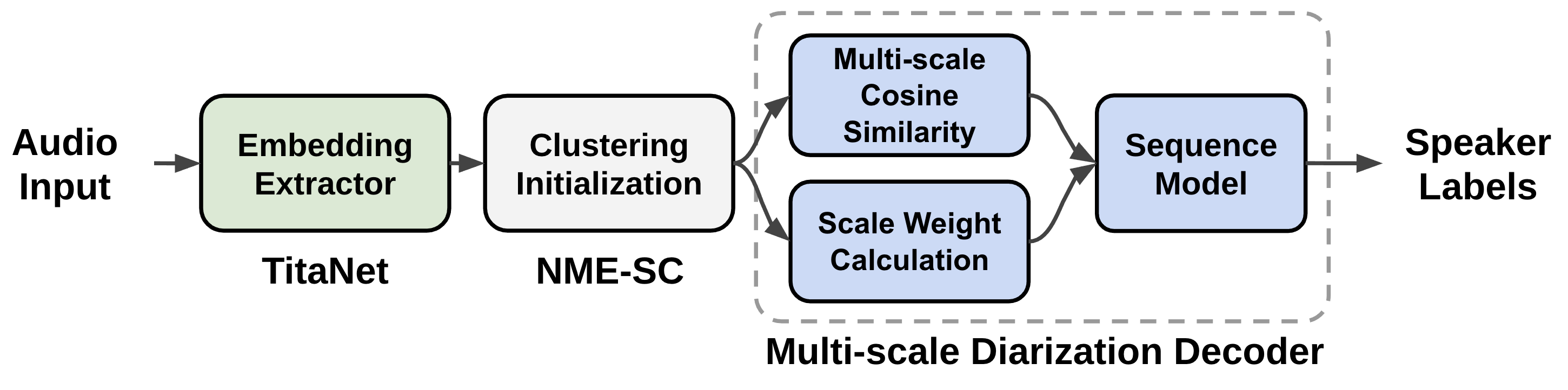
- The system uses a pretrained speaker embedding extractor (TitaNet) to generate frame-level embeddings.
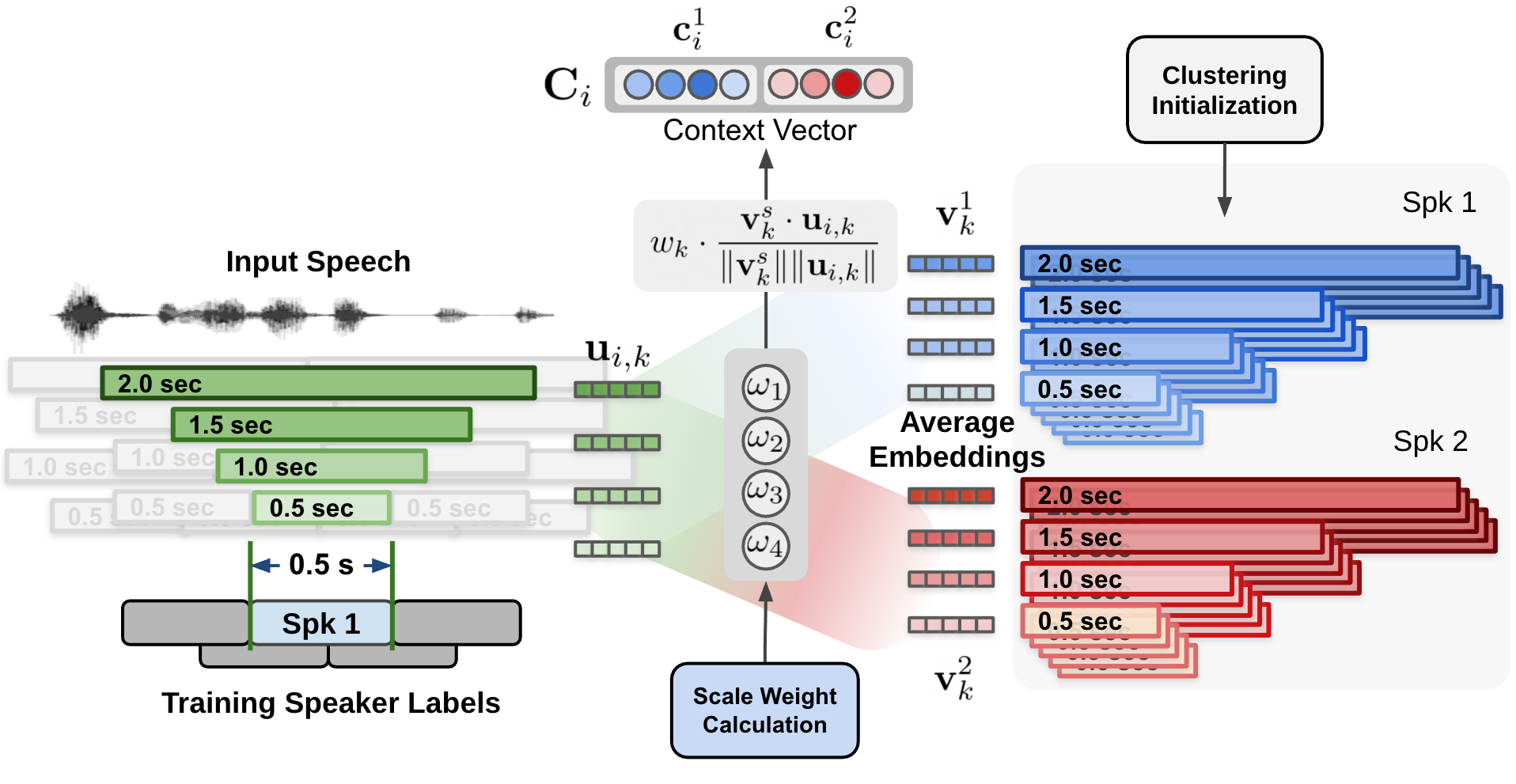
- Multi-scale clustering initializes the system by estimating speaker count and average speaker representations across multiple temporal scales.
- A 1D CNN computes dynamic scale weights at each time step based on input embeddings and cluster centroids.
- Weighted cosine similarities between speaker embeddings and cluster representations are computed using scale weights.
- An LSTM-based sequence model predicts binary speaker labels per frame, enabling overlap-aware diarization via multi-dimensional sigmoid output.
- Speaker labels are inferred by averaging sigmoid outputs across all speaker pairs, allowing flexible handling of unknown speaker counts.
Experimental results
Research questions
- RQ1Can a dynamic scale weighting mechanism improve diarization performance across multiple temporal resolutions?
- RQ2How does dynamic scale weighting compare to static or optimized scale weights in clustering-based initialization?
- RQ3Can an end-to-end sequence model with clustering initialization handle variable numbers of speakers without iterative refinement?
- RQ4To what extent does the proposed system outperform existing state-of-the-art modular and end-to-end diarization systems on standard benchmarks?
- RQ5Does the dynamic weighting mechanism reduce dependency on hyperparameter tuning in multi-scale diarization?
Key findings
- The proposed Equal-w-MSDD system achieves 3.92% diarization error rate (DER) on the CALLHOME test set, outperforming prior state-of-the-art methods.
- On the AMI MixHeadset dataset, the system achieves 1.05% DER, setting a new state-of-the-art performance.
- The Opt-w-MSDD variant, which uses optimized scale weights, achieves slightly better results than Equal-w-MSDD, but the latter shows robustness with no hyperparameter tuning.
- The system demonstrates stable performance across unknown domains due to reduced sensitivity to scale weight tuning compared to prior clustering-based multi-scale methods.
- The dynamic scale weighting mechanism enables effective overlap-aware diarization without requiring additional resegmentation or iterative refinement steps.
- The system maintains high accuracy even when the finest scale is reduced below 0.5s, though performance degrades slightly at very short scales.
Better researchstarts right now
From reading papers to final review, dramatically reduce your research time.
No credit card · Free plan available
This review was created by AI and reviewed by human editors.