
[Paper Review] Multi-Source Conformal Inference Under Distribution Shift
Develops distribution-free prediction intervals for a target population using multiple potentially biased data sources under missing outcomes and distribution shift, with data-adaptive weighting and privacy-preserving federated updates.
Recent years have experienced increasing utilization of complex machine learning models across multiple sources of data to inform more generalizable decision-making. However, distribution shifts across data sources and privacy concerns related to sharing individual-level data, coupled with a lack of uncertainty quantification from machine learning predictions, make it challenging to achieve valid inferences in multi-source environments. In this paper, we consider the problem of obtaining distribution-free prediction intervals for a target population, leveraging multiple potentially biased data sources. We derive the efficient influence functions for the quantiles of unobserved outcomes in the target and source populations, and show that one can incorporate machine learning prediction algorithms in the estimation of nuisance functions while still achieving parametric rates of convergence to nominal coverage probabilities. Moreover, when conditional outcome invariance is violated, we propose a data-adaptive strategy to upweight informative data sources for efficiency gain and downweight non-informative data sources for bias reduction. We highlight the robustness and efficiency of our proposals for a variety of conformal scores and data-generating mechanisms via extensive synthetic experiments. Hospital length of stay prediction intervals for pediatric patients undergoing a high-risk cardiac surgical procedure between 2016-2022 in the U.S. illustrate the utility of our methodology.
Motivation & Objective
- Provide valid prediction intervals for missing outcomes in a target site using multiple heterogeneous data sources.
- Leverage information from source sites when conditional outcome distributions vary across sites.
- Achieve nominal coverage without sharing individual-level data.
- Incorporate machine learning predictions for nuisance components while preserving efficiency.
Proposed method
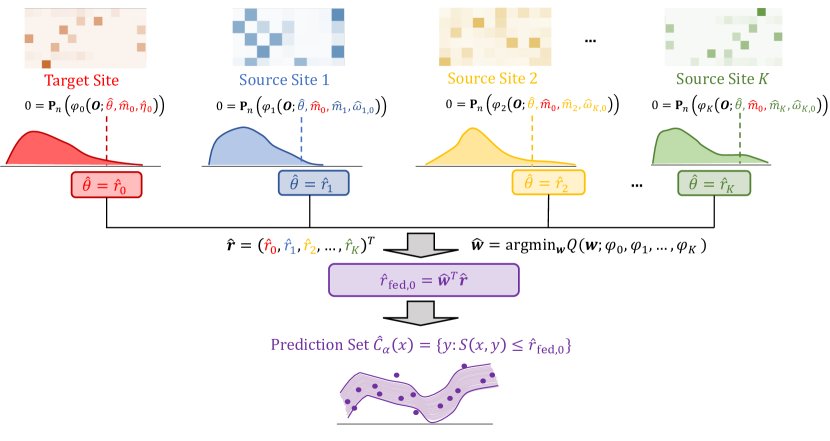
- Define conformal score S(X,Y) and target quantile r0 to achieve 1-α marginal coverage.
- Derive efficient influence functions for r0 under common conditional outcome distribution (CCOD) and missing-at-random assumptions.
- Propose cross-fitting and SuperLearner-based nuisance estimation to achieve parametric-like convergence rates.
- Introduce data-adaptive federated weighting to combine site-specific quantiles r_k when CCOD is violated.
- Provide a privacy-preserving procedure to compute density ratios and site-specific quantities with minimal data sharing.
- Offer an oracle coverage result showing the weighted aggregation can retain nominal coverage under specified conditions.
Experimental results
Research questions
- RQ1Can valid distribution-free prediction intervals be constructed for a target population using data from multiple heterogeneous sites with missing outcomes?
- RQ2How can information from source sites be integrated when conditional outcome distributions are not identical across sites?
- RQ3What are the efficient influence functions and estimation strategies that enable covariate shift and heterogeneity to be handled in multi-site conformal inference?
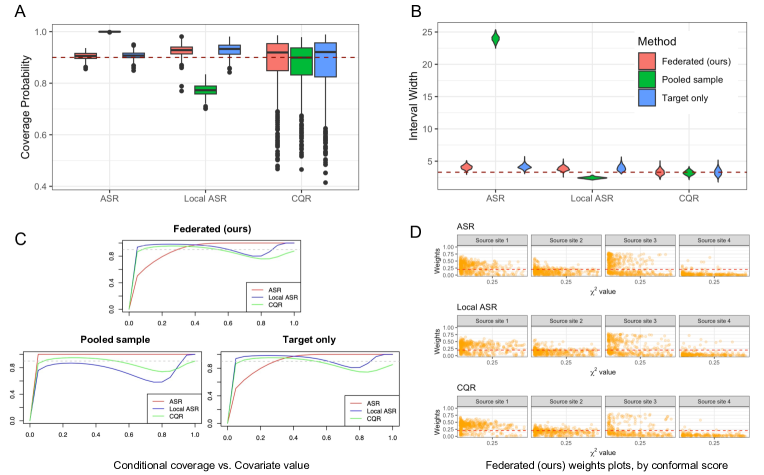
- RQ4How does data-adaptive federation affect coverage and interval width compared to target-only or pooled-sample methods?
Key findings
- The proposed method yields valid prediction intervals with nominal coverage under MAR and CCOD assumptions, while leveraging information from multiple sites.
- Efficient influence functions under CCOD enable pooling data across sites to improve estimation of the target-site quantile r0.
- A data-adaptive federation mechanism assigns weights to sites to improve efficiency when CCOD is violated, reducing bias from non-informative sources.
- Cross-fitting and SuperLearner allow flexible nuisance estimation without sacrificing coverage guarantees.
- Empirical results show federated intervals are tighter and competitively accurate compared to target-only and pooled approaches across varied simulation scenarios.
- A data application on congenital heart defect hospital LOS demonstrates tangible interval tightening over target-only methods.
Read this paper
Open the full text in the Nubint reader and ask about any passage as you read.
Read this paper on NubintThis review was generated by AI from the original paper. Please check the paper before citing it.