
[Paper Review] Multi-Task Semi-Supervised Adversarial Autoencoding for Speech Emotion Recognition
This paper proposes a multi-task semi-supervised adversarial autoencoder framework that leverages large-scale unlabeled data from auxiliary tasks—gender and speaker recognition—to improve speech emotion recognition (SER) performance. By jointly training on limited labeled emotion data and abundant unlabeled data through adversarial autoencoding and loss-weighted multi-task optimization, the model achieves state-of-the-art results on IEMOCAP and MSP-IMPROV datasets across categorical and dimensional emotion classification.
Inspite the emerging importance of Speech Emotion Recognition (SER), the state-of-the-art accuracy is quite low and needs improvement to make commercial applications of SER viable. A key underlying reason for the low accuracy is the scarcity of emotion datasets, which is a challenge for developing any robust machine learning model in general. In this paper, we propose a solution to this problem: a multi-task learning framework that uses auxiliary tasks for which data is abundantly available. We show that utilisation of this additional data can improve the primary task of SER for which only limited labelled data is available. In particular, we use gender identifications and speaker recognition as auxiliary tasks, which allow the use of very large datasets, e.g., speaker classification datasets. To maximise the benefit of multi-task learning, we further use an adversarial autoencoder (AAE) within our framework, which has a strong capability to learn powerful and discriminative features. Furthermore, the unsupervised AAE in combination with the supervised classification networks enables semi-supervised learning which incorporates a discriminative component in the AAE unsupervised training pipeline. This semi-supervised learning essentially helps to improve generalisation of our framework and thus leads to improvements in SER performance. The proposed model is rigorously evaluated for categorical and dimensional emotion, and cross-corpus scenarios. Experimental results demonstrate that the proposed model achieves state-of-the-art performance on two publicly available datasets.
Motivation & Objective
- To address the critical challenge of limited labeled speech emotion datasets, which hinders robust SER model development.
- To improve generalization and performance of speech emotion recognition by leveraging abundant unlabeled data from related auxiliary tasks.
- To integrate adversarial autoencoding with multi-task learning for semi-supervised representation learning in SER.
- To investigate the impact of loss weighting and data contribution from auxiliary tasks on primary SER performance.
- To achieve state-of-the-art results on both categorical and dimensional emotion classification across cross-corpus settings.
Proposed method
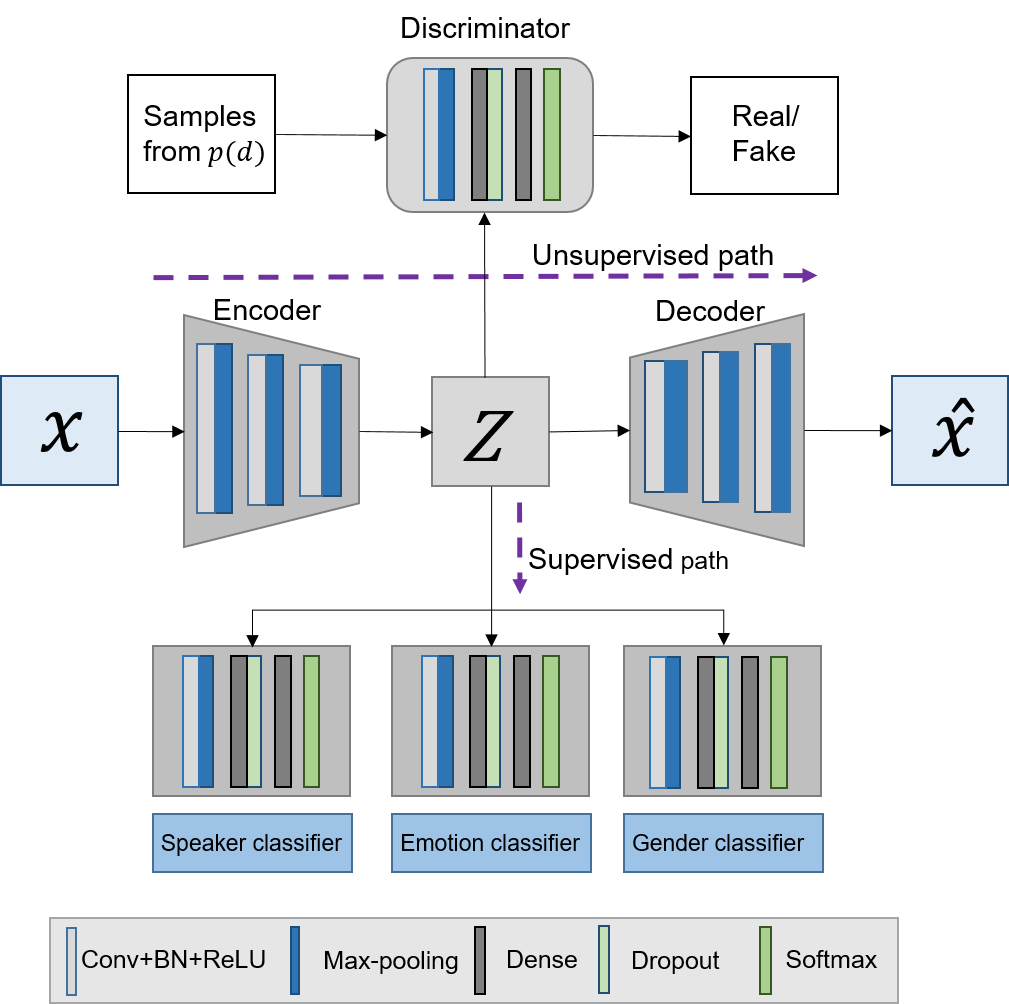
- The framework employs a multi-task learning setup with speech emotion recognition as the primary task and gender and speaker recognition as auxiliary tasks.
- An adversarial autoencoder (AAE) is used to learn powerful, disentangled, and discriminative speech representations in an unsupervised manner.
- The AAE is combined with supervised classification heads for the primary and auxiliary tasks, enabling semi-supervised training that leverages unlabeled data.
- Loss functions are weighted using hyperparameters α (unsupervised task) and β (supervised primary and secondary tasks), allowing control over contribution of each component.
- The model is trained end-to-end using a joint objective that balances reconstruction loss, adversarial loss, and classification losses.
- The framework is evaluated on IEMOCAP and MSP-IMPROV datasets for categorical emotion, valence, and activation classification.
Experimental results
Research questions
- RQ1Can the use of large-scale unlabeled data from auxiliary tasks (gender and speaker recognition) improve performance on low-resource speech emotion recognition?
- RQ2How does the integration of adversarial autoencoding enhance representation learning in a multi-task semi-supervised SER framework?
- RQ3What is the optimal balance between unsupervised and supervised losses (controlled by α and β) for maximizing SER accuracy?
- RQ4Does combining multiple auxiliary tasks yield better performance than using them individually in the multi-task setting?
- RQ5How does the proposed model generalize across different emotion classification paradigms (categorical vs. dimensional) and cross-corpus scenarios?
Key findings
- The proposed model achieves state-of-the-art performance on both IEMOCAP and MSP-IMPROV datasets for categorical, valence, and activation emotion classification.
- The model shows significant performance gains when using auxiliary tasks with large-scale unlabeled data, even though only limited labeled emotion data is available.
- The optimal range for the unsupervised loss weight α is 0.4–0.6, as values outside this range degrade performance.
- The optimal range for the supervised task weight β is 0.4–0.7, with very high or very low values reducing accuracy.
- Combining both gender and speaker recognition as auxiliary tasks leads to better performance than using either task alone.
- The framework demonstrates strong generalization across cross-corpus evaluation scenarios, indicating robustness to domain shift.
Read this paper
Open the full text in the Nubint reader and ask about any passage as you read.
Read this paper on NubintThis review was generated by AI from the original paper. Please check the paper before citing it.