
[Paper Review] MultiLegalSBD: A Multilingual Legal Sentence Boundary Detection Dataset
This paper introduces MultiLegalSBD, a multilingual legal sentence boundary detection dataset with over 130,000 annotated sentences across six languages. It demonstrates that existing SBD models underperform on legal text, while monolingual and multilingual models—especially transformer-based ones—achieve state-of-the-art F1 scores above 96% on multilingual data and over 90% in zero-shot evaluation on unseen Portuguese legal text.
Sentence Boundary Detection (SBD) is one of the foundational building blocks of Natural Language Processing (NLP), with incorrectly split sentences heavily influencing the output quality of downstream tasks. It is a challenging task for algorithms, especially in the legal domain, considering the complex and different sentence structures used. In this work, we curated a diverse multilingual legal dataset consisting of over 130'000 annotated sentences in 6 languages. Our experimental results indicate that the performance of existing SBD models is subpar on multilingual legal data. We trained and tested monolingual and multilingual models based on CRF, BiLSTM-CRF, and transformers, demonstrating state-of-the-art performance. We also show that our multilingual models outperform all baselines in the zero-shot setting on a Portuguese test set. To encourage further research and development by the community, we have made our dataset, models, and code publicly available.
Motivation & Objective
- Address the lack of high-quality, multilingual legal sentence boundary detection (SBD) datasets, which hinders robust NLP in legal text processing.
- Demonstrate that existing SBD systems perform poorly on legal text due to complex sentence structures, abbreviations, and domain-specific formatting.
- Develop and evaluate monolingual and multilingual SBD models using CRF, BiLSTM-CRF, and transformer architectures to improve performance on legal documents.
- Evaluate zero-shot transfer performance on unseen Portuguese legal text to assess cross-lingual generalization capabilities.
- Release the dataset, models, and code to foster community research and development in multilingual legal NLP.
Proposed method
- Curated a multilingual legal SBD dataset with over 130,000 annotated sentences from French, German, Italian, Spanish, English, and Portuguese legal texts.
- Employed a single native German speaker with intermediate French skills to annotate all languages, prioritizing consistency across languages despite language-specific nuances.
- Trained and evaluated monolingual and multilingual models using CRF, BiLSTM-CRF, and transformer-based architectures (e.g., BERT, XLM-RoBERTa) on the dataset.
- Applied standard NLP preprocessing such as replacing newlines with spaces and normalizing special characters to improve model generalization.
- Conducted zero-shot evaluation on Portuguese legal text to test cross-lingual transfer, comparing performance across model types.
- Optimized hyperparameters and explored architectural improvements, including legal-optimized pre-trained models and larger cross-lingual encoders like XLM-RoBERTa.
Experimental results
Research questions
- RQ1What is the performance of existing SBD systems on legal data in French, Spanish, Italian, English, and German?
- RQ2To what extent can we improve SBD performance through monolingual and multilingual models based on CRF, BiLSTM-CRF, and transformers?
- RQ3How do multilingual models perform on unseen Portuguese legal text in a zero-shot setting?
- RQ4Can sentence structure types (e.g., citations, lists) be leveraged to improve model performance through structured labeling?
- RQ5Does cross-lingual transfer generalize to languages from different language families, such as Hungarian?
Key findings
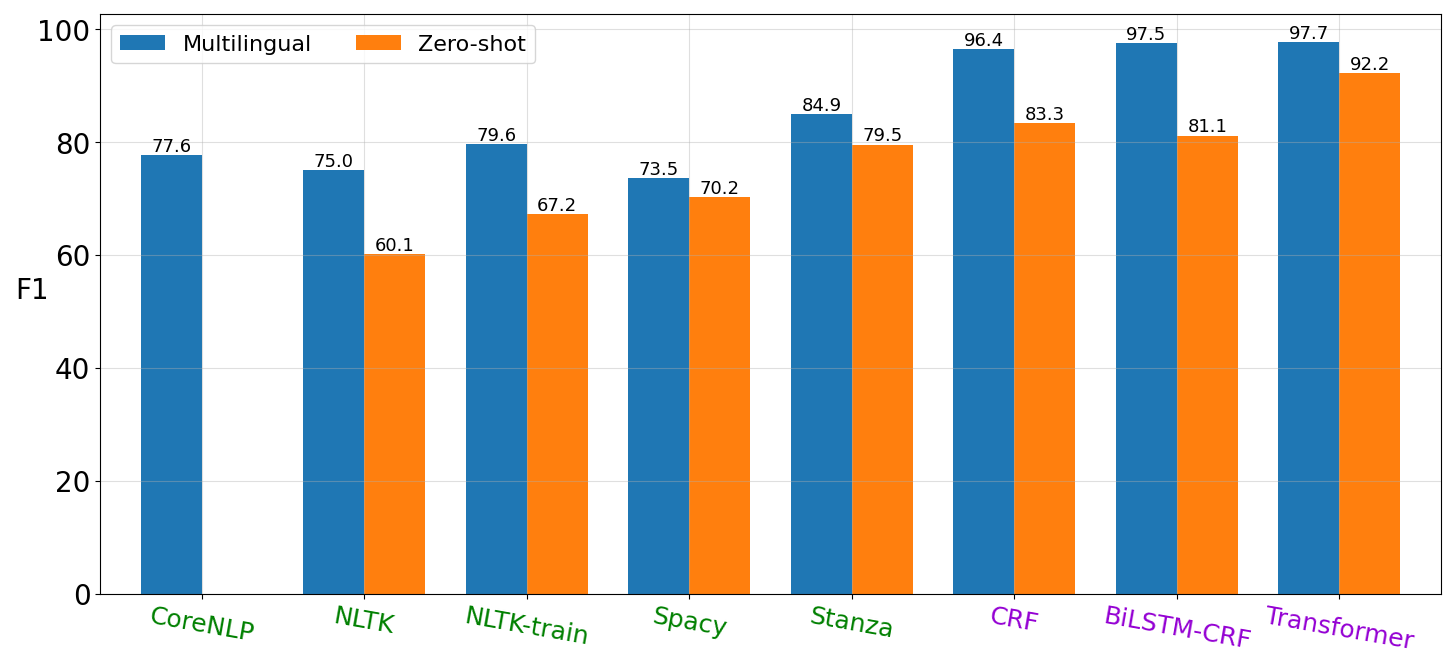
- Existing SBD systems achieve F1-scores between 73.5 and 84.9 on multilingual legal text and 60.1 to 79.5 on Portuguese, indicating subpar performance in the legal domain.
- Monolingual models trained on the MultiLegalSBD dataset achieve state-of-the-art F1-scores in the high nineties (96.4–97.7) across French, German, Italian, Spanish, and English.
- Multilingual transformer models achieve F1-scores of 96.4–97.7 on multilingual legal text and 81.1–92.2 on zero-shot Portuguese test sets, outperforming all baselines.
- The multilingual transformer model achieves an F1-score of 92.2 on Portuguese legal text, significantly outperforming CRF and BiLSTM-CRF models, which drop to baseline levels on the laws subset.
- CRF and BiLSTM-CRF models perform decently (around 90% F1) on Portuguese judgements but degrade substantially (to baseline levels) on legal texts, indicating limited zero-shot generalization.
- The study suggests that future improvements could come from sentence-type-aware labeling, better pre-processing, and using legal-optimized or larger multilingual pre-trained models like XLM-RoBERTa.
Read this paper
Open the full text in the Nubint reader and ask about any passage as you read.
Read this paper on NubintThis review was generated by AI from the original paper. Please check the paper before citing it.