
[Paper Review] Multilingual Holistic Bias: Extending Descriptors and Patterns to Unveil Demographic Biases in Languages at Scale
This paper introduces MultilingualHolisticBias, a multilingual extension of the HolisticBias dataset with 20,459 sentences across 50 languages and 13 demographic axes, using templated sentence structures and gendered translations to quantify demographic biases in machine translation and multilingual sentence embeddings. Key findings show a consistent 8 spBLEU performance gap in EN-to-XX translations favoring masculine references, and a 4 spBLEU advantage for masculine inputs in XX-to-EN translation, indicating systemic gender bias in model behavior.
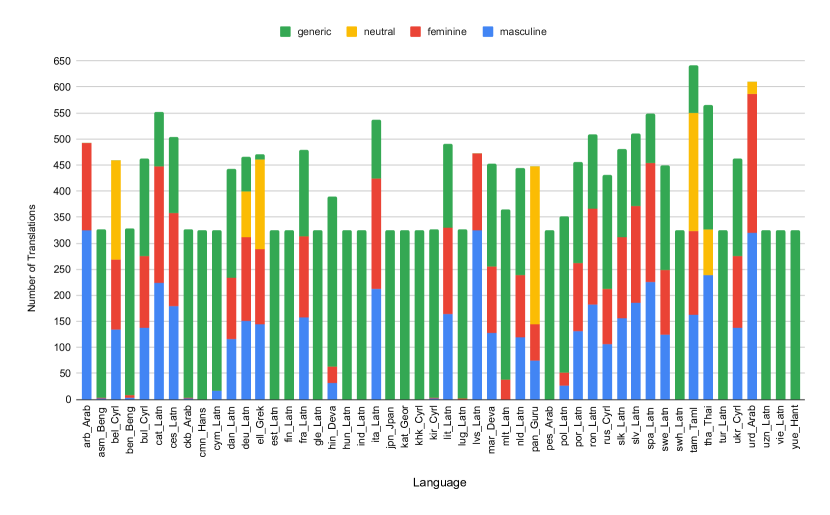
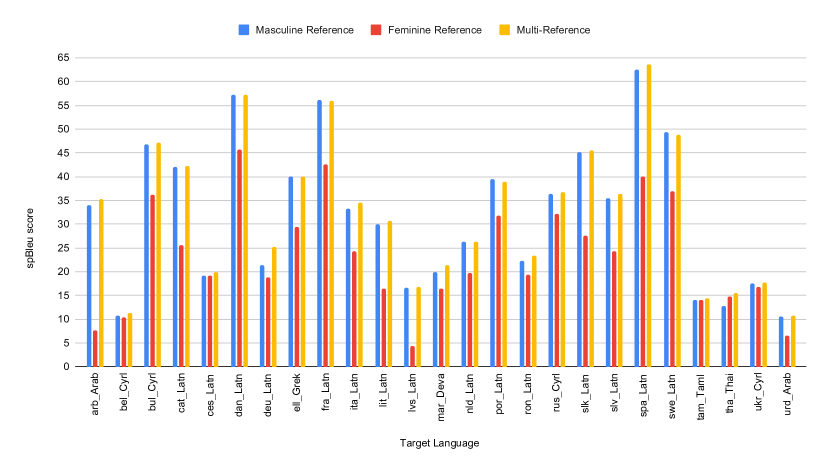
We introduce a multilingual extension of the HOLISTICBIAS dataset, the largest English template-based taxonomy of textual people references: MULTILINGUALHOLISTICBIAS. This extension consists of 20,459 sentences in 50 languages distributed across all 13 demographic axes. Source sentences are built from combinations of 118 demographic descriptors and three patterns, excluding nonsensical combinations. Multilingual translations include alternatives for gendered languages that cover gendered translations when there is ambiguity in English. Our benchmark is intended to uncover demographic imbalances and be the tool to quantify mitigations towards them. Our initial findings show that translation quality for EN-to-XX translations is an average of 8 spBLEU better when evaluating with the masculine human reference compared to feminine. In the opposite direction, XX-to-EN, we compare the robustness of the model when the source input only differs in gender (masculine or feminine) and masculine translations are an average of almost 4 spBLEU better than feminine. When embedding sentences to a joint multilingual sentence representations space, we find that for most languages masculine translations are significantly closer to the English neutral sentences when embedded.
Motivation & Objective
- To extend the HolisticBias dataset to 50 languages and 13 demographic axes to enable large-scale evaluation of demographic biases in NLP.
- To quantify gender bias in multilingual machine translation systems using controlled, template-based sentence generation.
- To assess the robustness of multilingual sentence representations (e.g., LaBSE) to gendered variations in translated sentences.
- To provide a standardized benchmark for evaluating and mitigating demographic biases in highly multilingual NLP models.
Proposed method
- The dataset is constructed by translating 118 demographic descriptors and three sentence patterns from English into 50 languages, preserving gendered distinctions where applicable.
- Translations are performed by human annotators using English source sentences, with separate masculine and feminine reference translations for gender-inflected languages.
- Translation quality is evaluated using spBLEU scores between model outputs and gender-specific reference sets (masculine vs. feminine).
- Multilingual sentence embeddings are generated using LaBSE, and cosine similarity between English neutral sentences and gendered translations is computed to assess bias.
- Statistical significance of differences in embedding similarity is tested using hypothesis testing (p < 0.01) across languages.
- The dataset is designed to support evaluation of MT systems, sentence representations, and bias mitigation strategies across diverse demographic axes.
Experimental results
Research questions
- RQ1Does machine translation exhibit a systematic preference for masculine over feminine gendered references across multiple languages?
- RQ2How does the performance of multilingual translation models vary when the input sentence is gendered (masculine vs. feminine) in the source language?
- RQ3To what extent do multilingual sentence embeddings preserve semantic similarity between neutral English sentences and their masculine or feminine translations?
- RQ4Are there demographic axes (e.g., nationality, ability, religion) where translation quality varies significantly based on gendered descriptors?
- RQ5How does the presence of gendered morphology in a language affect the detectability of gender bias in translation and embedding models?
Key findings
- EN-to-XX translation performance is on average 8 spBLEU higher when evaluating against the masculine reference set compared to the feminine reference set.
- XX-to-EN translation performance shows an average improvement of almost 4 spBLEU when the source input is masculine rather than feminine, indicating gender bias in model robustness.
- For most languages, masculine translations are significantly closer (p < 0.01) to the English neutral sentence in the multilingual embedding space than are feminine translations.
- The highest translation quality is observed for the nationality axis, while the lowest is for the cultural axis across languages.
- The gender bias in embeddings is most pronounced in languages like Modern Standard Arabic, Spanish, Italian, and Russian, with a maximum mean cosine distance difference of 0.09 between masculine and feminine translations.
- The dataset reveals that gender bias is not limited to gender but extends to other axes such as socioeconomic status, where 'one-percenter' shows stronger masculine stereotyping.
Read this paper
Open the full text in the Nubint reader and ask about any passage as you read.
Read this paper on NubintThis review was generated by AI from the original paper. Please check the paper before citing it.