
[Paper Review] Multilingual LLMs are Better Cross-lingual In-context Learners with Alignment
This paper proposes X-InSTA, a novel in-context learning prompt design strategy for multilingual large language models that improves cross-lingual text classification by enforcing semantic coherence in input examples and task-based alignment between source and target language labels. It significantly outperforms random prompt selection across 44 cross-lingual pairs on three tasks, demonstrating that structured alignment enhances zero-shot cross-lingual generalization without fine-tuning.
In-context learning (ICL) unfolds as large language models become capable of inferring test labels conditioned on a few labeled samples without any gradient update. ICL-enabled large language models provide a promising step forward toward bypassing recurrent annotation costs in a low-resource setting. Yet, only a handful of past studies have explored ICL in a cross-lingual setting, in which the need for transferring label-knowledge from a high-resource language to a low-resource one is immensely crucial. To bridge the gap, we provide the first in-depth analysis of ICL for cross-lingual text classification. We find that the prevalent mode of selecting random input-label pairs to construct the prompt-context is severely limited in the case of cross-lingual ICL, primarily due to the lack of alignment in the input as well as the output spaces. To mitigate this, we propose a novel prompt construction strategy -- Cross-lingual In-context Source-Target Alignment (X-InSTA). With an injected coherence in the semantics of the input examples and a task-based alignment across the source and target languages, X-InSTA is able to outperform random prompt selection by a large margin across three different tasks using 44 different cross-lingual pairs.
Motivation & Objective
- To address the limited performance of in-context learning in cross-lingual settings due to poor alignment in input and output spaces.
- To investigate why random selection of labeled examples in prompts fails for cross-lingual transfer.
- To design a prompt construction strategy that improves zero-shot cross-lingual generalization in multilingual LLMs without fine-tuning.
- To evaluate the impact of semantic coherence and task-specific label alignment on in-context learning performance across diverse language pairs.
Proposed method
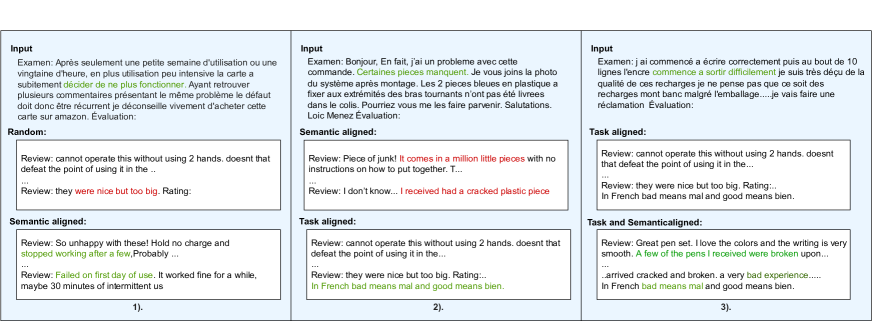
- Proposes X-InSTA, a two-stage prompt construction strategy combining semantic alignment of input examples and task-based alignment of label spaces between source and target languages.
- Uses similarity-based selection to group input examples sharing common semantic concepts, improving coherence in the prompt context.
- Introduces manually designed, task-specific mappings between source and target language labels to enable smoother transitions from source to target language predictions.
- Employs a hybrid prompting approach where both semantic and task-level alignment are applied simultaneously to maximize model performance.
- Constructs prompts using selected, aligned examples to improve the LLM’s ability to infer test labels from context without gradient updates.
- Validates the method across three cross-lingual text classification tasks using 44 multilingual pairs, comparing against random prompt selection.
Experimental results
Research questions
- RQ1Why does random prompt selection fail in cross-lingual in-context learning despite the model’s zero-shot capabilities?
- RQ2To what extent does semantic coherence in input examples improve cross-lingual in-context learning performance?
- RQ3How does task-based label alignment between source and target languages affect in-context learning accuracy?
- RQ4Can a combination of semantic and task alignment outperform either strategy in isolation?
- RQ5Does the effectiveness of X-InSTA vary across different language pairs or task types?
Key findings
- X-InSTA significantly outperforms random prompt selection across all 44 cross-lingual pairs evaluated in the study, demonstrating consistent gains in zero-shot cross-lingual text classification.
- Semantic alignment alone improves performance by reducing irrelevant or contradictory context transitions, especially when input examples share common concepts.
- Task-based label alignment further enhances performance, particularly in language pairs with strong semantic and syntactic divergence.
- The combination of semantic and task alignment yields the highest performance, indicating complementary benefits of both strategies.
- The method is robust across diverse tasks and language pairs, showing consistent improvements regardless of linguistic distance.
- The static, manually designed aligners limit scalability, suggesting a need for automated alignment methods in future work.
Read this paper
Open the full text in the Nubint reader and ask about any passage as you read.
Read this paper on NubintThis review was generated by AI from the original paper. Please check the paper before citing it.