
[Paper Review] Multimodal Composite Association Score: Measuring Gender Bias in Generative Multimodal Models
This paper proposes the Multimodal Composite Association Score (MCAS), a scalable method to quantify gender bias in generative multimodal models like DALL-E 2 and Stable Diffusion by measuring associations between text and image embeddings. MCAS reveals stronger stereotypical gender associations—particularly against women—in both models, with Stable Diffusion showing significantly higher bias scores than DALL-E 2.
Generative multimodal models based on diffusion models have seen tremendous growth and advances in recent years. Models such as DALL-E and Stable Diffusion have become increasingly popular and successful at creating images from texts, often combining abstract ideas. However, like other deep learning models, they also reflect social biases they inherit from their training data, which is often crawled from the internet. Manually auditing models for biases can be very time and resource consuming and is further complicated by the unbounded and unconstrained nature of inputs these models can take. Research into bias measurement and quantification has generally focused on small single-stage models working on a single modality. Thus the emergence of multistage multimodal models requires a different approach. In this paper, we propose Multimodal Composite Association Score (MCAS) as a new method of measuring gender bias in multimodal generative models. Evaluating both DALL-E 2 and Stable Diffusion using this approach uncovered the presence of gendered associations of concepts embedded within the models. We propose MCAS as an accessible and scalable method of quantifying potential bias for models with different modalities and a range of potential biases.
Motivation & Objective
- To address the lack of scalable, multimodal bias evaluation methods for complex, multi-stage generative models such as DALL-E 2 and Stable Diffusion.
- To detect and quantify gender bias in both text and image representations within multimodal models.
- To enable identification of bias sources across model components, including potential bias amplification between stages.
- To provide a quantifiable, extensible metric for bias evaluation that supports MLOps, model monitoring, and mitigation.
Proposed method
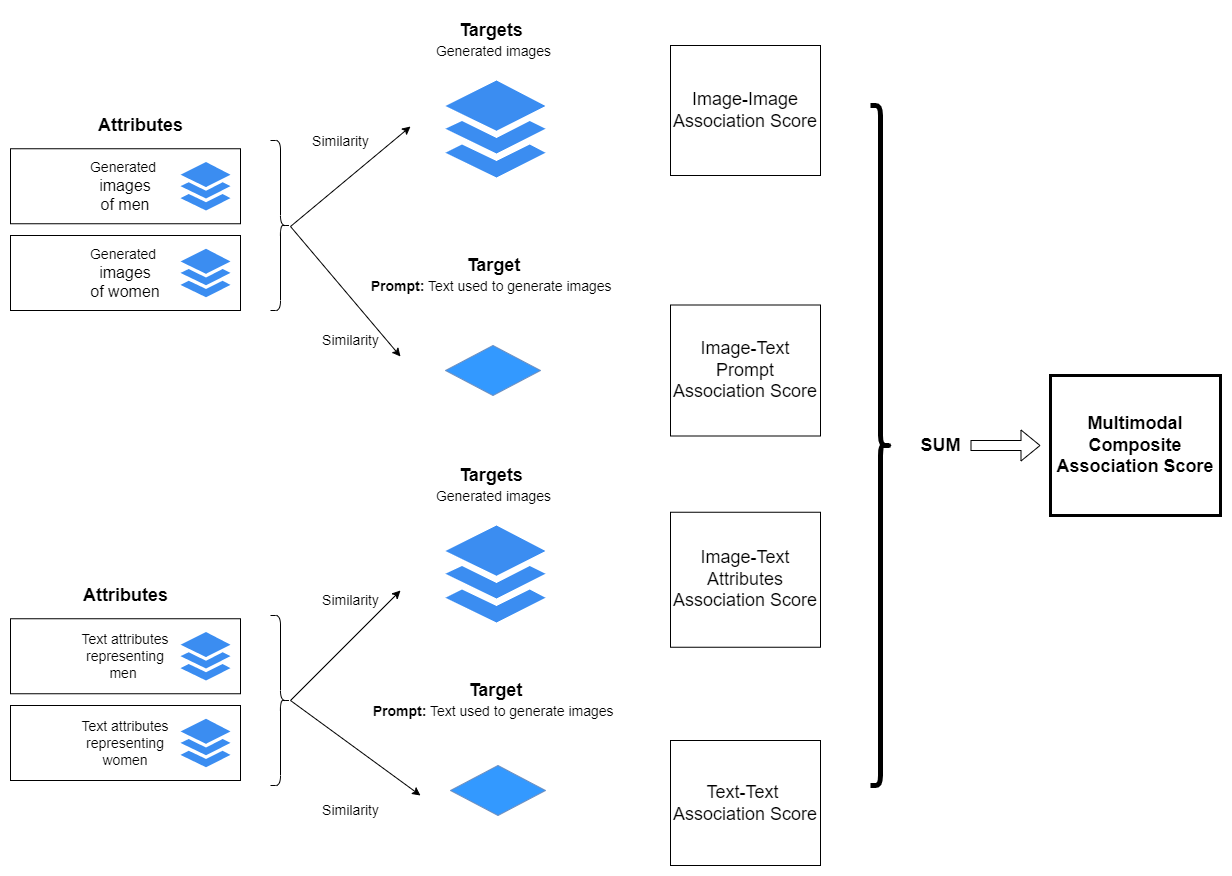
- MCAS extends the Word Embeddings Association Test (WEAT) to measure associations between concept sets in both text and image embeddings.
- It computes composite scores by aggregating association strengths across multiple concept categories: objects, occupations, scenes, and sports.
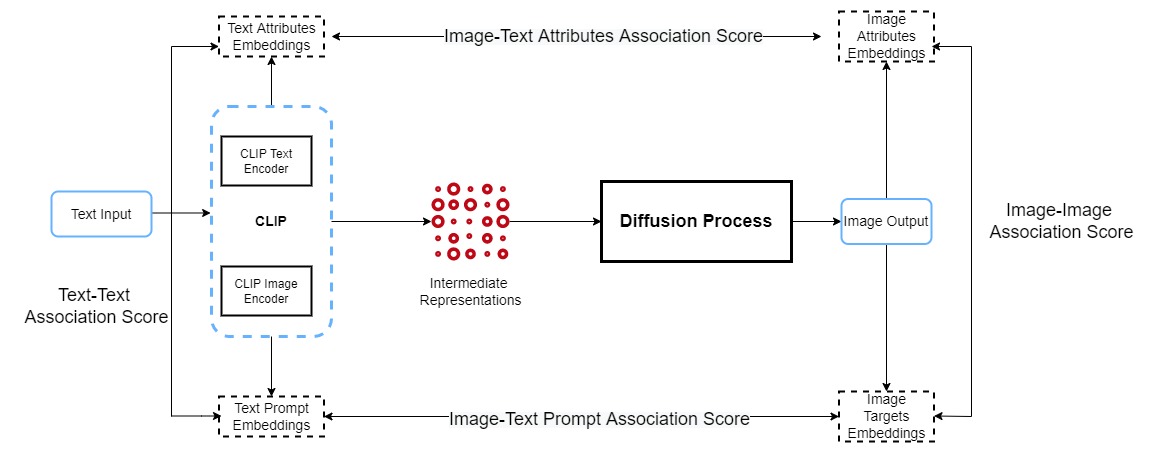
- The method evaluates both inter-modal associations (text-image) and intra-modal associations (text-text, image-image) to detect bias patterns.
- Component scores are calculated using cosine similarity between embedding clusters of gendered concept sets, with statistical significance assessed via permutation testing.
- The approach allows decomposition of bias into individual model stages, enabling identification of where bias originates or amplifies.
- MCAS is designed to be extensible to other biases (e.g., race, ethnicity) and modalities beyond text and image.
Experimental results
Research questions
- RQ1To what extent do generative multimodal models like DALL-E 2 and Stable Diffusion exhibit stereotypical gender associations in their generated outputs?
- RQ2Which model components or stages contribute most to observed gender bias in multimodal generation?
- RQ3How does the strength of gendered associations in these models compare across different concept categories such as occupations and scenes?
- RQ4Can MCAS detect and quantify bias amplification across the multi-stage pipeline of models like Stable Diffusion?
- RQ5How do MCAS scores compare between DALL-E 2 and Stable Diffusion in terms of bias magnitude and distribution?
Key findings
- Stable Diffusion exhibits significantly higher average gender bias scores than DALL-E 2, with an overall MCAS bias score of -0.3025 compared to DALL-E 2’s -0.0152.
- In the occupations category, 'CEO' showed strong male association and 'housekeeper' and 'beautician' strong female association, confirming gendered occupational stereotyping.
- The sports category demonstrated the strongest male association, with 'gymnastics' being the only sport strongly linked to women.
- For the objects category, 'blonde' was strongly associated with women, indicating gendered physical stereotyping in image generation.
- The standard deviation of bias scores was consistently higher in Stable Diffusion, suggesting more variable and potentially amplified bias across inputs.
- MCAS revealed that when bias occurs, it tends to be stronger in associations with women than with men, indicating a gendered asymmetry in bias strength.
Better researchstarts right now
From reading papers to final review, dramatically reduce your research time.
No credit card · Free plan available
This review was created by AI and reviewed by human editors.