
[Paper Review] Multimodal Foundation Models: From Specialists to General-Purpose Assistants
This paper provides a comprehensive taxonomy and evolution review of multimodal foundation models, detailing the shift from specialist vision models to general-purpose visual assistants guided by large language models and tool chaining.
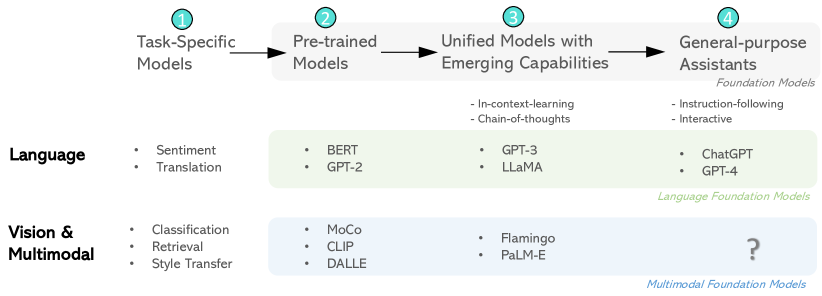
This paper presents a comprehensive survey of the taxonomy and evolution of multimodal foundation models that demonstrate vision and vision-language capabilities, focusing on the transition from specialist models to general-purpose assistants. The research landscape encompasses five core topics, categorized into two classes. (i) We start with a survey of well-established research areas: multimodal foundation models pre-trained for specific purposes, including two topics -- methods of learning vision backbones for visual understanding and text-to-image generation. (ii) Then, we present recent advances in exploratory, open research areas: multimodal foundation models that aim to play the role of general-purpose assistants, including three topics -- unified vision models inspired by large language models (LLMs), end-to-end training of multimodal LLMs, and chaining multimodal tools with LLMs. The target audiences of the paper are researchers, graduate students, and professionals in computer vision and vision-language multimodal communities who are eager to learn the basics and recent advances in multimodal foundation models.
Motivation & Objective
- Explain the landscape and taxonomy of multimodal foundation models in vision and vision-language domains.
- Analyze learning paradigms for visual understanding and generation across supervision signals.
- Discuss steps toward general-purpose visual assistants and interaction with LLMs.
- Present emerging topics: unified vision models, end-to-end multimodal LLMs, and tool chaining with LLMs.
Proposed method
- Classify multimodal foundation models into specific-purpose vs. general-purpose assistant categories.
- Survey historical and contemporary learning paradigms: supervised pre-training, language supervision, and image-only self-supervised learning.
- Summarize visual generation approaches including text-to-image and text-based editing paradigms.
- Describe the progression toward unified vision models and interaction with LLMs for multimodal tasks.
- Discuss training strategies for large multimodal models and the design of multimodal agents that chain tools with LLMs.

Experimental results
Research questions
- RQ1What are the core components and learning paradigms that underpin multimodal foundation models in vision and vision-language tasks?
- RQ2How do current approaches transition from specialist models to general-purpose visual assistants?
- RQ3What are the key challenges and emerging directions for unified vision models, end-to-end multimodal LLMs, and tool-chaining multimodal agents?
Key findings
- Identification of a two-class taxonomy: specific-purpose pre-trained models and general-purpose assistants.
- Documentation of three broad topics for general-purpose assistants: unified vision models, end-to-end multimodal LLMs, and tool chaining with LLMs.
- Summarization of learning signals for visual understanding: label supervision, language supervision, and image-only self-supervision, plus multimodal fusion and pixel/region-level pre-training.
- Overview of visual generation trends, including text-conditioned generation and human-aligned generation techniques.
- Discussion of progress toward multimodal agents and the integration of vision models with LLMs for interactive, tool-augmented capabilities.
Read this paper
Open the full text in the Nubint reader and ask about any passage as you read.
Read this paper on NubintThis review was generated by AI from the original paper. Please check the paper before citing it.