
[Paper Review] MultiModal-GPT: A Vision and Language Model for Dialogue with Humans
MultiModal-GPT fine-tunes OpenFlamingo with LoRA for multimodal dialogue, using unified vision-language and language-only instruction data to improve multi-turn human conversations.
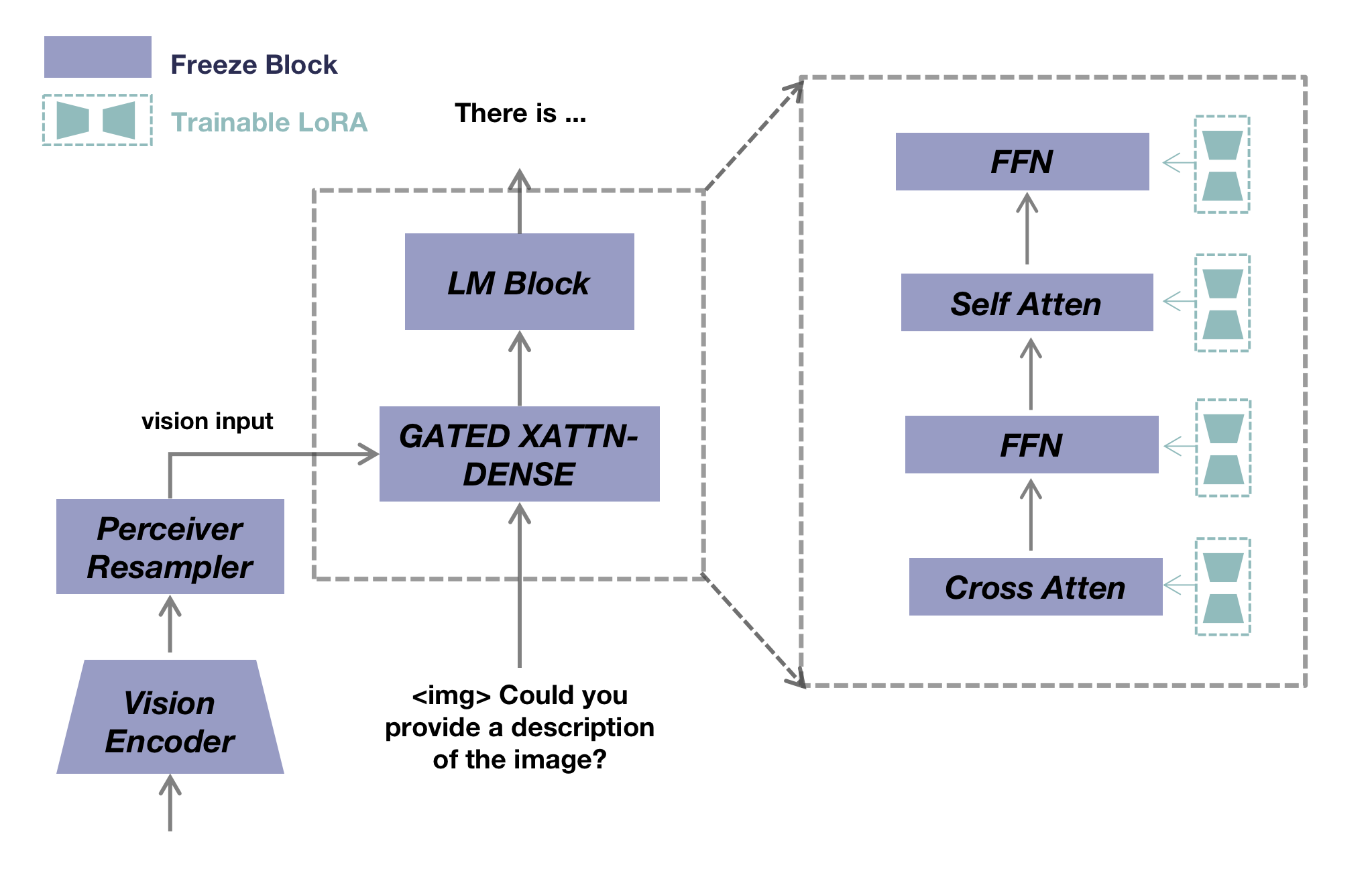
We present a vision and language model named MultiModal-GPT to conduct multi-round dialogue with humans. MultiModal-GPT can follow various instructions from humans, such as generating a detailed caption, counting the number of interested objects, and answering general questions from users. MultiModal-GPT is parameter-efficiently fine-tuned from OpenFlamingo, with Low-rank Adapter (LoRA) added both in the cross-attention part and the self-attention part of the language model. We first construct instruction templates with vision and language data for multi-modality instruction tuning to make the model understand and follow human instructions. We find the quality of training data is vital for the dialogue performance, where few data containing short answers can lead the model to respond shortly to any instructions. To further enhance the ability to chat with humans of the MultiModal-GPT, we utilize language-only instruction-following data to train the MultiModal-GPT jointly. The joint training of language-only and visual-language instructions with the \emph{same} instruction template effectively improves dialogue performance. Various demos show the ability of continuous dialogue of MultiModal-GPT with humans. Code, dataset, and demo are at https://github.com/open-mmlab/Multimodal-GPT
Motivation & Objective
- Motivate the development of a versatile multimodal dialogue agent that can follow diverse vision-language instructions.
- Enable efficient fine-tuning by leveraging Low-rank Adaptation (LoRA) on a frozen base model.
- Develop unified instruction templates to train on both vision-language data and language-only data.
- Investigate the impact of data quality on dialogue performance and identify datasets that may degrade performance.
- Demonstrate continuous human-like dialogue capabilities through qualitative demos and evaluations.
Proposed method
- Base architecture builds on OpenFlamingo with a vision encoder from CLIP and a perceiver resampler feeding a LLaMA language decoder.
- LoRA is applied to self-attention, cross-attention, and feed-forward networks within the language decoder during fine-tuning.
- A unified instruction template is used to convert language-only and vision-language data into a common training format.
- Joint training uses both language-only instruction data (e.g., Dolly 15k, Alpaca GPT4) and vision-language instruction data (e.g., LLaVA, Mini-GPT4, A-OKVQA, COCO Caption, OCR VQA).
- Only the response and EOS tokens contribute to loss, with the model predicting the next token.
- Training details include eight A100 GPUs, one epoch, batch size 1 per GPU, gradient accumulation, and LoRA updates every 16 iterations.
Experimental results
Research questions
- RQ1Can a unified vision-language and language-only instruction template enable effective multimodal dialogue through joint training?
- RQ2How does the quality and composition of training data affect the quality and length of multimodal conversational responses?
- RQ3Does freezing the base model and using LoRA for targeted components yield robust multimodal dialogue performance?
- RQ4What is the impact of including diverse vision-language datasets on continuous dialogue abilities?
- RQ5Can the model maintain coherent multi-turn conversations and perform tasks like counting, description, and general inquiries?
Key findings
- Data quality critically impacts dialogue performance; datasets with short responses can lead to overly brief model replies.
- Joint training with both vision-language and language-only instruction data significantly improves conversational abilities compared to using either alone.
- Excluding low-quality or overly terse datasets (e.g., VQA v2.0, OKVQA, GQA, CLEVR, NLVR) prevents rush to brief answers and improves user-friendliness.
- A unified instruction template effectively leverages both data modalities to enhance multimodal understanding and response generation.
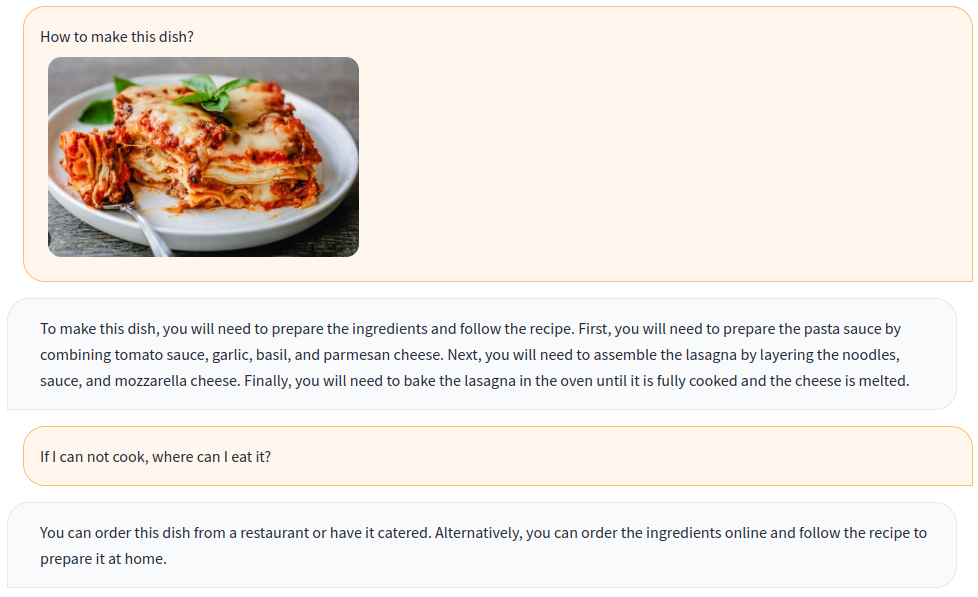
- The approach demonstrates continuous dialogues with humans across various demonstrated tasks (e.g., recipes, dining recommendations, OCR, counting).
- Code, dataset, and demos are available at the project repository https://github.com/open-mmlab/Multimodal-GPT.
Read this paper
Open the full text in the Nubint reader and ask about any passage as you read.
Read this paper on NubintThis review was generated by AI from the original paper. Please check the paper before citing it.