
[Paper Review] Multimodal Image-Text Matching Improves Retrieval-based Chest X-Ray Report Generation
X-REM uses a multimodal image-text matching score to retrieve radiology reports for chest X-rays, outperforming prior retrieval-based and image-captioning methods in clinical and natural language metrics, with favorable human evaluations.
Automated generation of clinically accurate radiology reports can improve patient care. Previous report generation methods that rely on image captioning models often generate incoherent and incorrect text due to their lack of relevant domain knowledge, while retrieval-based attempts frequently retrieve reports that are irrelevant to the input image. In this work, we propose Contrastive X-Ray REport Match (X-REM), a novel retrieval-based radiology report generation module that uses an image-text matching score to measure the similarity of a chest X-ray image and radiology report for report retrieval. We observe that computing the image-text matching score with a language-image model can effectively capture the fine-grained interaction between image and text that is often lost when using cosine similarity. X-REM outperforms multiple prior radiology report generation modules in terms of both natural language and clinical metrics. Human evaluation of the generated reports suggests that X-REM increased the number of zero-error reports and decreased the average error severity compared to the baseline retrieval approach. Our code is available at: https://github.com/rajpurkarlab/X-REM
Motivation & Objective
- Motivate automated, clinically accurate radiology report generation to support radiologists and patient care.
- Address limitations of image-captioning models that hallucinate or are incoherent.
- Propose a retrieval-based framework using a learned image-text matching score to select clinically relevant reports.
- Leverage domain-specific pre-training and supervised contrastive learning to align X-ray images with radiology reports.
Proposed method
- Adopts a three-layer X-REM pipeline with unimodal image/text encoders and a multimodal encoder.
- Uses ALBEF as the backbone language-image model to produce image-text embeddings and a multimodal image-text matching score.
- Retrieval workflow: filter by cosine similarity on unimodal embeddings, then select top candidates by image-text matching score.
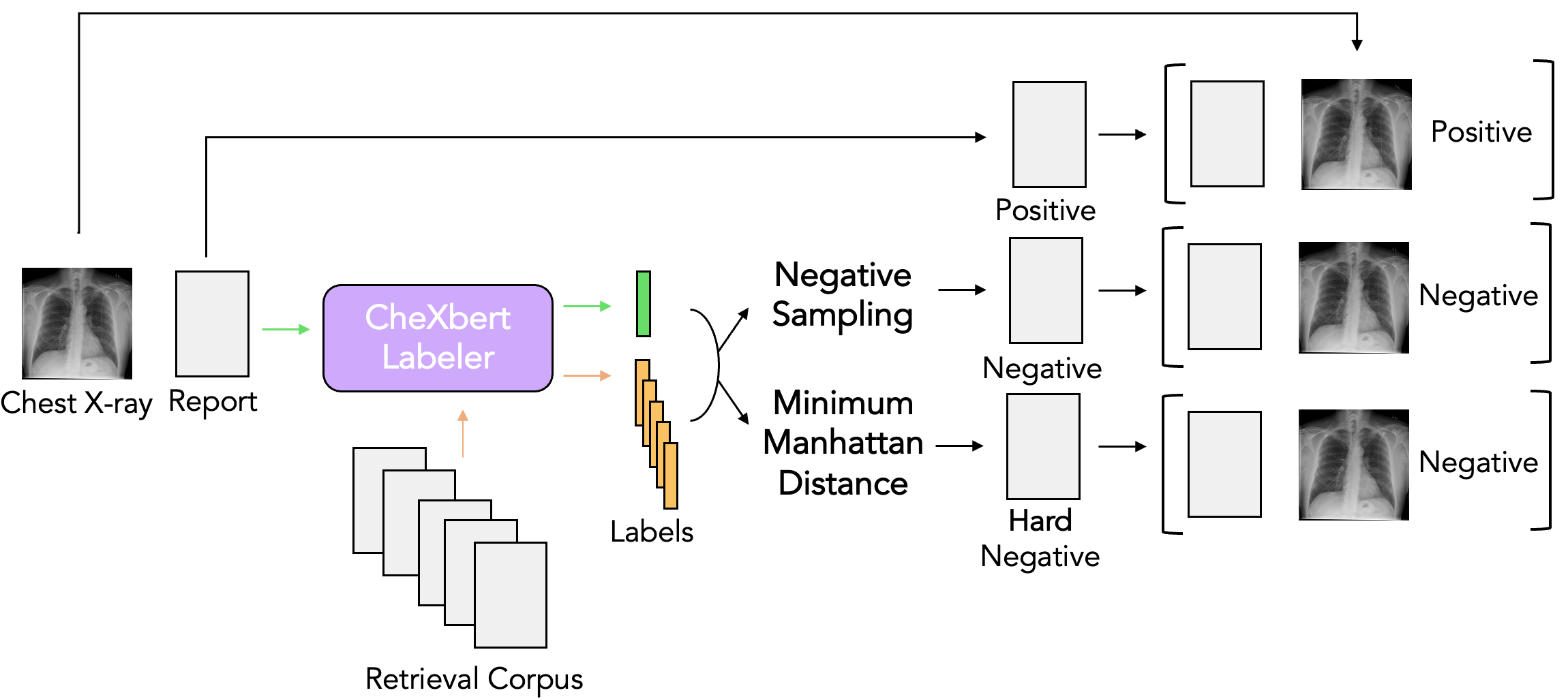
- Applies a natural language inference (NLI) based filter to remove redundant or conflicting reports.
- Fine-tunes the model on image-text matching and NLI tasks with supervised clinical labels for negatives.
- Trains and evaluates on a MIMIC-CXR derived dataset with impressions, findings, or both, and reports RadCliQ, RadGraph F1, CheXbert, BERTScore, and BLEU2.

Experimental results
Research questions
- RQ1Does using a learned image-text matching score improve retrieval-based radiology report generation over cosine similarity and baseline retrieval methods?
- RQ2Can a multimodal encoder with supervised contrastive learning better capture image-text interactions in the radiology domain?
- RQ3What is the impact of domain-specific pre-training on model performance and clinical accuracy of generated reports?
- RQ4How does X-REM perform across different report sections (impression, findings, or both) compared to prior methods?
- RQ5What is the effect of post-retrieval filtering (NLI, content redundancy) on report quality and error rates?
Key findings
- X-REM outperforms prior radiology report generation modules on clinical and natural language metrics.
- Human evaluation shows X-REM increases zero-error reports by 70% versus the baseline retrieval model.
- Among evaluated reports, 18% generated by X-REM had zero mistakes, versus 9% for the baseline and 34% for the human benchmark.
- Image-text matching score provides a stronger similarity signal than cosine similarity for retrieval.
- A domain-pretrained and fine-tuned ALBEF-based model yields better RadCliQ, RadGraph F1, CheXbert similarity, and BERTScore than several baselines.
Read this paper
Open the full text in the Nubint reader and ask about any passage as you read.
Read this paper on NubintThis review was generated by AI from the original paper. Please check the paper before citing it.