
[Paper Review] Multimodal Large Language Models: A Survey
A survey that defines multimodal models, surveys historical development, architectures, datasets, and practical guidance for building and evaluating multimodal large language models.
The exploration of multimodal language models integrates multiple data types, such as images, text, language, audio, and other heterogeneity. While the latest large language models excel in text-based tasks, they often struggle to understand and process other data types. Multimodal models address this limitation by combining various modalities, enabling a more comprehensive understanding of diverse data. This paper begins by defining the concept of multimodal and examining the historical development of multimodal algorithms. Furthermore, we introduce a range of multimodal products, focusing on the efforts of major technology companies. A practical guide is provided, offering insights into the technical aspects of multimodal models. Moreover, we present a compilation of the latest algorithms and commonly used datasets, providing researchers with valuable resources for experimentation and evaluation. Lastly, we explore the applications of multimodal models and discuss the challenges associated with their development. By addressing these aspects, this paper aims to facilitate a deeper understanding of multimodal models and their potential in various domains.
Motivation & Objective
- Define multimodal models and situate them in the history of multimodal research.
- Summarize key architectural patterns, learning objectives, and information fusion techniques for multimodal LLMs.
- Provide a practical guide to technical aspects such as knowledge representation, prompts, and datasets for evaluation.
- Review current datasets, algorithms, and prominent models from industry and academia.
- Discuss applications and challenges to guide future research in multimodal AI.
Proposed method
- Define multimodal concepts and classify homogeneous vs. heterogeneous modalities.
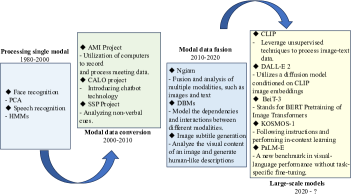
- Outline historical stages of multimodal research (single modality, modality conversion, fusion, large-scale models).
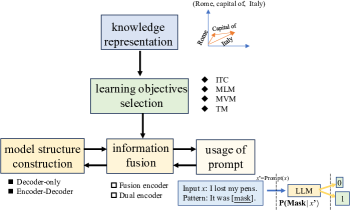
- Present a practical guide covering knowledge representation, learning objectives, model construction, information fusion, and prompting.
- Review foundational and large-scale multimodal pre-trained models and their architectures (encoder-only vs. encoder-decoder).
- Describe information fusion strategies (fusion encoder vs. dual encoder) and implications for inference vs. retrieval.
- Summarize prominent models and open-source implementations in a tabular form.
Experimental results
Research questions
- RQ1What defines multimodal models and how have they evolved historically?
- RQ2What are the core technical considerations (representation, objectives, fusion, prompting) for building multimodal LLMs?
- RQ3How do different model architectures (encoder-only vs. encoder-decoder) compare for various multimodal tasks?
- RQ4What datasets and algorithms drive current multimodal model development and evaluation?
- RQ5What applications and challenges shape the deployment of multimodal LLMs across domains?
Key findings
- Multimodal models integrate multiple data types (images, text, audio) to overcome pure-text LLM limitations.
- There is a clear historical progression from single modality to modality conversion, fusion, and large-scale multimodal pretraining.
- Combination of learning objectives (e.g., MLM, ITC, MVM, TM) generally improves performance, but too many objectives can be counterproductive.
- Encoder-only models excel at retrieval tasks, while encoder-decoder models excel at generative tasks; fusion strategies influence inference speed and capability.
- Recent large multimodal models (e.g., CLIP, BEiT-3, KOSMOS-1, PaLM-E) demonstrate cross-modal capabilities and vision-language grounding.
- Practical deployment relies on prompt management and modular use of visual foundation models to enable flexible multi-step visual reasoning.
Read this paper
Open the full text in the Nubint reader and ask about any passage as you read.
Read this paper on NubintThis review was generated by AI from the original paper. Please check the paper before citing it.