
[Paper Review] Multimodal sensor data fusion for in-situ classification of animal behavior using accelerometry and GNSS data
This paper proposes a multimodal fusion approach using accelerometry and GNSS data to improve in-situ classification of cattle behavior, particularly rare behaviors like walking and drinking. By fusing posterior probabilities from separate MLP classifiers on each sensor modality, the method achieves higher accuracy and efficiency than feature concatenation or single-sensor approaches, with low computational overhead suitable for embedded systems.
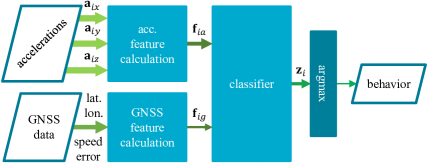
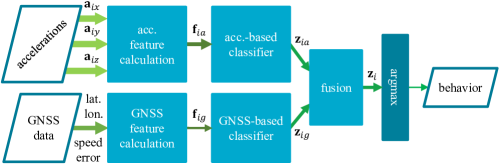
In this paper, we examine the use of data from multiple sensing modes, i.e., accelerometry and global navigation satellite system (GNSS), for classifying animal behavior. We extract three new features from the GNSS data, namely, distance from water point, median speed, and median estimated horizontal position error. We combine the information available from the accelerometry and GNSS data via two approaches. The first approach is based on concatenating the features extracted from both sensor data and feeding the concatenated feature vector into a multi-layer perceptron (MLP) classifier. The second approach is based on fusing the posterior probabilities predicted by two MLP classifiers. The input to each classifier is the features extracted from the data of one sensing mode. We evaluate the performance of the developed multimodal animal behavior classification algorithms using two real-world datasets collected via smart cattle collar tags and ear tags. The leave-one-animal-out cross-validation results show that both approaches improve the classification performance appreciably compared with using data of only one sensing mode. This is more notable for the infrequent but important behaviors of walking and drinking. The algorithms developed based on both approaches require little computational and memory resources hence are suitable for implementation on embedded systems of our collar tags and ear tags. However, the multimodal animal behavior classification algorithm based on posterior probability fusion is preferable to the one based on feature concatenation as it delivers better classification accuracy, has less computational and memory complexity, is more robust to sensor data failure, and enjoys better modularity.
Motivation & Objective
- Address the challenge of accurately classifying infrequent but critical cattle behaviors such as walking and drinking using wearable sensor data.
- Overcome limitations of single-sensor approaches—where accelerometry captures movement but lacks spatial context, and GNSS provides location but low temporal resolution—by fusing complementary data from both modalities.
- Develop computationally efficient, on-device classification algorithms suitable for real-time deployment on low-power smart collar and ear tag embedded systems.
- Improve classification performance for ambiguous or rare behaviors (e.g., 'alia' class) by leveraging discriminative features from both sensor streams.
- Evaluate the proposed fusion strategies under realistic constraints, including limited training data and sensor noise, using real-world cattle datasets.
Proposed method
- Extracted three novel features from GNSS data: distance to water point (DtWP), median speed (estimated via Doppler shift), and median horizontal position error.
- Used two distinct fusion strategies: (1) concatenating accelerometry and GNSS features into a single vector for input to a multi-layer perceptron (MLP) classifier, and (2) training separate MLPs on each modality and fusing their posterior probability outputs.
- Applied leave-one-animal-out cross-validation to evaluate generalization performance on two real-world datasets collected from smart cattle collars and ear tags.
- Assessed computational efficiency and robustness to sensor failure by comparing memory and processing requirements between the two fusion approaches.
- Assumed conditional independence of features from accelerometry and GNSS given the behavior class in the probability fusion model, enabling modular and scalable design.
- Implemented the final models for on-device inference, ensuring low latency and minimal resource usage suitable for edge deployment.
Experimental results
Research questions
- RQ1Can combining accelerometry and GNSS data improve the accuracy of in-situ animal behavior classification compared to using either sensor modality alone?
- RQ2Does posterior probability fusion of two modality-specific classifiers outperform feature concatenation in terms of classification accuracy and computational efficiency?
- RQ3How effective is the proposed multimodal approach in classifying rare or infrequent behaviors such as walking and drinking, which are critical for livestock health monitoring?
- RQ4To what extent do novel GNSS-derived features—distance to water point, Doppler-based speed, and position error—contribute to improved behavior discrimination?
- RQ5How robust are the proposed algorithms to sensor data failure or noise, particularly in real-world field conditions?
Key findings
- The posterior probability fusion approach achieved higher classification accuracy than feature concatenation, especially for infrequent behaviors like walking and drinking.
- The probability fusion method required less computational and memory resources than feature concatenation, making it more suitable for embedded deployment on smart cattle tags.
- Both multimodal fusion approaches significantly improved classification performance over single-sensor baselines, with the most notable gains observed in distinguishing walking and drinking behaviors.
- The distance-to-water-point (DtWP) feature carried strong discriminative power for walking behavior, likely due to the constrained experimental area where walking events were primarily associated with pen-to-paddock movement.
- The average GNSS position error of approximately 7 meters limited the utility of the DtWP feature, suggesting that higher-precision GNSS (e.g., RTK or DGPS) is needed for broader field applicability.
- The 'alia' class, encompassing diverse low-intensity behaviors like grooming and vocalizing, remained challenging to classify due to data scarcity and high inter-class variability, highlighting a need for future methods that reduce reliance on such ambiguous categories.
Read this paper
Open the full text in the Nubint reader and ask about any passage as you read.
Read this paper on NubintThis review was generated by AI from the original paper. Please check the paper before citing it.