
[Paper Review] Multimode amplitude squeezing through cascaded nonlinear optical processes
This paper proposes a cascaded nonlinear optical cavity with engineered Q factors to achieve multimode amplitude squeezing exceeding 10 dB below the shot noise limit in discrete frequency modes. By leveraging a common idler bath mode and creating a synthetic frequency cavity that supports Bloch oscillations, the system enables tunable, bright squeezing across multiple modes through enhanced nonlinear coupling over dissipation.
Multimode squeezed light is enticing for several applications, from squeezed frequency combs for spectroscopy to signal multiplexing in optical computing. To generate squeezing in multiple frequency modes, optical parametric oscillators have been vital in realizing multimode squeezed vacuum states through second-order nonlinear processes. However, most work has focused on generating multimode squeezed vacua and squeezing in mode superpositions (supermodes). Bright squeezing in multiple discrete frequency modes, if realized, could unlock novel applications in quantum-enhanced spectroscopy and optical quantum computing. Here, we show how $Q$ factor engineering of a multimode nonlinear cavity with cascaded three wave mixing processes creates strong, spectrally tunable single mode output amplitude noise squeezing over 10 dB below the shot noise limit. In addition, we demonstrate squeezing for multiple discrete frequency modes above threshold. This bright squeezing arises from enhancement of the (noiseless) nonlinear rate relative to decay rates in the system due to the cascaded generation of photons in a single idler "bath" mode. A natural consequence of the strong nonlinear coupling in our system is the creation of an effective cavity in the synthetic frequency dimension that sustains Bloch oscillations in the modal energy distribution. Bloch mode engineering could provide an opportunity to better control nonlinear energy flow in the synthetic frequency dimension, with exciting applications in quantum random walks and topological photonics. Lastly, we show evidence of long-range correlations in amplitude noise between discrete frequency modes, pointing towards the potential of long-range entanglement in a synthetic frequency dimension.
Motivation & Objective
- To demonstrate bright amplitude squeezing in multiple discrete frequency modes using cascaded parametric processes.
- To overcome the 3 dB theoretical limit of single-process amplitude squeezing by engineering nonlinear coupling and dissipation.
- To explore the role of synthetic frequency dimensions in controlling nonlinear energy flow and quantum noise.
- To investigate long-range amplitude noise correlations as a signature of potential long-range entanglement in frequency space.
- To enable tunable, broadband, and spectrally selective squeezing for applications in quantum-enhanced spectroscopy and optical computing.
Proposed method
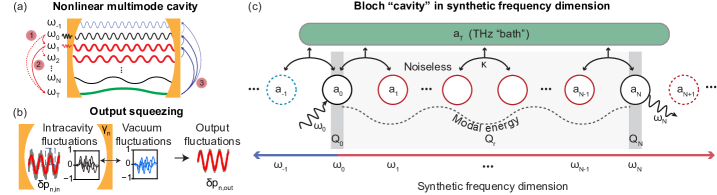
- Utilizes a multimode nonlinear cavity with cascaded three-wave mixing processes to couple multiple signal modes via a shared idler 'bath' mode.
- Engineered Q factor profiles in the frequency domain to enhance nonlinear coupling relative to decay rates, creating a synthetic frequency cavity.
- Leverages counter-propagating Bloch modes in the synthetic frequency dimension to generate standing wave patterns in modal energy distribution.
- Employs photonic crystal-based frequency-tunable filters to selectively control outcoupling (Q factor) for individual frequency modes.
- Models mean field dynamics and quantum noise using coupled nonlinear differential equations, including relaxation oscillations due to strong multimode coupling.
- Analyzes noise correlations and squeezing spectra via the full quantum Langevin and Heisenberg-Langevin formalism in the linearized regime.
Experimental results
Research questions
- RQ1Can cascaded nonlinear processes in a multimode cavity generate amplitude squeezing beyond the 3 dB limit in multiple discrete frequency modes?
- RQ2How does Q factor engineering in the synthetic frequency dimension influence the strength and spectral distribution of amplitude squeezing?
- RQ3What role do Bloch oscillations and interference between counter-propagating modes play in shaping the steady-state energy distribution and noise properties?
- RQ4Can long-range amplitude noise correlations in frequency space indicate the presence of long-range quantum entanglement in a synthetic dimension?
- RQ5To what extent can this platform be used to generate tunable, bright squeezed frequency combs for quantum applications?
Key findings
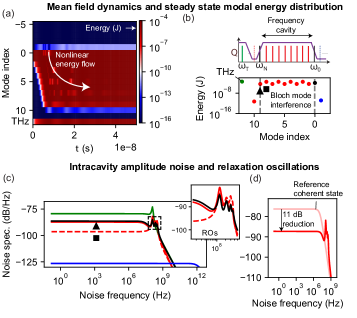
- The system achieves single-mode amplitude squeezing exceeding 10 dB below the shot noise limit through Q factor engineering and cascaded nonlinear coupling.
- Simultaneous multimode amplitude squeezing is demonstrated across multiple discrete frequency modes above threshold, with bandwidth exceeding 100 MHz.
- The synthetic frequency cavity supports Bloch oscillations and counter-propagating modes, leading to standing wave patterns in modal energy distribution.
- Strong long-range amplitude noise correlations are observed between discrete frequency modes, suggesting potential for long-range entanglement in the synthetic frequency dimension.
- The system enables tunable control over which modes are squeezed by adjusting the outcoupling Q factor for individual modes.
- Theoretical analysis confirms that enhanced nonlinear coupling over dissipation is the key mechanism enabling strong squeezing, consistent with noiseless rate enhancement.
Better researchstarts right now
From reading papers to final review, dramatically reduce your research time.
No credit card · Free plan available
This review was created by AI and reviewed by human editors.