
[Paper Review] Multivariate Time Series Classification Using Dynamic Time Warping Template Selection for Human Activity Recognition
This paper proposes a dynamic time warping (DTW)-based template selection method for multivariate time series classification in human activity recognition, avoiding complex feature extraction and domain knowledge. By using modified DTW to cluster motion data and construct activity templates, the approach achieves comparable or better accuracy than traditional feature extraction, especially in noisy conditions and for new subjects.
Accurate and computationally efficient means for classifying human activities have been the subject of extensive research efforts. Most current research focuses on extracting complex features to achieve high classification accuracy. We propose a template selection approach based on Dynamic Time Warping, such that complex feature extraction and domain knowledge is avoided. We demonstrate the predictive capability of the algorithm on both simulated and real smartphone data.
Motivation & Objective
- Develop a computationally efficient and accurate method for classifying human activities using smartphone sensor data.
- Eliminate reliance on complex feature extraction and domain expertise in human activity recognition (HAR).
- Create interpretable, visually meaningful activity templates from multivariate time series data.
- Improve robustness to noise and generalization to new test subjects not present in training data.
- Demonstrate the method's effectiveness on both real-world UCI HAR data and synthetic, noisy data.
Proposed method
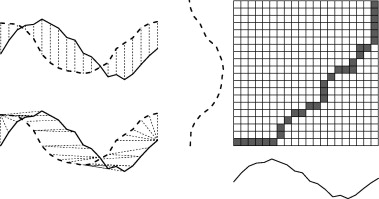
- Modify Dynamic Time Warping (DTW) as a similarity measure to improve accuracy and computational efficiency for multivariate time series.
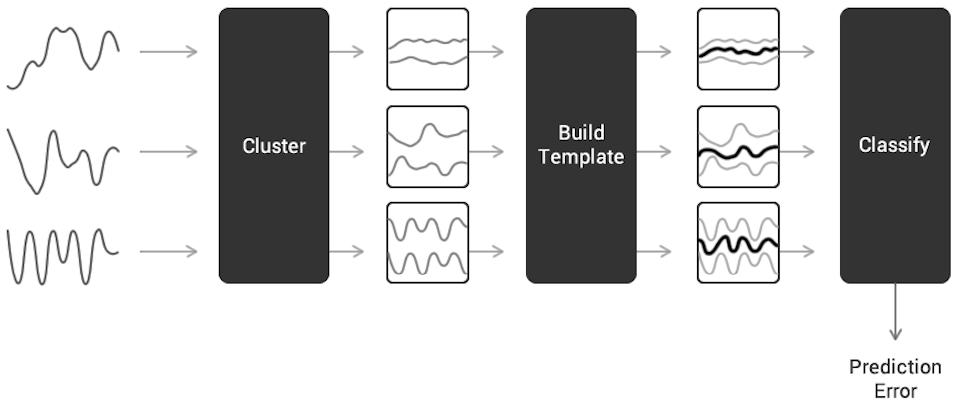
- Use DTW-based clustering to group similar motion sequences into clusters representing distinct human activities.
- Construct activity templates as time series averages (via DBA or DPA) from each cluster to represent typical activity patterns.
- Apply a subsequence-based DTW variant (DTWsubseq) to enhance similarity measurement and classification performance.
- Introduce a threshold parameter 'cut' to control template generation, with lower values increasing accuracy by reducing overfitting.
- Use the templates for classification by computing DTW distances between test sequences and all templates, assigning the closest match.
Experimental results
Research questions
- RQ1Can a DTW-based template selection method achieve comparable or better classification accuracy than traditional feature extraction in HAR?
- RQ2How does the proposed method perform in the presence of noise and on data from new individuals not in the training set?
- RQ3Does using DTWsubseq or modified DTW improve classification accuracy compared to standard DTW?
- RQ4Is there a performance difference between using DBA (Dynamic Time Warping Barycentric Averaging) and DPA (DTW-based Pairwise Averaging) for template construction?
- RQ5How does the 'cut' threshold parameter affect classification accuracy and model generalization?
Key findings
- The proposed method achieved 0.860 accuracy on the UCI HAR dataset (0.890 with dynamic activities), comparable to feature extraction methods.
- On synthetic data, the method achieved 0.700 accuracy using DTWsubseq with DPA and cut=0.25, outperforming feature extraction (0.67).
- DBA-based templates were significantly more robust to sporadic noise than DPA-based templates, preserving shape even in noisy regions.
- Lowering the 'cut' parameter consistently improved accuracy across both real and synthetic datasets, indicating better generalization.
- DTWsubseq outperformed standard DTW in all configurations, showing improved similarity measurement for classification.
- The method demonstrated strong generalization to new subjects and noisy data, with higher accuracy than feature extraction in synthetic evaluations.
Read this paper
Open the full text in the Nubint reader and ask about any passage as you read.
Read this paper on NubintThis review was generated by AI from the original paper. Please check the paper before citing it.