
[Paper Review] Music Generation by Deep Learning - Challenges and Directions
This paper identifies core challenges—control, structure, creativity, and interactivity—in deep learning-based music generation and proposes solutions through structured modeling and interactive generation frameworks. It introduces DeepBach, a bidirectional LSTM-based architecture using incremental Gibbs sampling to enable user-controlled, partial regeneration of polyphonic Bach chorales, demonstrating improved compositional control and interactivity over standard autoregressive models.
In addition to traditional tasks such as prediction, classification and translation, deep learning is receiving growing attention as an approach for music generation, as witnessed by recent research groups such as Magenta at Google and CTRL (Creator Technology Research Lab) at Spotify. The motivation is in using the capacity of deep learning architectures and training techniques to automatically learn musical styles from arbitrary musical corpora and then to generate samples from the estimated distribution. However, a direct application of deep learning to generate content rapidly reaches limits as the generated content tends to mimic the training set without exhibiting true creativity. Moreover, deep learning architectures do not offer direct ways for controlling generation (e.g., imposing some tonality or other arbitrary constraints). Furthermore, deep learning architectures alone are autistic automata which generate music autonomously without human user interaction, far from the objective of interactively assisting musicians to compose and refine music. Issues such as: control, structure, creativity and interactivity are the focus of our analysis. In this paper, we select some limitations of a direct application of deep learning to music generation, analyze why the issues are not fulfilled and how to address them by possible approaches. Various examples of recent systems are cited as examples of promising directions.
Motivation & Objective
- To analyze fundamental limitations of direct deep learning application in music generation, particularly in control, structure, creativity, and interactivity.
- To identify why standard deep learning models fail to support meaningful human-composer collaboration or stylistic control.
- To propose architectural and algorithmic strategies that enable user-informed, partial, and structured music generation.
- To demonstrate how deep learning can be adapted to support interactive, creative composition rather than passive, monolithic generation.
Proposed method
- Uses a bidirectional Long Short-Term Memory (LSTM) architecture that processes musical data both forward and backward in time to capture long-range dependencies.
- Employs a hybrid network structure with two LSTMs (forward and backward) and two feedforward networks to model simultaneous voices in polyphonic music.
- Applies a pseudo-Gibbs sampling algorithm for incremental, iterative generation, where individual notes are resampled one at a time based on context.
- Enables selective regeneration by allowing users to modify only specific measures or voices and re-sampling only the affected parts of the composition.
- Integrates the model as a plugin for MuseScore, enabling real-time user interaction and control during composition.
- Trains the model on-the-fly by randomly sampling notes from existing chorales and predicting their values using surrounding context.
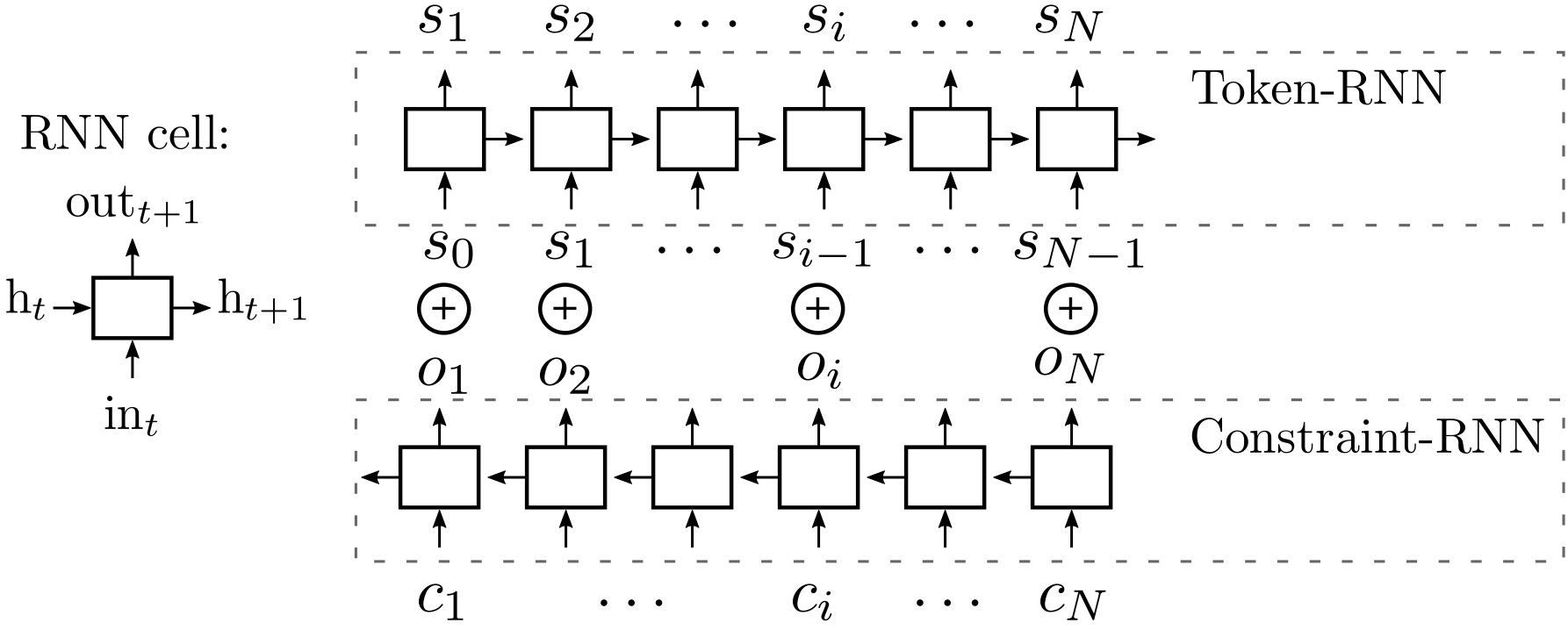
Experimental results
Research questions
- RQ1How can deep learning models be adapted to support user control over musical parameters such as tonality, rhythm, and voice leading?
- RQ2What architectural and algorithmic strategies enable structured, coherent music generation beyond simple sequence prediction?
- RQ3Can deep learning models support interactive, incremental music generation that allows composers to refine specific sections without regenerating the entire piece?
- RQ4How can deep learning-based systems balance imitation of training data with genuine musical creativity and originality?
- RQ5What role does bidirectional context play in improving the quality and coherence of polyphonic music generation?
Key findings
- The DeepBach architecture successfully generates Bach-style chorales with high musical coherence and stylistic fidelity, as validated by expert evaluation.
- Incremental Gibbs sampling enables partial regeneration of musical content—e.g., modifying only the soprano voice allows re-sampling of only the corresponding counterpoint voices.
- The model supports user interaction through a MuseScore plugin, allowing real-time editing and regeneration of specific measures, enhancing interactivity.
- Bidirectional context (forward and backward processing) significantly improves the model’s ability to maintain harmonic and contrapuntal consistency across voices.
- The approach demonstrates that deep learning can be extended beyond end-to-end autoregressive generation to support structured, controllable, and interactive music composition.
- By combining global representation with selective instantiation, the method avoids the limitations of single-step generation and enables more intuitive human-AI collaboration in music creation.
Read this paper
Open the full text in the Nubint reader and ask about any passage as you read.
Read this paper on NubintThis review was generated by AI from the original paper. Please check the paper before citing it.